And here's more info on The Little Ice Age: https://en.wikipedia.org/wiki/Little_Ice_Age
Debatable as to whether solar activity was a contributor to The Little Ice Age.
It doesn’t seem completely implausible.
Good thing initiatives like the passive house institute are bringing back some of these principles, you can easily cut a modern home heating/cooling needs by 70%+ by following simples rules
People building houses today are much better served by spending their money on solar + battery + heat pumps than going passive.
Which brings us to next interesting problem - you would think that ERV should be built-in into modern cooling/heating systems, but it’s no the case.
It's better no matter the heat source really. And it allows you to do without central heating and/or complex heating techs which are more annoying to maintain and replace
> expensive mechanical ventilation
A top of the line heat recovery ventilation unit cost the same as a shit tier air/air heat pump and has no moving parts besides the fans, which are cheap and easy to replace.
You can even make reasonably efficient heat exchangers at home with corrugated plastic sheets...
Most modern homes have this issue. Building science has driven them to be air tight bubbles. Look at blower door tests on current construction and a lot of "building science" driven construction.
All you need to do is design a house with a sensible ventilation system, which costs virtually nothing compared to the rest of the building costs. It's even more stupid for americans because they already all have complex ventilation system...
Maybe for newer houses. I have an older house and I don't have a ventilation system. Forced radiator hot water heat and no AC in New England.
The old houses didn't overheat because the floor wasn't insulated all that well so the cold came from below. We could do something similar by just mounting heat pump ground loop under the house, before it is built, but today house developers want it cheap and quick so you pretty much can't find much of that and would have to do it on your own.
Other interesting system is using underground as a way to cool house air intake, just running pipes underground for several metres to get it to cool down in summer and heat up a bit in winter. But again, expensive thing compared to "just add more solar panels/battery storage and let AC handle it"
I'm always a little confused by radiators placed underneath windows in modern buildings. I'm sure it evens out cold spots, but it sends a lot of heat right outside.
But, to answer the OP, putting conditioning on the perimiter of the building keeps the interior temperature gradient minimal. If you deliver conditioning to the center of the building, the perimeter approaches outside temperatures (depending) and you have a big gradient and much less comfort. There's also better heat transfer when you deliver conditioning at bigger delta T, which pushes towards the perimeter as well... But it means more ducting/piping. And if you're using fireplaces for heat, it's complex because classically fireplaces pull in air from the conditioned space, and make up air comes from outside, you really want that fire to warm up surfaces to get radiative heat; burying it in the center of the building will be better than having it off in the corner; but it you use outside air for combustion, you can put it on the perimeter.
Article[0] on it
  I’ve heard a story, and I don’t know if it’s an urban legend, that steam heat became popular after the 1918 flu pandemic because it was going to force overheating of units and make people open their windows and let the bad air out.

  I’ve never heard it put that way, but the flu pandemic had a huge impact on heating systems, because they actually changed the code requirements for heating systems when the pandemic was around, because they didn’t know what was causing this. They thought there was something in the air that was causing this. And so what they did is they started requiring buildings to be ventilated. Essentially, they changed the requirements for heating buildings so you had to maintain 70 degrees in the building with all the windows open in the sleeping rooms. So people see these great big huge radiators and think that that’s what they have to have in the house. Usually, the reason those radiators are so big is because they had to heat the house with windows open.
Edit: switched out to different article focused on Chicago
On more than one occasion, I found my bedsheets completely frosted stuck to the wall.
The fireplace had a stone chimney - and the kitchen was built in an 'L' shape around the first floor of the fireplace. The (master) bedroom (an additional bedroom was built in the 1950s), the stone of the chimney was a good quarter of one of the walls.
I do, however, think that the rough hewn stone and mortar of the chimney with the insets around it had a certain rustic beauty... aside from the "that got warm" in the winter and could keep the kitchen, living room, and bedroom warm.
As a kid I lived in homes with both - and a home with a barrel stove - and as an adult with a pellet stove and I don’t remember that being a problem. Net, it was fine?
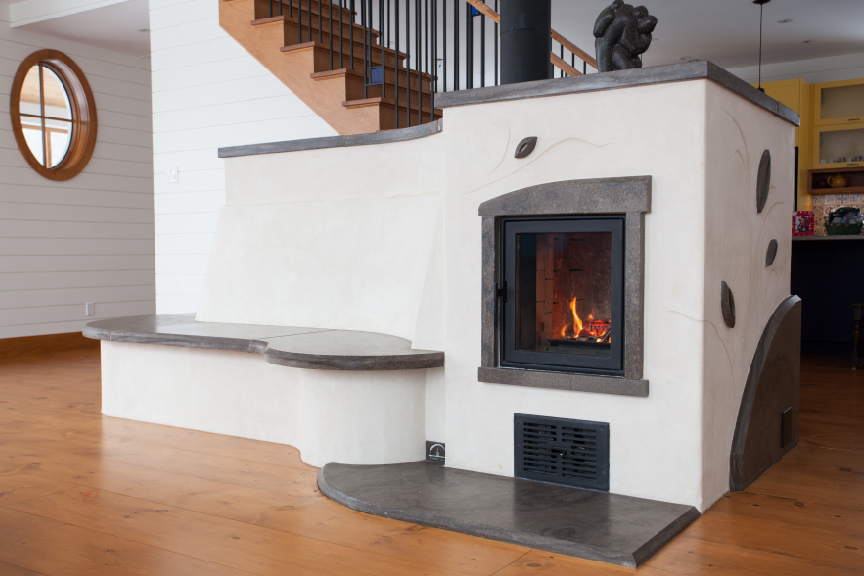
Old school version of that were masonry stoves that come with ton+ of mass for the bricks and smoke being routed all over (often including a place to sleep) to take as much heat as possible from it.
If I had money for that I'd put a big hot water tank for buffer, heat it normally with heat pump, and just had emergency water-sheathed fireplate, with big buffer you can just fire it up once and have tank slowly give the heat back to the building. Or fire it up at the coldest days to save some heat pump power in days where there is barely any solar.
I assume most decorative fireplaces on the other hand are not built to heat the house.
There's a whole site dedicated to the (highly efficient) Russian/German stove: https://larsenfamily.com/russian_stove/nojava/index.html
Open floor plans also destroy the efficiency as the heat goes up which made your already inefficient heating even worse.
Combine both together and you probably have 5% efficiency.
(It feels like it's getting warmer - may all be wishful thinking though, I haven't taken any measurements!)
Were you in prison when you experienced the above?
I have had multiple conversations with people who lived a while in that area. Rich, educated countries, modern economies, but they live like they are poor farmers in the 19th century.
It appears that something like 50% of homes are still over 50 years old, which seems to be more than enough for “some subset of brits large enough to be notable complain about the cold weather because they don't have a properly insulated place to warm up in” to have explanatory power.
We don't use fireplaces anymore (a major "trick" being to put them in the middle of the house rather than in the exterior walls), and while using large windows to capture sunlight and heat works great in the winter, it also leads to overheating in the summer and thus more energy for air conditioning.
> These are modest changes, imperceptible to most, and they won't enable us to forgo active heating and cooling entirely. But they do echo a way of thinking which, today, is oft ignored. Hardwick Hall was designed with Sun, season and temperature in mind.
Everyone I know who has built a house has thought very much about sun, season and temperature. This is very much a factor in determining the sizes and quantity of windows on south-facing vs. north-facing walls, for example.
Again, it's a very interesting article on this one particular castle, but the idea that it has something to teach modern architects and builders is pure fantasy. We're already well aware of all these factors and how they interact with materials and design.
That's what awnings (or solar overhangs, or light shelves) are for. You block the high/hot summer sun but let in the low/cool winter sun.
> the idea that it has something to teach modern architects and builders is pure fantasy
Isn't the idea of mcmansions that they co opt smart classic design ideas, but use them in a manner which doesn't let them fulfill their function purpose(skeuomorphism)? So someone certainly has some things to learn
Right, this is my point. We already think about these things.
> Isn't the idea of mcmansions
I don't think McMansions, or whatever your favorite example of bad architecture is, shows that we've somehow lost knowledge. Architects and builders are aware of all of these things, but that doesn't mean there aren't still clients who want less energy-efficient designs for all sorts of reasons, like aesthetics.
We know how to build energy-efficient buildings that are appropriate for the location and seasons. We also know how to build buildings for other purposes, and are aware of the tradeoffs in how they use more energy. Energy conservation isn't the only goal in home design.
I imagine that McMansions are generally about as energy efficient (per square foot) as other contemporary homes, though.
All architects think about siting and solar exposure. But the builders are in charge, and they optimize for what the market responds to -- which does not always include factors like these which contribute to long-term comfort and livability.
So I would say that consumers could learn a thing or two. That said, most buyers are not buying newly-built homes, so their ability to influence the inclusion of some of these features are limited.
The industry is downstream of market demands. If customers aren't aware enough to demand smart things, builders will skip them to save money, or to optimize for more visible features. Same old story.
Even then I think Americans are not at all well-versed in what makes a house a good house in terms of design or aesthetic and there isn’t a marketplace that exists to help customers shop and compare.
Today, if you’re buying a new build your only option is McMansion style or just a smaller and equally distasteful version of the McMansion. And yes they are all distasteful - it’s a matter of fact, not opinion.
So most people buying new builds end up with the same cargo culled designs. And then “architects” design more and more different versions of these horrendous designs and plop in things like Sedona Avenue near the golf course and that’s how you get suburbia. There’s never a market signal, despite the fact that we can build homes much more nicely and with techniques to be a little more naturally energy efficient and kinder on the eyes.
There is also much less competition with neighborhood design though surprisingly there have been some inroads there that have fostered some competition, but it’s mostly for now for the wealthy. I live in a neighborhood designed before cars, a neighborhood that today is largely illegal to build. But the home prices are highest here because the market is demanding this type of neighborhood - single family detached homes mixed with apartments and coffee shops and small offices and restaurants. “Mixed-use development”. It’s incredibly scarce and in most American cities it has the most expensive average real estate and tends to be the most economically vibrant. Little pockets of Europe.
Neither home builders or zoning officials have taste and because as you in my view correctly acknowledge the builders are downstream of market demands, because the market doesn’t even understand what is actually good and possible, the entire industry and government regulation apparatus is downstream of the sewer.
In the UK that means adding lots of insulation. UK houses predominantly had a lot of thermal mass from the inner skin of the cavity wall being brick or later concrete blocks. The little wall insulation, if it even existed, was in the cavity. In a push for more insulation they switched to lightweight thermal blocks, and sometimes more insulation inside, or timber frames. All of which designed for insulation while reducing the thermal mass. No matter how much sun you put in during the day you only heat the air, which goes cold quickly. This is not the architects choice.
Architects can only design for orientation on a single house plot. In the UK they are trying to cram houses on at 50 to the acre or more due to the price of building land. They focus on best use of space, rather than orientation because of that
> Or it is set out in building codes that they must design in a certain way.
An anecdote: Two decades ago in college in the US, I knew several people doing Architecture. One day in one of their dorm rooms, one of them went on this long rant about how modern codes ignore environmental factors and just require certain things no matter the climate.
I don't know how universal her experience was, but I can see these two lines I quoted as both happening, just in reverse - the building codes are causing loss of knowledge/wisdom.
Making what's essentially "an insulated box" is far more universal climate-wise than most of the old methods, because what's good in summer (north-facing windows, good airflow, getting some cold from the ground) is terrible for winter and vice versa. And where it is useful, it IS used, just instead of fireplace having big thermal mass we have floor heating where the concrete floor is the heat storage (and sometimes extra tank of water)
And every method to make it "better" directly competes with "just buy more solar/battery to run heat pump cheaper.
A lot of contemporary energy-efficient designs slope the windows now such that light can enter in the winter but not the summer, but in the past this problem would have been remedied with awnings.
I've lived in houses that certainly did not take into account sun, season and temperature. I learned a lot from that experience. My current house is optimized for it. I've learned a few more things about it, and could do better.
> the idea that it has something to teach modern architects and builders is pure fantasy
Not my experience with architects and builders.
For example, how many houses have a cupola? They're common on older homes, but non-existent on modern ones. What the roof does is accelerate the wind moving over the roof, then the air vents in the cupola let the wind through, which sucks the heat out of the attic.
Another design element is eaves. Eaves shade the house in summer and don't shade it in winter (for more heat gain). Eaves also keep the sides of the house dry, which means your siding and paint and window frames last a lot longer. Mine are 1.5 feet. Most houses around here have tiny or even non-existent eaves.
The advent of air-conditioning is when architects stopped paying attention to the sun.
This one is genuinely obsolete. With modern techniques, it’s straightforward to build a reliable unvented attic, and there are few if any climates where a vented attic makes sense. There are plenty of climates where a vented attic, even a nice one with a cupola, is massively inferior to an unvented, conditioned attic.
Seal and condition your attic. Put on a decorative cupola if you like. If you live in a place with heavy snow load, you vent a small gap between the top of your attic and your roof surface to help keep the actual roof surface cold enough to avoid melting the snow.
While it’s true that the top side of above-attic insulation will be rather warmer than a vented attic on a hot sunny day, insulation on top of your attic also tends to work rather better than ceiling insulation. And there are plenty of other benefits to an unvented, insulated attic.
If you live in a climate where the outdoor air is generally fairly dry and also sufficiently warm that it spends most of its time above the interior dewpoint, then fine. You can vent our attic and it stays dry. This covers rather little of the world.
If you do not insulate at all and you heat your house when it’s cold or wet and you do not experience hot and humid weather, then there will be enough heat flow to keep your attic dry. This is generally an awful idea, but old insulated houses did work in many climates.
If you live somewhere cold and put fluffy stuff on your ceiling and you vent your attic and you have air leaks in your ceiling (hint: this is basically unavoidable) and it’s very cold in your attic, you may get condensation in the ceiling insulation or the attic. Mold time.
If you live somewhere hot and humid and you vent your attic, then you are are filling your attic with hot, humid air. Your dehumidifier or A/C will not control your attic humidity. But your A/C may cool parts of your attic, leading to additional condensation.
If you have nasty severe blowing rain, it may blow into your attic, leading to damage. This is a problem in hurricanes.
Wildfire embers can ignite the inside of your attic. You can try to use fancy supposedly ember resistant vents to mitigate this, or you can omit vents entirely.
If you seal your attic and control moisture in the living spaces well enough to avoid moisture problems and you have adequate conditioning in your attic, your attic will be about the same temperature and humidity as your living spaces, and you’ll be fine.
You can geek out at buildingscience.com. The author appears to have become increasingly convinced that vented attics are basically never the answer.
1.5' overhang is good, 2' is ideal. Cheap builders will go 1' or even less.
Good architects still pay attention to the sun. It's often builders who are the culprits because they want to save money.
You're right about ridge vents, they behave much like a cupola, but the holes in them are too small for much airflow, and are easily blocked by debris, insects and moss.
That's a concern. It may be a good idea to put a connected thermometer and hygrometer in the attic. If it is ventilating properly, the temperature and humidity should be close to outdoor values.
If you aren't using A/C and have the windows open, then it only helps, of course.
> If you aren't using A/C and have the windows open, then it only helps, of course.
I make use of the "stack effect" to cool the house down in the evening. Not even a fan is necessary.
One mistake I made was to not have the A/C pull from the basement, which is always 10 degrees cooler than the rest of the house.
Of course you should have soffit venting, but forced ventilation results in negative pressure, regardless of whether that venting is a cupola harnessing the wind or a motorized fan. That negative pressure will pull conditioned air out and building science research shows higher attic temperatures are better than forced ventilation.
Even better is larger amounts of passive ventilation, but if the only thing you change is adding forced ventilation, then you're creating negative pressure and this is worse if using A/C.
The cupola does that using the "stack effect" and the acceleration of the wind as it hits the sloping roof, at zero cost!
That said, I do have an attic fan connected to a thermostat. I'd rather have a cupola, though.
I vised Löwenburg in Kassel which has bedrooms with similar curtains around the bed. Much later (1891) and with other heating technology of note. I was intrigued by the fireplace design in the room immediately behind the bed. The open fire is backed by a huge granite block built into the wall. The room had a close connection to servant stairways directly down to the exterior.
The guide describe the otherwise plain room as a dressing room. It looked like a convenient place to store a lot of firewood to stoke the fireplace attached to the bed behind it to me.
A great example is the Clinton Presidential Library in Little Rock, Arkansas. At first glance, the building seems to be a giant rectangular box made of glass. Hardly ideal in the long, hot Arkansas summers.
It’s not the truth, though. In reality, the building is said to be highly efficient and was the first Federal building to be LEED certified. Amazing.
I guess we’ve learned a few things over the years.
https://www.clintonlibrary.gov/about-us/leed-certified-build...
The problem in Europe isn't keeping warm in the winter but keeping cool in the summer. In part thanks to their near-total lack of AC in residential buildings, Europe has an extremely high heat-related death rate. 200k people per year die of heatstroke in Europe: this accounts for 36% of global heat-related deaths. This is despite Europe being only 9% of the world population, having a very cool climate in comparison to India and similar countries, and being among the richest regions in the world.
I once lived in a rental house in a "historical" neighborhood (on US timelines, not European) in a big city, and most of the houses had porches on two or three sides, depending on the cardinal orientation. These kept sunlight from falling directly on main body of the house, and strategically placed windows let you open two or three and get a breeze through the whole house.
We learned this visiting a neighbor who owned their home. The rental was not as well-maintained: some of the window frames had been painted shut over decades of touchups, but we never thought much of it. The day we jimmied them open and experienced a true cross-breeze through the living room was a HUGE "Aha!" moment.
Setting aside porches, even simple features like awnings above windows (esp. second-story windows) have fallen out of fashion, but they can reduce the demand on indoor AC significantly. They save money, but people think they look old-fashioned or something like that.
>The problem in Europe isn't keeping warm in the winter but keeping cool in the summer. In part thanks to their near-total lack of AC in residential buildings,
The times they are a-changing. Every house on my 21 year old estate came with ac. I'd assume the same for newer constructions. People rarely use it due to the price of electricity. Temps get well over 30C for a couple of weeks in august.
Extremely doubtful. Even Teh Grauniad disagrees.
https://www.theguardian.com/environment/2025/sep/17/human-ma...
Note that the Grauniad figures include some very unusual heat waves. There's no way the normal average could be a lot higher in years that were a lot colder.
30 degrees Centigrade is exceptional here.
Whereas in other parts of Europe it gets much hotter. Probably best not to generalise over a whole continent that covers 36 degrees of latitude (more than the contiguous 48 states of the US, at about 25 degrees), and goes from islands sat in the Gulf Stream to land sat next to an even larger land mass.
https://en.wikipedia.org/wiki/Russian_stove
Modern fire codes require large space between a stove and walls which is usually goes unused where it could have been really filled with such a thick brick structure with the smoke passage snaking through it like in Russian and German stoves. Or like this:
https://www.mha-net.org/wordpress/wp-content/uploads/2020/05...
All that is to say that builders cheap out on new home construction so most people don't get to enjoy the benefits if these innovations.
Sounds you're somewhere with some actual building standards though.
As an example single pane windows havent been effective or widely used since the 70-80s in north america and europe. And both places energy standards effectively preclude them since 2000ish. Or insulation in australia is effectively absent in pre 2000s, and maybe R-4ish on a new build now. Conversely NA was R-4 in the 70-80s and it would be about R-6 (or more) these days.
Our residential solar and heat pump uptake is great. But for building standards and quality were a joke.
Modern windows don't last very long, because the seals leak, and the argon gas or whatever leaks out. The glass is still good, but the insulative quality is gone.
The parent poster didn't realize that if you don't have double pane windows, you have single pane windows, which have no gas to leak.
But my point was that windows, the glass part, lasts centuries, if not longer. Not the mere decades cited upstream.
In my house and on my road a lot of the glass is 150+ years old.
I remember talking to a builder once who was building a house this way. He said the mass wasn't allowed to be advertised with an R-value since it wasn't actually insulation, but he said it was comparable to an R-50 house.
I think variable output heating/cooling has one interesting capability - it can adjust to things you've adjusted. For example, a one or two-stage heating system has trouble if you close heating vents in some rooms. It might overheat if too many are closed for example. With a variable-output system, it can support this. further with variable dampers it can support zoned heating and cooling. You can give the places that need it less or more airflow and have a more comfortable house without waste.
after seeing things like heatermeter (pid controlled smoker controller based on the raspberry pi), I wonder why this kind of convenient and efficient control isn't more common.
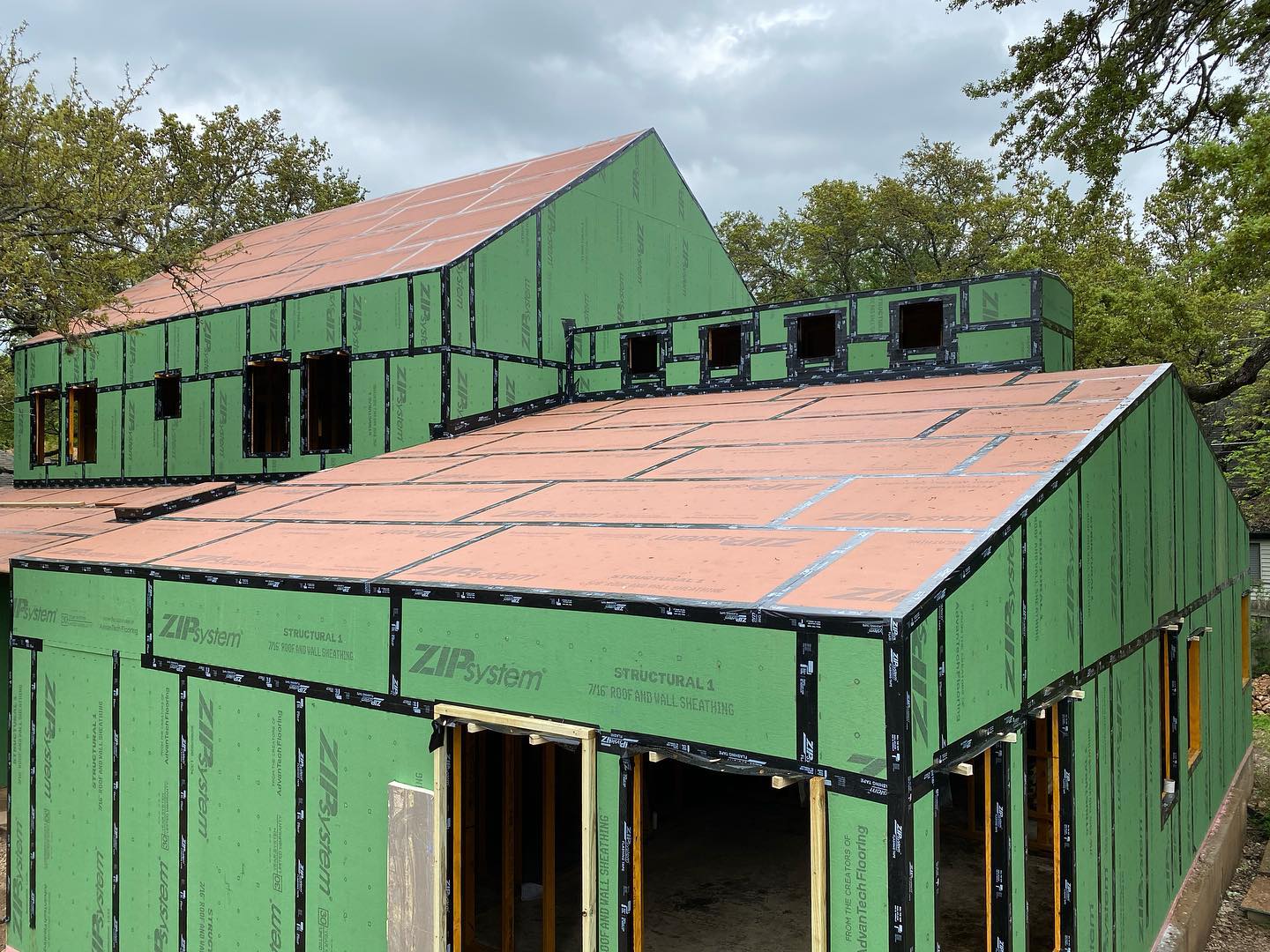
This is what a monopoly framed house looks like before the roof and siding are put on: https://www.afirsttimehomebuilder.com/img/pure_monopoly_fram...
All of the Zip boards are air and water tight and they use the tape on all of the seams to seal those. The roof will sit on top of the already water & air tight frame. Same with the siding.
Yeah, massive battery and massive solar install might let it run continuously… even in a small well insulated house that’s gonna be using a lot of power to heat a room or two.
> Pretty much all the fireplaces I see are also built on the central spine of the building, meaning not much heat would be lost to the windows or exterior wall.
Or maybe because, as the first half of the article say, it is because the outside walls have nowhere to put a fireplace, because they are covered in windows?
> he told me it can feel around 10C (18F) warmer inside on a cold winter's day. Other, typical Elizabethan houses, he estimates, would have only feel 2-3C (3.6-5.4F) warmer.
It 'feels' warmer...he 'estimates'. Nice way to do science
> Since it's winter, and cold, I move my desk to a south-eastern window. It brightens the mornings and if I wear another layer, I find I can lower the thermostat by 2C (3.6F).
More good science, change two variables but attribute the effect to only one of them. If I wear another layer of clothing, move my desk to the basement, sacrifice a goat, speak in tongues and draw a pentacle on the floor, I can turn the thermostat down 2 degrees too.
But let's start at the top
>England's longest river was usually flowing freely
Then list lots of evidence that it was not at all unusual for it to freeze at the time.
Great work
The article takes a long view of time, stretching back to at least the founding of London, the capital city, two thousand and more years past on the banks of that very river.
There was a relatively short period of time when the Thames did freeze in winter and England was much colder, this article talks about a chunky bit of architecture during that period.
The windows are discussed wrt their thermal effects, allowing the sun in to heat central stone during the day on one side of the building, likely with heavy curtains at night, with windows blocked internally and largely for show on the rear.
You always this cranky and uncharitable?
You're better served by looking to 19th century lower and middle class architecture. Right before air conditioning, but with relatively modern designs using modern building materials and practices ("insulation" (horsehair and newspaper), fireplaces/stoves, corridors with doors to separate cold rooms from hot ones, windows designed to allow cross-breezes, covered porches to provide shade in summer, etc). Right before air conditioning came in, we had pretty much gotten to the peak of design that used natural forms of temperature regulation. Some designs even created mini greenhouses of glass, with half the wall mounted with earth, for thermal regulation as well as solar heating. The only better passive methods invented since then is geothermal.
The peak of winter heat management were the pechka, Russian rocket stoves built into literal tons of masonry, for the most thermal mass possible. You'd heat it up once with a small amount of wood and it warms the house the whole day. They were so big you could sleep on top of it.
It was so bad that even rich people had to admit that the country had become an embarrassment.
It immediately brings to mind when we had insulation blown into our walls, and the guy doing the work showing us the shredded newspaper treated with borax, and explaining how the borax made it fire-resistant.
Point of a thermostat is to not have to do this.
Requires a well calibrated heating system though, depending on outside temperature.
Someone appears to have had a bit of fun being unspecific
He pointed out that Tado (who do smart radiator valves) noted from a study, which drew from their data, that the UK sucks at insulation, losing heat up to three times faster than other European neighbours[0].
[0] https://www.tado.com/en-gb/press/uk-homes-losing-heat-up-to-...
Disclaimer: I'm not affiliated nor am I a customer of Tado. Also, I'm British and I just felt like commenting here because it felt relevant.
I've noticed in general a thorough dismissal of passive benefits. It seems that we are caught by a cultural need for immediacy. Thermal management, and particularly passive thermal management, pays immense dividends slowly, but it takes a greater intelligence or broader perspective for anyone to appreciate these advantages.
Those who sit still and think clearly see the advantages of passive benefits, and anyone who gardens or does systems design intrinsically observes the long-term flows and thus understands the passive benefits at play. But so many people – from practitioners like the architect to stakeholders like their clients – go through life wholly unaware of this goldmine that is right there in front of their imagination.
I lived in an almost passive house for about a year. When the HVAC system stopped working* in July, I didn't notice until the middle of November.
* Air handler was running, compressor was off.
Me and my wife are taking shower daily, hers being hotter than mine (apparently that's common difference between female & male).
Every time, I am thinking that so much heat is going down the drain as waste, why not circulate this under the bathroom floor until it cools down.
Since we have a tub, I usually close the drain, sit/stand on a bench above the tub, rinse thoroughly at the end, keeping hot water afloat for next 20 minutes.
Since tub itself absorbs the heat, even after I open the drain and let go all the water, tub itself stays warmy for an hour or so.
I told him, "What's the big deal? It's free insulation during brutal north Texas summers. It's as good as vermiculite insulation minus the asbestos contamination!"
I only put about as much rigor into this as reddit PC builders making untested "gut calls" about thermodynamics, and I was mostly just being a smartass, but it's nice to see I had the same idea as English nobility who comfortably survived winters before the invention of HVAC as we know it.
Nice to see some proof I'm not completely full of crap.