(edit: I guess it's more of no-brainer on a train/bus where you don't have a seat belt)
But it's really theoretical, and does not account for the passenger in front of you headed head-first into your throat.
PS: I laughed hard that xlbuttplug2 is answering to deadbabe. The internet lives!
Are you one of the safety engineers? Have you discovered anything which isn't included in normal safety tests which should be?
But sitting backwards is very very uncomfortable if there is any kind of uneven acceleration, bumps, swaying, rolling, curvy tracks or whatever. Humans need to look forward at the horizon to get their visual stimuli aligned with their motion/balance sense in the inner ear. If that alignment isn't there, you will get seasick. Backwards makes this even worse.
Babies don't suffer from this, because closing your eyes helps, and infants don't have as strong a reaction to motions anyways, due to them usually being carried by their parents until walking age. So reverse baby seats only work for babies.
I don't have data but I would imagine crashes on these high speed lines (which always seem to be run at a higher level of professionalism than the general networks) are rarest of all.
I don't think it's a good use of mental energy to plan for a crash like this. You're better off using your brain cycles on hygiene or not losing your luggage.
> I would imagine crashes on these high speed lines (which always seem to be run at a higher level of professionalism than the general networks) are rarest of all
If this crash is anything like the other ones, you might be surprised. Safety complacency tends to cause maintenance failures. Plus the low speed lines are less deadly since the total energy is proportional to velocity squared, and v is low.
In other words, it might be more helpful to look at it as "if they’re run at a higher level of standards, it’s because they have to be".
Statistically you’re probably right, but considering how many brain cycles we waste on non-essentials, it’s just as fun to waste them on this. That way you can start a nerdy conversation with your travel companions, and they can learn to travel without you next time.
Sure they are.
> Besides, you’ll get to feel a nice jolt of serotonin when you remember to sit backwards.
I can also get that by remembering that I'm conquering a superstition and fitting my behavior closer to real risks.
You're forgetting about the probability of a crash.
The vast majority of train crashes is due to an impact with a vehicle on a railway crossing.
However, high-speed rail is grade separated, so it doesn't have railway crossings, which means the main cause of crashes is fundamentally impossible.
In other words: Regular rail has a high rate of crashes (with a small number of fatalities each) due to car/truck drivers screwing up. High-speed rail has a low rate of crashes (with a large-ish number of fatalities each) due to catastrophic failure of track & train equipment.
In France and Japan, HSR has had zero fatalities in the entire period of operation.
In China, HSR had AFAIR one fatal crash, with 40 fatalities. Per passenger-mile, Chinese HSR is twice as safe as US air travel.
At first, when seeing it was in 2015 I was extremely surprised I didn't heard about it at the time. Then I saw the date: Nov 14th 2015, just the day after the ISIS terror attacks in Paris, France's 9/11. Of course we barely heard about a train crash at that time…
It did briefly made the news but not for long due to the terror attacks and also there wasn’t any passenger on this train, it was a train testing.
In fact the story is even more tragic when you know that the day before, they also were too fast in the same turn and in the records you hear something like « few, that was close, better take care next time ».
However, for sure this crash should have never happened but it only happened because they were testing the limits of both the train and the track.
It’s literally like a test pilot crashing an airplane while testing all the limits : it should never happen but they are still there for it not to happen in commercial flights.
No. It happened because they were under-prepared and disorganized, and thereby didn't respect the speed restrictions for the segment of track they were on.
They crashed entering a 175 km/h segment at 265 km/h, which is well above the 10% overspeed they were theoretically testing that day.
Most railway deaths in the EU are due to unauthorized people on the tracks or due to crossings. The actual number of passengers deaths has been really low in the past years.
https://ec.europa.eu/eurostat/statistics-explained/index.php...
In the EU it's safer than flying, with 0.5 deaths per 100 billion km/ passenger vs 3 deaths per 100 billion kms/ passenger. However, since an airplane flies at, let's say, six times the average speed of a train, the actual probability of dying during a 1-hour trip is almost 40 times more on a plane than on a train.
However, there were a number of problems - people didn't like sitting in them, people didn't like hearing that their seat wasn't as safe as the others, you can't get as many rows in unless you turn them all backwards, and the structure needs to be designed differently so then you need more spares.
You never know.
The Italians designed it but won't run it at more than 300km/h in Italy citing local infrastructure concerns. I guess that leaves other countries to find the edge cases. I'll be interested to find out how fast it was going during the crash.
The defect was not caught by the manufacturer or the system operator. It was due to two crossed wires in an assembly.
I know a lot more engineering goes into these trains due to the higher stakes. Japan’s high speed rail hasn’t had a fatal accident in 60 years. I’m wondering what the cause of this will turn out to be.
There are a lot of safety lessons embedded in these videos, which is why I like them. I also did a double take when I heard "semaphore"; its history goes back far longer than the ~century of software engineering. https://en.wikipedia.org/wiki/Semaphore
Also hope you’re doing well it’s been a minute since our paths crossed on gdnet.
This morning, big debates about what happened, whose fault it is, how safe/dangerous trains are, anecdotes from the past and jokes. Somber but lively discussions. Benefit is social cohesion with your neighbours and compatriots :)
So I would standby for this tragedy to be used for political purposes to try and get foreign operators banned from Spanish tracks, regardless of the facts of the matter.
European energy markets were famously liberalised in 1996, allowing French state-owned EDF to acquire the previously state-owned monopolist Electrabel in Belgium. All the while France negotiated an exemption for not privatising EDF because of its nuclear facilities. EU regulations should prevent this type of free-ridership: state-owned companies shouldn't be able to compete abroad if they don't face competition at home.
Open competition kind of spoils this model. It's not really sustainable.
Massive efforts are done to implement reforms to conform to EU standards, believing that that’s how the “superior” EU members do it (Germany, NL, Nordics…). But then I go there and I see that their system has nothing to do with the standards and they are not doing much to conform.
It’s fine, these reforms are often beneficial for Spain, and I do believe that generally being in the EU is a big win-win. Although sometimes it’s just a lot of unnecessary reshuffling at great cost.
A certain segment of the Spanish population really looks up to northern EU countries, or rather they feel a sense of inferiority. In practice there is not all that much to look up to and I believe Spain should be feel more confident. Many great things are prevented by the widespread belief that we are in a shitty country and that everyone is useless, but it is just not true.
I can't speak for Germany or the Nordics, but here in the Netherlands the government is doing just about anything in their power to keep foreign competition from our rail network. The only lines serviced by foreign operators are the ones that would cost the national operator more than they would bring in and (some of) the international train services.
Our "high speed" rail is a joke. The trains themselves are fine, but the bridges over them are too brittle for the train to actually achieve high speeds, so it's operating at less than half the speed Spanish high speed rail is operating at. If anything, the success of the Spanish rail operators is an argument in favour of actually bringing competition to Dutch rail operators.
That said, the Dutch railway network is very different from the Spanish railway network. We're a small, densely populated country with many stops along just about any track, barely giving most trains time to accelerate even between larger city centers. The network is complex, the rails are extremely busy all hours of the day, our trains run on an idiotically low voltage and two trains with a dozen minutes in delays can back up the national train grid in no time if they slow down in the wrong spot. There are only a few long-distance high-speed rail options that make sense, some of which already sort of exist (Eurostar to the south), some of which our neighbours plainly don't want (any Dutch rail project crossing into the German border), and some of which are hardly financially viable (trains from the big cities to remote parts of the country) in a country that doesn't want to spend money on public transport.
Do you need high speed rail at all? There are not many points in the country that are more than 1 hour away with regular speed trains.
Groningen -> Amsterdam
Maastricht -> Amsterdam
Eindhoven -> Amsterdam
Nijmegen -> Amsterdam
I can only speak for myself, but a trip from Maastricht to Amsterdam is almost 2.5 hours by train for a distance of a smidge over 200km. This is mainly due to all of the stops along the way to pick up riders in every major city between the two.
Currently, our trains never go faster than 160km/h if the onboard screens are to be trusted.
I've got good memories waiting on the platform in Arnhem for my train back into Germany in the early morning, after a night in the coffeeshops there in the nineties.
Observing all the commuters holding on to their coffee to go, and balancing it in their hands, anticipating the jerky start of these things https://en.wikipedia.org/wiki/NS_Mat_%2764 :-)
Looked hilarious. All in sync. Like orchestrated.
Regarding the percieved slowness, and differences on both sides of the border(at the times?).
When doing the same route by car, your motorways felt supersmooth, even with all the strange markings and traffic signs :-)
Crossing back into Germany toward Oberhausen-> Ruhrpott came the Autobahn made of concrete slabs, and gaps between them. Thump, thump, thump, thump, thump!.
Very annoying when still 'under the influence' of that grassy green stuff :-)
Our regular train speeds are 80kmh to 140kmh, with maybe a little bit of 160kmh on specific stretches.
I realize my country is incredibly well-connected by public transit and those 2 hours are already a massive luxury compared to probably most of the world's population, but I wouldn't mind a few high-speed lines from the center of the country (probably Utrecht) to major cities. With trains currently being more expensive than taking a car if you travel with two people or more, it'd make the high cost worth it.
The major cities (Amsterdam, Rotterdam, Utrecht, Den Haag) typically have 4 trains/hour going between them. Higher-speed trains won't make any difference there, unless you first build out dedicated infrastructure (like the IC Direct line between Schiphol and Rotterdam, which cuts a whopping 20 mins from the regular IC travel time).
Like this?
https://www.openstreetmap.org/#map=19/51.901456/6.137620
https://www.bing.com/maps?cp=51.901346%7E6.137722&lvl=19.8&s...
https://www.google.com/maps/@51.9016843,6.1374348,210m/data=...
This is an ignorant opinion. For multiple reasons.
Derailing under these circumstances is a track issue, which means ADIF, the state's infrastructure maintainer, is under suspicion. Not operators, the state's infrastructure maintainer.
Liberalization of the railway sector is an EU-wide mandate. It's not some whimsical slip of a single country's leadership.
Years ago there was an AVE derailment in Santiago de Compostela. No one banned RENFE from the lines.
This is the most likely outcome, but it is not as cut-and-dried as you are presenting it.
It could be a broken rail weld, it could be track sabotage, it could be a broken wheel or bogie... we don't know yet.
Yes, the root cause is still unknown, and an investigation needs to happen to determine the root cause.
Sabotage or not, the infrastructure is by far the most likely suspect.
Even in the Santiago de Compostela accident, the root cause was the way the Spanish high speed railway infrastructure was mismanaged. Originally they tried to throw the train conductor under the proverbial bus with accusations of speeding to impress a girl, but later the investigation determined the track section failed to support basic speed limiters.
Jumping to conclusions about evil private railway operators is just ignorant and dumb.
There are plenty of cases of lack of maintenance in the railway network.
I'd say the same about the railway network. We don't know what happened yet.
[1]: https://www.elespanol.com/reportajes/20260119/adif-notifico-...
[1]: https://elpais.com/espana/2026-01-19/el-fabricante-hitachi-r...
[2]: https://www.elespanol.com/reportajes/20260119/adif-notifico-...
Why are you so quick on disregarding their opinion?
We've seen lots of serious fuck ups in Europe lately: including for a start several cases of maintenance improperly done on big passenger planes that nearly led to hundreds of passengers deaths (several planes have been diverted in the last months and the cause was improper maintenance).
I'm not saying improper repairs/maintenance on the rails are the cause: I'm saying it's a fact we've seen improper repairs/maintenance on passenger planes in the recent months.
The tracks were laid in May 2025, that means no winters had passed before now and any defects in the tracks due to temperature differences hadn't had a chance to appear before now.
The former Transport Minister is jailed because of corruption in public contracts, and hiring prostitutes[3][4].
The government is doing a poor job maintaining the current railway network.
[1]: https://www.eldebate.com/espana/madrid/20251119/cercanias-ma...
[2]: https://www.vozpopuli.com/espana/tren-accidentado-renfe-reco...
[3]: https://www.infobae.com/espana/2025/12/23/adif-altero-puntua...
[4]: https://www.elespanol.com/espana/tribunales/20250412/koldo-e...
Regarding the former Minister (Ábalos), he's awaiting trial and not yet convicted (even though, IMHO he is probably guilty), and he hasn't been in the ministry since 2021[^2] so it makes no sense to bring it up when he has been out for nearly 4.5 years now.
[^1]: https://www.lavozdegalicia.es/noticia/espana/2026/01/18/osca... [^2]: https://www.elconfidencialdigital.com/articulo/otros/jose-lu...
Blaming others for the current underinvestment of the railway network is disingenuous.
Where do the articles mention that the current government has been cutting corners? In fact, they have increased the current investment plan on the Cercanías commuter railway network to more than 7,000 million euro, from 5.000 million that the previous government planned[1].
Now, this isn't to that the current political landscape is fine because ( as portrayed by the last articles ) is totally unacceptable, and of course that affects the rail network negatively.
[1]: https://maldita.es/malditateexplica/20231212/cercanias-madri...
Maldita.es is founded by ex-employees of La Sexta, a TV channel known to be politically aligned with the socialist party (currently in the government).
[1]: https://www.vozpopuli.com/economia/la-carencia-de-repuestos-...
[2]: https://www.eldebate.com/espana/20250626/marido-pardo-vera-f...
[3]: https://www.20minutos.es/noticia/5729873/0/quien-es-isabel-p...
[4]: https://www.elespanol.com/espana/20250717/cese-discreto-alto...
In this particular article they were fact-checking a wrong claim made by the socialist party, to me that shows that besides their alignment, they care about fact checking information. They also mention that the last three development plans were developed by PP ( People's party ) -- if they're aligned with the socialist party, why are they mentioning this and leave the socialist party "in a bad light"?
In regard to the state of the railway network, I totally agree with what you mentioned. Thought corruption will inevitably occur and doesn't mean that the persons above are aware of it nor that the socialist party is intentionally cutting funds. Nonetheless, totally unacceptable.
How does that relate to the Maldita.es article linked by GP commenter? The article starts by debunking a false claim that was made by a minister in the socialist government against the conservative regional government of Madrid.
> The accident occurred near Atocha station, on a curve where signage indicates a speed limit of 45 kilometers per hour. However, sources consulted by this newspaper assert that the train, out of control, easily approached speeds of 90 to 100 kilometers per hour, ultimately resulting in the derailment. [...] Two mechanics who were inside the wrecked train escaped injury.
Any indication they deliberately derailed the train?
Edit: yes! E.g.
https://www.theolivepress.es/spain-news/2024/10/22/railway-w...
(Non-specific?)
https://euroweeklynews.com/2024/10/26/investigation-reveals-...
(Says the train was diverted away from others, rather than deliberately derailed maybe)
They were pulling it uphill with another unit, and the coupler broke so it rolled backwards and flipped at the curve.
You are acting like a good politician servant. I am bringing facts to the conversation while you try to derail it.
I'm not angry at you or your comments, I'm mad about misinformation and opinion-pieces lacking nuance though, that I can confess. I have no party, I purposefully don't vote in the nationwide elections, only in local elections.
Anything else you'd like to know about me? Or we're good-to-go for second date already?
More often than you think.
https://en.wikipedia.org/wiki/Catch_points
Especially when the train to be derailed is slow-moving or a freight train or runaway.
As I don't know whether you are referring to an actual train, or just use that as a term for moving railway cars, the answer to your question could be either yes or no.
There is an accident with death people, maybe people still trapped there and the causes are still unknown. Too early to start playing politics, don't you think?
Also, it's been four and a half years since the former Transport Minister who is in jail left the office (july 2021).
[1]: https://www.elespanol.com/reportajes/20260119/adif-notifico-...
"Cercanias" is a different rail network to the one where the accident happened (high-speed). Also the political issue that you are mentioning happened 5 years ago on a single individual not directly affiliated to the organization that manages the rail network. Please let's be serious and bring constructive things to the conversation
But that doesn't mean we should resolve into skipping nuance, not understanding situations and critically evaluate what everyone is claiming. Mixing together two networks in order to score some cheap internet points, when the point doesn't even hold up to the most basic scrutiny, does the opposite of helping the case of proving how shit the government is.
For a bit of context according to the OECD 2023 Spain had ~1800 on the road during the previous year, so that's about 5/day. There are more deaths on the road in Spain in a couple of weeks than this tragic accident. Either way it's too many deaths obviously but I want to highlight what a freak event this is compared to a more popular mode of transportation.
Edit : Motivation behind that clarification https://ourworldindata.org/does-the-news-reflect-what-we-die... read some months ago but that stuck with me.
I'm in Spain currently. Very sad news.
And the top comment of this tread is doing exactly that. We still have no idea of what happened and the bodies aren't even cold yet, it's disgusting.
In both you had people saying wait till the thorough investigation finishes, but I don't recall any commotion or bells and whistles around any final reports on those events. Unless I totally missed it of course.
United States: 7.83 deaths/km
Spain: 4.41 deaths/km
Sweden: 2.79 deaths/km
HOWEVER, there is something unique scary about a single incident that kills more people that fit in a typical car. Combined with the fact that you have 0 control over it is much more frightening (for lack of a better word) than car static deaths.
Just my opnion, may not be rational but I'd still rather be behind the wheel?
Maybe if it's a trip I do once in a while. But going from Málaga to Madrid and back once a week, in a car, driving? Or Barcelona <> Madrid once a week? No, hard pass, I'd rather be driven by someone else, in a comfy carriage, where I can comfortably sleep or do other things in the meantime.
Me and thousands of others agree, otherwise we wouldn't have one of the most expansive train networks in the world. Spain might be larger than people think, driving to everywhere in the country while fun, isn't feasible for repeated trips, the distances are just too large.
With that said, every once in a while a road trip with a car is really nice, maybe every 1-2 years, and driving across Europe stopping when you see something interesting or driving towards interesting things you see in the distance. Hard to get that same "explorer" feeling with other modes of transportation :)
I may feel in control inside of my car, but it's up to the rest of the general populace to not T-bone me and kill me on every intersection and roundabout I pass. Every corner is a risk where someone can steer into my lane and cause a frontal collision. Every highway off-ramp, a suicidal driver may try to kill himself against my car. Every truck I pass is a possible burst tyre away from crushing me against the barriers. And that's outside of the car; pedestrians are at the whim of any vehicle.
Most people usually behave on the road, stick to driving legally, don't drink or do drugs behind the wheel, and can manage to stop safely in dangerous situations. However, I feel like many people overestimate how well they could control their car in a dangerous scenario.
* Everyone over estimates their driving ability vs the average
* No matter how much control you think you have, there are always things outside your control.
> * Everyone over estimates their driving ability vs the average
Reflect on that for a moment.
Exactly. If there's an issue, I'd much rather delegate control to the pilots or train drivers who have been trained to deal with such issues.
I feel WAY more safe knowing that the vehicle is operated by trained professionals and there's an extremely robust system around them to ensure safety, rather than whatever semblance of control I think I have driving my car.
I would like to see an apples to apples comparison of deaths per mile travelled on the road and rail networks.
EDIT: You replied no and then deleted your post, I assume that is because you agree.
1. The last 3 cars from the Iryo train (Frecciarossa 1000) derailed for unknown reasons. It's a straight line, so this is extremely rare.
2. The Renfe train (Alvia) didn't have time to break and hit the derailed trains from Iryo, the two first cars derail as a consequence of the impact.
3. The Iryo train(Frecciarossa 1000), that caused the accident, was manufactured in 2022 and it passed a technical inspection just 4 days ago.
4. The renovation of this specific part of the infrastructure finished on May 2025, so it's practically new.
Spanish high speed trains are one of the best in the world and it had plenty investment from governments of different sign over the years. This has nothing to do with the regional network (Cercanias) and the local struggles in certain regions.
IMHO, this is a horribly timed accidental technical issue.
https://english.elpais.com/spain/2026-01-19/at-least-39-dead...
There is underfunding in all the railway network.
[1]: https://www.eldebate.com/economia/20250809/maquinistas-piden...
Since two trains collided, wouldn't that have happened regardless of the state of the railway tracks?
The biggest part then might be that they should have listened to the operators warnings and scheduled a proper re-inspection of the route once they started warning of issues.
Defects in laying the tracks have a chance to show up on an inspection, either the final one when building or one done at the regular intervals. If it doesn't shows up, your inspection is bad. If you can't inspect what you build, you can't build it.
Also modern high speed rails are built with continious welding without thermal expansion joints.
https://www.youtube.com/watch?v=zqmOSMAtadc goes through track building and the effects and literally mentions at about 12:30 that they do need to do inspections when it gets cold if the track cracks (there was a photo linked in another post about a cracked track).
Is it the cause? No idea but doesn't feel far fetched.
Edit: Seems official investigators are now even pointing to that as an initial theory, https://www.reuters.com/world/europe/investigators-find-brok...
As I mentioned before, this area was renovated last year, so attributing the accident to under-funding is highly unlikely. If the infrastructure happened to be the issue at the end, it might be because of different causes: eg. Planning the wrong materials for the amount of traffic / weather conditions / etc.
In general, when you talk about under-funding in the rail network it's often regional or small areas within the inter-city (larga distancia) and transport networks. High speed infrastructure is very well financed, it's not cheap to move trains close to 300 km/h.
Knowing this, you're still all over the thread trying to score political points while there are dead people still on the tracks. One quick glance on your posting history is all one needs to see that you're happy to take any chance to do so, apparently including the death of at least 39 people. You disgust me. Y te creerás un "español de los buenos". Felicidades, patriota.
The way I looked at it is that the first train derailing wasn't a big issue, I don't think it caused any injuries. What was really catastrophic was the impact with the second train.
https://www.abc.es/espana/andalucia/cordoba/via-l10717-salto...
The inspection is a risk factor. There is data from the aviation industry for example that engine incidents on an engine that is certified for some thousands of hours of operation between inspection happen disproportionally in the first 100 hours (and then again at the end of the inspection interval). The inspection itself is an intervention that causes incidents.
Plane controls systems all live behind thin, deformable metal or plastic covers.
Trains aren't perfect, obv, but most train accidents reduce to "A human on the tracks fucked up". Drivers trying to maintain schedules by speeding, or vehicles or humans standing on rails where they had no business being (dodging crossing guards, suicide, etc).
looks like it's a rail welding failure.
So my first gut instinct is that one wagons breaks malfunctioned and suddenly applied breaking power since it was the last two wagons that went off.
I wonder how anybody knows that it was the Iryo train that caused the accident.
Photo at 38.00771000519087, -4.565435982666953
Accident at 38.009292813090475, -4.564960554581273
[1] https://img2.rtve.es/im/16899875/?w=900
[2] https://x.com/eleanorinthesky/status/2012961856520917401?s=2...
Thus things like these are integrated:
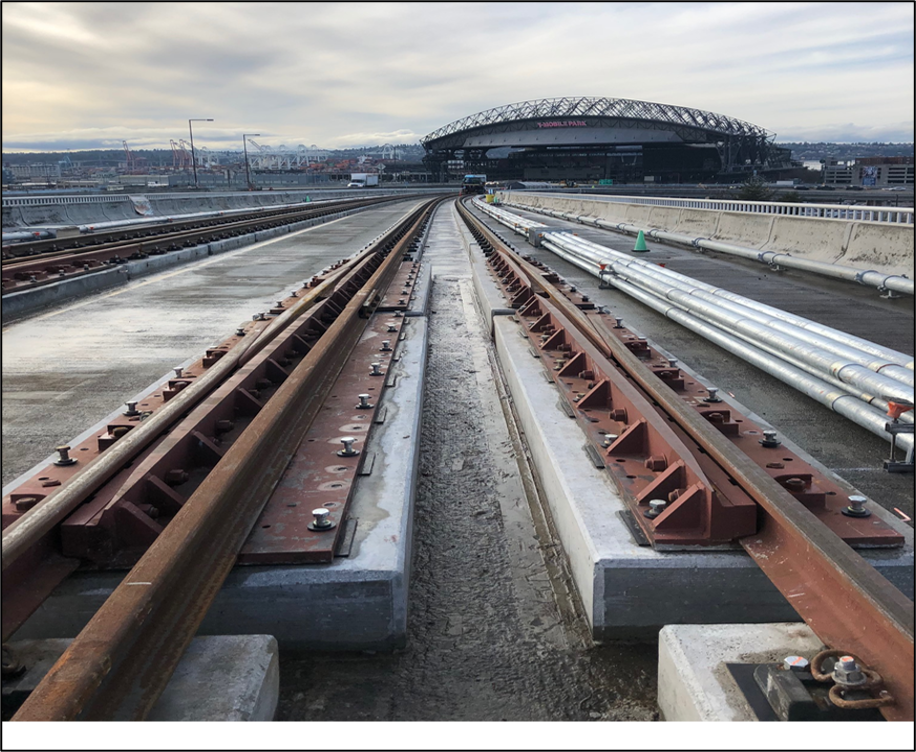
The gap looks about 50cm which is maybe 1.5km of contraction from installation tension.
Some better pictures:
https://www.eisenbahn.gerhard-obermayr.com/produzenten/vae/s...
https://slabtrackaustria.com/our-technology/red/
https://www.voestalpine.com/railway-systems/en/products/rail...
https://upload.wikimedia.org/wikipedia/commons/7/7d/Oelzetal...
https://upload.wikimedia.org/wikipedia/commons/b/bf/Schienen...
https://cmi-promex.com/wp-content/uploads/2023/06/CurvedRail...
https://cmi-promex.com/wp-content/uploads/2023/06/Sound-Tran...
https://www.hsrail.org/wp-content/uploads/2024/06/HSR_Track_...
> "[Prime Minister Donald] Tusk said that a military-grade C4 explosive device had been detonated on 15 November at about 21:00 (20:00 GMT) near the village of Mika."
> "The explosion, which happened as a freight train was passing, caused minor damage to a wagon floor. It was captured on CCTV."
> "Tusk said the train driver had not even noticed the incident."
> "A previous attempt to derail a train by placing a steel clamp on the rail had failed, he added."
> "The second act of sabotage, on 17 November, involved a train carrying 475 passengers having to suddenly brake because of damaged railway infrastructure, said Tusk."
[1]: https://euroweeklynews.com/2026/01/19/focus-of-guardia-civil...
Just to add context:
In 2025 August, the Spanish government blocked the attempt from Ganz MaVag Europe to buy Talgo, the main Spanish train maker. Ganz Magyar Vagon is an Hungarian company linked with Oil oligarchs close to the Victor Orban government. The government alleged National Security reasons when the National Intelligence Center started to suspect that the operation was really funded by a Russian Company, lending money to the Hungarians, via Corvinus International Investment Ltd.
https://www.ft.com/content/e3074c51-7de1-4ed4-aafd-e3c20d9be...
So it seems that Moscow could be trying to gain access to the Spanish train technology for some reason.
Also, this crash happened in Andalucia. On 8 January 2026 the high velocity trains in Andalucia were delayed some hours by somebody stealing small amounts of copper cable from several vital parts of the system. It was ruled as common thievery, and it was not the first time. Similar events on may 2025:
https://www.bbc.com/news/articles/cm24l14l4zmo
Stealing copper from the Spanish railway is like an Olympic sport lately. It seems strangely common on the previous hours to a big holiday, election or major event.
The problem is causing serious economic damage and lots of troubles to the users of the Spanish Commuter rail system "Cercanias" and now escalated also to the high speed railway. The troubles with Cercanias can be often attributed to poor maintenance, but sometimes include also somebody placing rocks and trunks directly on the railway with the mere purpose to create chaos.
EU is on an hybrid war with Russia, and that there are many documented boycotts against relevant European infrastructure, like the regular cut of submarine cables. At this moment is to soon to discard anything.