I'm also curious to see the details of the models that Dynomight's LLMs produced!
  LLM  T(t)  Cost
  Kimi K2.5 (reasoning)  20 + 52.9 exp(-t/3600)+ 27.1 exp(-t/80)  $0.01
  Gemini 3.1 Pro  20 + 53 exp(-t/2500) + 27 exp(-t/149.25)  $0.09
  GPT 5.4  20 + 54.6 exp(-t/2920) + 25.4 exp(-t/68.1)  $0.11
  Claude 4.6 Opus (reasoning)  20 + 55 exp(-t/1700) + 25 exp(-t/43)  $0.61 (eeek)
  Qwen3-235B  20 + 53.17 exp(-t/1414.43)  $0.009
GLM-4.7 (reasoning) 20 + 53.2 exp(-t/2500) $0.03I'd like to see a sensitivity study to see how much those terms would need to be changed to match within a few %. Exponentials are really tweaky!
I'd be very interested in seeing separate graphs for each major component and how they add up to the total. Even asking the LLMs to separate it out might improve some of their results, would be interesting to try that too.
The evaporative cooling as you pour into the cup is when the coffee is at the highest temperature and has the most surface area even though it only takes a few seconds. One could test this either by including it explicitly in the requested calculation, or by putting the fill spout directly at the bottom of the cup when filling.
dT/dt = -k(T_0 - T_room)
so T(t) = T_room + (T_0 - T_room) exp(-kt)
exp(-x) has a fast drop off then levels off.
scroll down, these graphs just don't look similar.
There is another factor here: convection. Its speed depends on the viscosity of the fluid and the temperature difference both. And viscosity itself depends on the temperature, so you get this very sharp dropoff.
Apparently the act of pouring has a huge effect on temperature because of the surface area :: volume ratio of the fluid as it streams (and turbulence after striking the bottom). The site above claims a single pour can drop it 20-30 degrees. There may be a similar effect here.
Does that seem hard? I think it’s hard. The relevant physical phenomena include at least..,
But that has presumably always been a pitfall for humans: trying to second guess the physical world and sometimes being "non-intuitively" wrong.
This is what humors me about analytical minded computation focused people vs dumb simple engineer and physics (practical) people. That is imagining all the infinities of what may change a physical result vs knowing by experience or education.
ANOVA: analysis of variance from linear fit parameters will show you in experimental data or simulation the contributing factors. Or you can read a chapter in an undergraduate heat transfer book.
Decay rate of (T(t) - T_inf)/(T(0) - T_inf) is probably dominated by the wind speed in your room. For an 8-12oz cup a sphere or cylinder will get you pretty close.
Imo no, this seems like something that would be in multiple scientific papers so a LLM would be able to generate the answer based on predictive text.
Impossible, since it is chaotic.
But a T(t) model should not be too hard for an LLM with a basic heat transfer book in its training set.
Of all the cooling modes identified by the author, one will dominate. And it is almost certainly going to have an exponential relationship with time.
Once this mode decays below the next fastest will this new fastest mode will dominate.
All the LLM has to do, then, is give a reasonable estimate for the Q for:
$T = To exp(-Qt)$
This is not too hard to fit if your training set has the internet within itself.
I would have been more interested to see the equations than the plots, but I would have been most interested to see the plots in log space. There, each cooling mode is a straight line.
The data collected, btw, appears to have at least two exponential modes within it.
[The author did not list the temperature dependance of heat capacity, which for pure water is fairly constant]
https://apps.apple.com/ph/app/grind-finer-app/id6760079211
Its far from perfect when it comes to predictions right now but I expect to have massive improvements over the coming weeks. For now it works ok as an espresso log at least.
I'm hoping after a few tweaks I can save people a lot of wasted coffee!
Wifey found a kitchen built in unit a few years ago and it is still doing the job, very nicely.
Let's face it, what you want is a decent coffee and you have to start from that point, not what sort of bump or grind (that's grindr).
I want a cup of coffee with: - Correct volume - sometimes a shot, mostly an "Americano" - I'm British don't you know - Correct temperature - it'll go really bitter if too hot. Too cold - ... it'll be cold. - Crema - A soft top is non negotiable - Flavour - Ingredients and temperature (mostly)
The unit we have now manages bean to cup quite reasonably, without any mensuration facilities. I have made coffee for several Italians and they were quite happy with the results.
A reliable way of reproducing the effect was found in 2021. [0] Though the precise cause is still unknown.
Will near-boiling water drop 10 temperature points in a shorter time than the warm water? Yes.
Will it reach 10C faster than the warm water? No.
Today's your lucky day, you get to learn about the Mpemba effect.
(Although the why of the effect is disputed, the trivial counter to your point is that boiling water loses mass quickly so there's less mass to cool)
This is like someone with no background in physics or engineering wondering "can a LLM predict the trajectory of my golf ball". They then pontificate about how absolutely complex all of the interacting phenomenon must be! What if there was wind? I didn't tell it what elevation I was at! How could it know the air density!? What if the golf ball wasn't a perfect sphere!!? O M G
And then being amazed when it gets the generic shape of a ballistic curve subject to air resistance.
This speaks far more to the ignorance of the author than something mind boggling about the LLM.
This is the kind of model you would expect from a simple cylindrical model of the coffee cup with some inbuilt heat capacity of its own.
However, those decay coefficients are going to be very dependent of the physical parameters of your coffee cup - in particular the geometry and thermal parameters of the porcelain. There's a lot of assumptions and variability to account for that the models will have to deal with.
The exponential decay is obvious because he started the readings at boiling. If he had started at 150°F, it might not have been as obvious that the readings were on an exponential curve.
Is that right? I didn't get much sleep and don't drink coffee. Lol
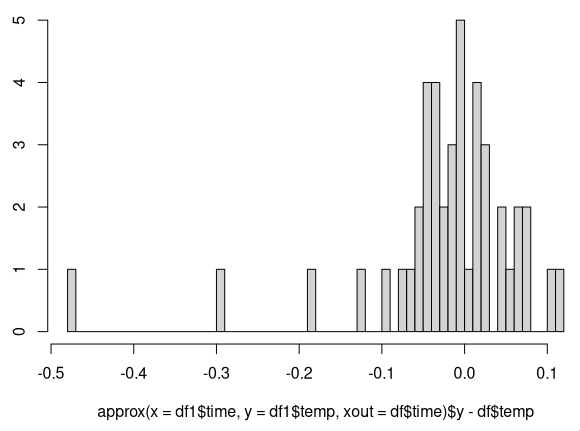
A logarithmic fit to their data indicate a standard deviation of 1 ℃ in the residuals. This includes both model error (the logarithmic fit is not that tight) and errors in my transcription from the plot, so the actual uncertainty of the measurements is probably even less.
(The logarithmic fit was lazy. I tried a dual exponential fit and the standard deviation of residuals dropped to 0.45 ℃. Appears that measurement error is very small.)
This isn't really uncertainty so much as not defining the meaning of "temperature of the water".
T(t) = 20 + 25e^(-2.3*t) + 54e^(-0.034*t)
(a) 20 ℃ represents the room temperature this will eventually reach.
(b) 25 ℃ is how much of the temperature the mug will absorb as it is heating up.
(c) The decay -2.3 represents how fast heat is transferred to the mug. (It will be halfway after 20 seconds.)
(d) 54 ℃ is the differential between room temperature and starting temperature once we've accounted for the loss of 25 ℃ to heat the mug.
(e) The decay -0.034 is how fast heat is transferred out of the mug to the room. (It will be halfway to room temperature after 20 minutes.)
I'm okay with (a), and I could probably have guessed (d) once I know the other parameters.
I can also sort of see myself figuring out (b): I would guess the heat capacity of the mug would be maybe 500 × 0.6 = 300 J/K, do the same for the water (4000×0.2 = 800 J/K). Some work later this comes out to a temperature loss of 20 degrees. Close enough.
But even if I tried to use my intuition for how hot the mug feels as these processes go on, I would have ended up nowhere near -2.3 and -0.034 for the decay coefficients. What would I need to know about convection, mug materials, and air properties to guess that more accurately?
Is it a neat coincidence or a good, very approximate rule of thumb that heat transfer to air is about 60× slower than that to ceramic-like solids?
[1]: https://web.eecs.utk.edu/~dcostine/personal/PowerDeviceLib/D...
If equations were included you'd probably see a standard equation (Integral form of Newtons law of cooling). With the time parameters known from the input and the heat transfer parameters having reasonable guesses (cup opening area, mass of water).