Typo? I didn't think we had sample rates anywhere near that high!
Also, the 50GS/s is actually more like 25GS/s as it has a Nyquist frequency of 12.5 GHz. This is because they take 2 samples at the same time, instead of 180 degrees out of phase. I wish they had made that clearer to customers, it felt misleading to some.
You have to have the 240V model of the scope to run all four channels at full rate (110GHz) though.
The calibration procedure on the scope fiddles with the time alignment to get the different DACs correctly offset so that the combined signal is correct.
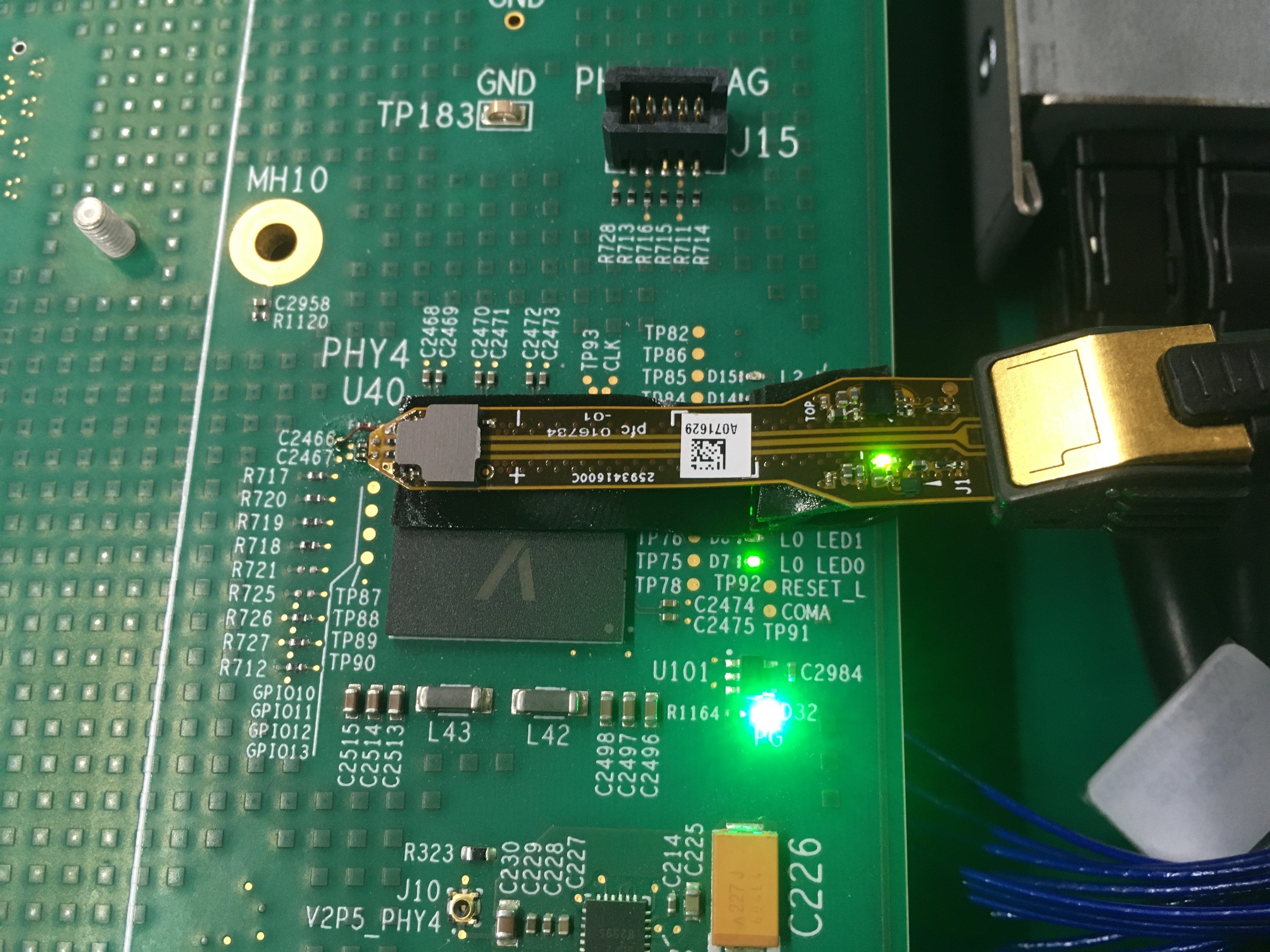
The hybrid ceramic input boards in their metal cases are a thing of beauty, fragile (don't ask how I know), but beautiful.
https://www.tek.com/en/documents/application-note/real-time-...
Otoh, at 5Gbps, a sample rate of "just" 10GS/s would be sufficient (barely).
I rather suspect the oscilloscope is capable of 1TS/s equivalent time sampling, but that mode wasn't used.
What you can do, if and only if you have an exactly repeating signal triggering at the same point within a cycle, is change the delay between the trigger and sample, and repeat. In other words, sample at different times within the same signal (since it's exactly repeating), to build up samples in time, of that waveform, to whatever time resolution you want.
Of course, you're limited to any noise in the trigger, variation in the signal, etc.
This is how you can record light moving through your garage [1]!
The number he's referring to is in units of samples per second. It's not doing interpolation between samples, to achieve a high samples per second, because that's not possible, which is my point. Interpolation results in an imagined value, but samples are measured values.
It would be correct to say that the values between samples are interpolated, but the subject of interpolation isn't applicable for anything mentioned in this comment chain.
The only time these are interpolating is when they are visualizing, there is no point (hah) in storing interpolated data, you can generate that whenever you want.
There are some budget sampling oscilloscopes on the market, but budget is still mid four figures and up. That's before probes, cabling, and other things you'd need. Sampling oscilloscopes are only useful for repeating test patterns sent by SDK tools, not for capturing normal data as it goes by
It's possible to look at Ethernet signals with oscilloscopes in the budget range but you would need appropriate fixtures to tap the line. Even at those speeds, touching a regular oscilloscope probe on to a wire disturbs the circuit so much that it might stop communicating.
https://www.mattkeeter.com/blog/2022-08-11-udp/probes_full.j...
With only a voltmeter in hand, I measured the voltages on the address lines - thankfully my dumb programming error was a very tight loop so it was easy to deduce where the looping was happening !
Some things were easier back in the day.
…typically we decode I2C.
Oh, I‘ve equipped the lab with all kinds of oscilloscopes. I find a lower mid-tier product (like Rigol DHO 900/1000 series) most suitable: good enough resolution and nice quality-of-life features (many physical buttons / dials and input channels go a long way!), yet not too feature-packed and physically compact to still be approachable.
Do you happen to know if that batronix board useful to have even if you have a Rigol DHO 924S without the logic probe (PLA2216)?
In fact, to demonstrate the very physical foundation of digital computing, it is very useful to use the analog inputs and zoom all the way in to see the slight imperfections in signal transmission.
You get to define your own model of continuity on top.
I wonder if more systems should move toward explicitly modeling session continuity instead of inheriting it implicitly from transport.