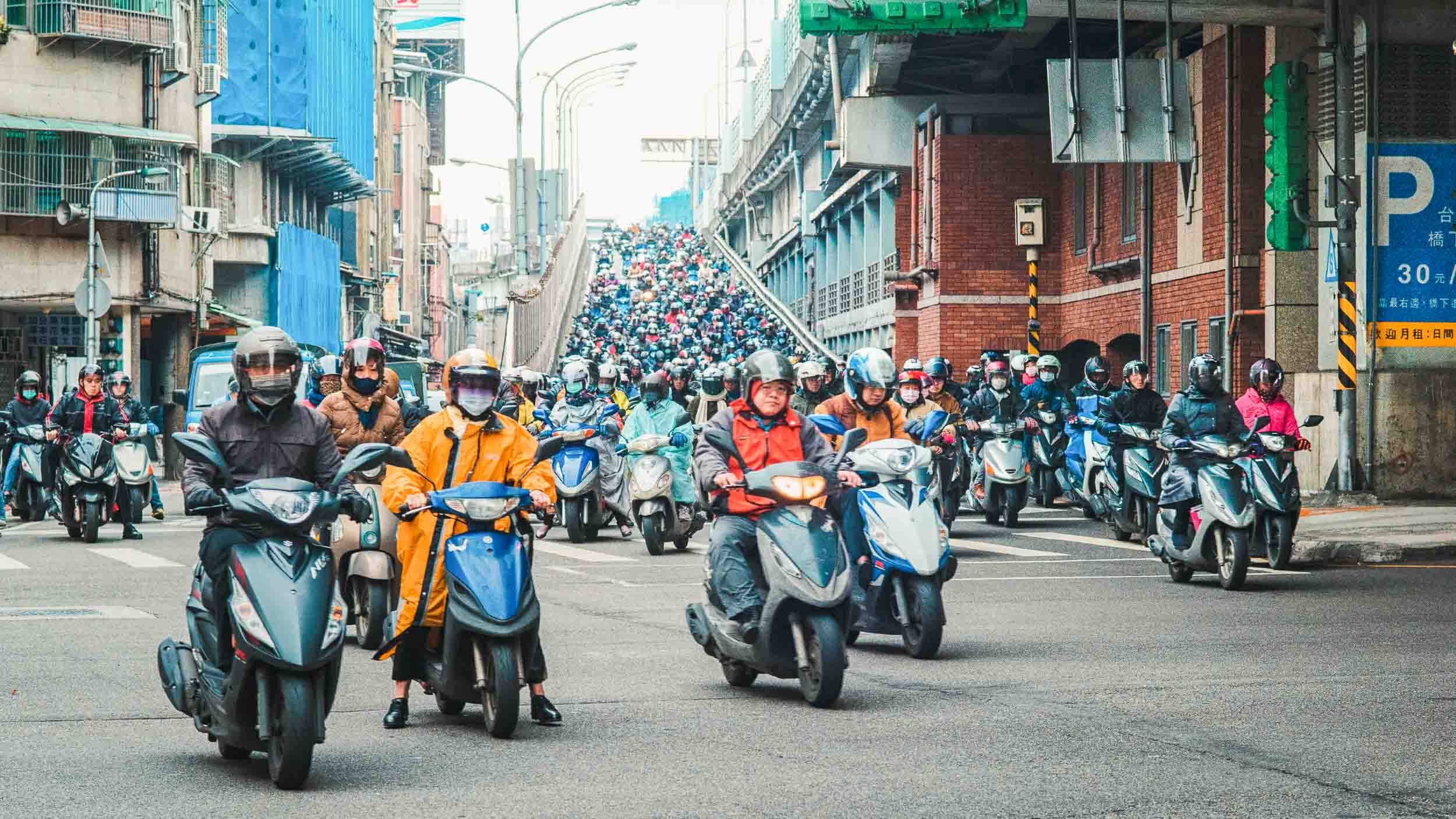
It keeps repeating how the cleaner air is so good for tourists.
But tourists visiting Paris for a week don’t get the majority of the benefit from cleaner air.
The Parisian residents living there throughout the year do.
Maybe because it’s CNN, an American outlet, they’re focused on the “tourist”, but these benefits have mostly accrued to Parisians.
Also, the 4% increase in traffic jams is minuscule when compared to other large cities across the world (outside of maybe NYC, since it implemented congestion pricing over that period). Paris has not escaped the wrath of the SUV, and a large part of the congestion cities across the world are seeing is solely down to cars becoming bigger.
This has led to a big increase in %age terms of cyclists in London, but a fairly significant decline in bus passengers.
I think roughly 300m/yr cycle journeys were added, but bus has lost 500m pax/yr (mainly because of increased congestion making them less and less attractive). Note this isn't all down to bus lane removal, but it's a significant part of it.
That’s not necessarily a problem, particularly for saturated lines like the 13.
https://www.businessinsider.com/switzerland-workers-commute-...
There isn’t much you can do to prepare for the possibility of, say, an SUV vaporizing you and your family on the sidewalk because the 80yo driver zoned out. https://www.theguardian.com/us-news/2026/mar/20/san-francisc...
What a ridiculous statement. Motorized vehicles are involved in the vast majority of road casualties. You are much, much more likely to die from a car accident than a bike accident.
> whether or not the level of injury is the same
It is not the same.
Of course there is. The world isn’t black and white. I said “could”, there are many shades of grey in between. Don’t be such an absolutist, like your truth is the truest one.
> It is not the same.
Well, … it depends, no?
A collision between a pedestrian and a cyclist going at around 15mph is more likely to lead to the cyclist getting more hurt and the blame is slightly more likely (something like 60%/40%) to be attributed to the pedestrian.
Whilst a lot of people are fearful of cyclists and pedestrians sharing space (often due to cyclists being quiet and passing very close), the statistics show that the actual danger comes from car drivers, even just looking at incidents on the pavement.
The thing is that cyclists have "skin in the game" and so have a disincentive to collide with anything. There are certainly idiots on bikes, but it's far better to get as many idiots as possible out of cars and onto bikes (or ideally walking) for the purpose of harm minimisation. Every idiot on a bike could be an idiot that drives.
Because I keep an eye on the official Police stats in Toronto and it is eye-opening. Statistically, drivers kill people, and cyclists don't. It is not even remotely close.
As I recall, pedestrians are more likely to be killed by a driver whilst on the pavement, so whilst collisions may be more frequent with cyclists, they are extremely unlikely to lead to a KSI.
Paris Metro is pretty nice, and reaches most of the car free area. But I'm not sure if it can handle all of the cyclists if they're all trying to avoid a déluge.
And not just young active people, it's a habit found across all age groups, parents bike their children to school (or with them if old enough, etc.)
All that to say I wouldn't worry too much about the feasibility issue, it's really more of a mindset to adopt, and it's happening more and more in France.
But with electric bikes becoming more affordable, hopefully the gap can eventually close.
Or those with bad legs. Raises hand.
It's completely flat and the obvious reason why everyone cycles. Nothing to do with mindset, like you're somehow superior to the rest of EU.
No, what makes the Netherlands different is their street design prioritizing safety rather than speed at all costs. When the streets feel safe from speeding drivers, more people choose to ride a bike.
Assuming everyone but you is retarded.
https://en.wikipedia.org/wiki/Cycling_in_the_Netherlands#His...
I agree with another commenter that while flat, the Netherlands have their own hurdles (biking with a strong headwind on the banks of the IJ is not easy, even if flat), and I definitely agree that their city design is what makes this unique.
I lived in various parts of France growing up, and I can assure you there are flat cities there, yet biking in them felt very risky at best.
Nah, jk, it's a beautiful day today and I'm thinking of going for a ride.
I cycle in Paris every week, and the only annoying experience climate-wise is the extreme heat you can get some days in july and august. If it's cold or wet, you can just wear appropriate clothes and be comfortable. But if it's sunny and 35°C, you are going to be drenched in sweat no matter what! Of course, being in the metro those days is even worse...
It is not really an issue.
The only thing that was slightly meh was the yearly ~two weeks of thick snow in Southern Germany. It increases effort a bit, but still not a huge issue and the cycling roads got cleared pretty quickly.
One of the saddest effects of car-dependency is people forgetting how to dress themselves for the weather.
Cycling is wonderful, except when it rains, when it's cold, when it's hot, when it's windy, or when you want to carry stuff. So it's not a practical solution 80% of the year.
Personally, I enjoy cycling on snow as it's often not that slippery and due to the cold, I'll usually have a fair amount of clothing to act as padding for if I do come off. Black ice is worse as the rest of the road may be fine, so you go fast until suddenly you're sliding down the road.
Wind does suck. I can't help you there.
Or just building some fitness, which in my experience comes automatically when you bike
There are millions of people who find cycling incredibly practical, so claiming it's impractical for some easily debunked reasons only shows the limitations of your experience. But you can fix that. Give it a try.
When we were there a few years ago we saw a young woman on a bike slam into one on her morning commute.
I nearly nutted myself a few time too.
Take my city for example. I work in an office block around a 15 minute walk from the centre, which has free parking for employees. Monday this week the city announced that the land is now paid parking to the city effective immediately. When it was pointed out they they hadn't provided any of the necessary signage or machines for this, they decided it was illegal to park there at all, with fines and tow trucks for non compliance. An email from them suggested "cycling or using public transport as the weather is nicer".
I cannot stress this enough. No warning, no compromise, no other use for this land, just an immediate draconian announcement.
It's very easy to call another group entitled if you're not one of them
what a strange way to put it... why didn't they just say that they are not using any more taxpayer money to finance your parking space? Land in a city is not "for free".
> It's very easy to call another group entitled if you're not one of them
yeah, well: my point, exactly!
Most of those marginal improvements can only be seen as something positive in retrospective, not while they're being made. While they're being made, they'll always be unpopular, as the voter base is usually not keen on defending the people that are currently in charge. That doesn't mean they won't show up in the next elections, just that they are quieter in the meantime.
and even in the ideal world a great leader can do more in the next term if they get relected.
Until you throw yourself in front of my car
> Until you throw yourself in front of my car
Fragile with regard to their egos, as illustrated here.
It's like claiming getting rid of slavery is "harassment", because your unfair privileges are being taken back.
Why not? Fewer cars means more room for bus stops.
My city excels at this. We are at level where bus system is not enough at all. But the municipality is trying to avoid it since it’s seen as politically tricky. Nobody wants to start it, take the beating and then let opponents cut the tape a decade later. The bus system is struggling too. Old buses, incomplete bus lanes and so on. When one jackass got an idea to reduce car traffic and started with adding obstacles to cars without improving public transit… Traffic did not better. And buses get stuck with the rest. Thankfully remote/hybrid work is all the rage. In recent decade quite a few offices and other workplaces moved away from urban core. That helps the situation a bit.
The reality is that a lot of traffic is simply unnecessary, and dissipates once you add some friction. The most extreme example of that is the rise of remote work during and after Covid. As it turns out, none of these people actually needed to go anywhere.
And more generally, cars induce their own demand simply by virtue of being the fastest and most comfortable option, and they shape the environment around them to depend on them. Small local shops get outcompeted by distant behemoths due it being more convenient to drive. People move to a large house in a distant suburb rather than a small apartment because they know it's just thirty minutes away from work by car anyways. The easier it is to drive, the more entrenched driving becomes. And any way you slice it, undoing that process will cause pain, so you might as well go ahead and start, because you're never going to find a way to prevent the consequences anyway.
The outcome seems so obviously good. I have never heard of anyone complaining about a city becoming less car centric, but maybe somehow it's an under-represented story?
In contexts like this, using a car is perceived as a right - restricting usage doesn't make people think "I'll take the chance to use the bike", rather "How the f*ck do I get there now?".
All it takes is an understanding how fucked up it is to operate a 2 tonne personal vehicle everywhere you go(if you are able, which most people aren't, legally or mentally), spread the general knowledge and make a long term commitment to public transport, walking and bicycling.
:-)
You’re missing the point: tourists are good for the city. If Paris gets a reputation of being polluted, tourism will decline.
Europeans don't drive Suburbans. They drive crossovers that are, if anything, shorter than the equivalent sedan or wagon.
https://adventure.com/wp-content/uploads/2018/01/Hero-Gettin...
The same of course goes with mass.
Usually this kind of negative-sum-prisoner's-dilemma incentive matrix is resolved by government intervention which changes the payoff structure.
Of course, as I mentioned, compact pickup trucks are basically dead in the US. You can get a four door car with a three food bed that is marketed as a small truck. If you want a single cab and a six foot bed, you have to buy a full size truck and those are usually taller and bigger and less efficient than a compact truck would be; it can do bigger truck things, but I only need little truck things.
Maybe the Bezos truck brings back small trucks to the US.
I was next to a GMC pickup on my bike the other day at a stoplight. When I stood up, the hood was roughly shoulder-height for me. They can easily make the hood at least a foot shorter (and probably more) and still fit everything under the hood, or even go with a cab-forward design.
But people think those look dorky.
At the extreme end of things, it's hard to argue they are wrong: https://en.wikipedia.org/wiki/Oshkosh_NGDV
I've got an old cabover passenger van, visibility for me is pretty good, but if you were next to it on a bike, you wouldn't be able to see over the hood cause there isn't one.
It's also pretty dorky, but it's got essentially a porsche engine, which makes it a rear engined mid-life crisis sports car. I have to run it at red line for 30+ seconds to get up to freeway speed...
Take the claim that the locals hate the changes. Well, the mayor was reelected. So they claim the voter turnout was low and people were complaining, so people obviously don't support it. Sorry, you can't make that conclusion. Under ordinary circumstances, 100% turnout would only tell you the overall support for a particular candidate or party, not a particular policy. A low turnout may reflect an electorate who is not particularly passionate in any of the issues presented in the election, or it may mean something else. It was probably something else in the 2020 elections because those were anything but ordinary: they fell during the peak of pandemic uncertainty (i.e. March to June). So a flimsy assertion based upon flimsy evidence.
Then there are the scanty numbers without context. A 4% increase in traffic jams since 2015 and 31% decline in bus use between 2018 and 2024. First of all, the words "bus use" sounds highly selective. It looks like the Paris metro has been expanding and modernizing rapidly in recent years, which would both take load off of busses and be disruptive to transit users. Oh, and that pandemic thing raises its head again. I don't know about Paris, but a lot of cities took a hit to transit ridership during the pandemic and some are claiming to reach pre-pandemic levels only now. Also, cyclists tend to be the whipping boy for traffic congestion. I can't speak for Paris, but the reality in my parts are that population growth and a surge in construction have been far more disruptive than cycling infrastructure.
Sorry about the rant, but I'm sick and tired of the views of one segment of the population completely overriding the views of another segment of the population ... especially when there are assertions based upon assumptions and flimsy evidence.
First impressions matter, though.
When you fly into e.g. New York and they pop the door open you get that whiff of exhaust fumes. The city reeks.
Vancouver on the other hand it smells like the ocean.
Any improvement of air quality does matter for tourists and residents.
I thought the above needed a /s, but a check shows 30% of the people in France smoke. (I can't find city stastics)
it's not a weird framing, it's a clearly marked travel piece on "CNN Travel"
the French don't read that, they read French newspapers etc.
Edit: The responses reasonably talk about the officially mobility impaired people. I was thinking more about the unofficially mobility impaired people by obesity, like me. French obesity rates are ~16% compared to ~42% in the US. That contributes to a fierce US constituency for cars.
It frees space for people (wider sidewalks...), reduce the risks of navigating the streets, and for the ones that have to use a car, there's less traffic and less people stealing dedicated parking spots.
Less cars also means less mobility impaired people. Cars create them through crashes and a lifetime of sedentariness.
Finally, it should be noted that most of the time when someone says "what about mobility impaired people?", when debating reallocating public space to people instead of cars, they are not mobility impaired themselves and don't actually care about them. They just try to guilt shame their opponents to win.
The article mentions there's now constant traffic jams for city buses in Paris. It seems best for people who can cycle, walk, or people who already live in the city and don't need to travel much.
Well, no, the article says that
> traffic jams in Paris have risen 4% [in 11 years]
That's a baseless and false slur. My first thought was that visiting Paris would be difficult because of all of the walking. I fall in the large gap between disabled and fit. On the one hand I would benefit from more walking, on the other I would not get much enjoyment out of a city that way, and would tend to drive far to services where I could park nearby.
Basically a city is either small enough to be crossed walking, or big enough to have public transportation.
And after walking or cycling, public transportation is the best way to visit the city. In Paris, there's bus stops or metro (subway) stations everywhere. A bus or metro puts the passenger at a higher level than walkers/cyclists/car passengers and with huge windows, allowing to enjoy a unique view of the city.
The view of the Eiffel Tower you get when crossing the Seine on the Bir-Hakeim bridge is an experience that can ONLY be enjoyed by riding the metro. https://www.youtube.com/shorts/cqIJVzkLD4c
These sorts of reforms are generally aimed at discouraging people from commuting in by car. People who _regularly drive around central Paris_ (except for delivery drivers etc) would be a fairly small constituency.
Car-dependent sprawl creates mobility impaired people where there were previously none. Many people are too old, too young, too intoxicated, too vision impaired or too poor to drive. Lack of viable transportation options is the greatest barrier to upward economic mobility for Americans today.
The vast majority of obese people are not meaningfully mobility impaired.
Why frame it as a fight? There’s no need to start there; you don’t need to waste time fighting against people not in your group. You just need to establish group status. If the constituency of obese people is strong, why not seek to establish policy on behalf of obese people and not everyone? As the article and others here have said, reducing traffic congestion benefits everyone in multiple ways, including benefits for the people who still have to drive. Given a choice that doesn’t affect your ability to drive, I assume you’d rather have less pollution, less noise, and fewer other drivers on the road?
The other angle missing from your comment is e-bikes. Most of those ~42% of obese people in the U.S. are still capable of riding an e-bike, and for short trips in busy areas, e-bikes are more convenient and easier to park than cars.
It was my first time, and his fourth. We stayed South of the Republique metro station.
After the literal 30th indie Manga [0] shop that we walked by, I asked him: "how are all these shops financially viable?" He said: "look inside."
Holy crap, they all had customers inside! I had no idea that Japanese culture has such a strong presence in the heart of Paris, in the middle of Europe.
[0] I should be clear, this was not just Manga. There were so many cool indie retro video game shops that it blew my little mind. I should probably get out of my Silesian village more often.
I also really like French food, especially when mixed with the crazy chefs in that area that we stayed.
Edit: just so everyone knows, this is what an airport terminal could be, according to Air France: https://postimg.cc/ZCww5xFs - So cool that I had to take photo.
This was the least customer-hostile area that I have ever seen at an airport. Oh, you have to wait for a flight? Just lay back and chill.
It is almost like its own tiny airport for short hops by Air France in the EU.
It feels like a completely different world from the main mixed-carrier international disaster situation. It really feels like a designer experimental terminal.
CDG wouldn’t be my _least favourite airport (I think that’s probably San Francisco, specifically the international terminal), but it definitely would be up there.
Meanwhile, I went to Terminal 2G, and there was absolutely zero security wait. It was like a 1 screener per 3 people type situation. It was like being at some rich people resort airport. Once I got through security, which took 5 minutes, I was presented with a high-end shopping center, a roving smiling robot garbage/recycling can straight out of Shenzhen asking people for deposits... excellent food, anyone could lay down on comfy couches. It blew my mind. It was France, and Air France, flexing.
(Living inside Europe but outside Schengen tends to get you the worst terminals/sections of terminals. Berlin Tegel used to have a tiny little terminal that, as far as I could see, only flew to Ireland and Turkey (not sure where the UK flights went from). Absolutely horrendous; there’d sometimes only be one passport control line, so if the person in front of you had an issue you might be waiting for an hour.)
I don't even take the subway, walking and biking are enough where I live. Hopefully we can reach the comfort of dutch cities within a decade.
Before reading this book I always thought Germany (where I grew up) was the exception for being more decentralized. But it looks like actually France is way more centralized even compared to other pretty centralized countries.
Or maybe it’s a scapegoat?
This is closely related to the concept of primate cities (you can read its wikipedia page for more details if interested). Essentially, places like France, UK, Russia (countries with primate cities) have an unusually/disproportionately high concentration of population in the largest city. There are some pros but unsurprisingly cons as well.
Trump keeps saying that they want to prevent USA becoming a dangerous place like Europe, even said that recently and the Irish president disagreed with him. As an American, would you say that EU has fallen and it has become a shithole or maybe something in between? I'm just curious if its just about differences of expectations or something.
If anything, the US degraded far more over the time I spent there than Europe did while I was away.
Comparing countries and policies is a great thing, we have to learn from each other. Just be careful of misinformation and out of context numbers. Sure France's GDP seems lower, but they don't need a larger car and a larger diet coke to be happier.
Better to get crime information from anything else.
The question to ask is why those videos are being made.
Paris, as other people have pointed out, has a much lower homicide rate than big US cities.
However for pickpocketing, paris is notorious. But getting actual stats that are comparable is difficult.
It depends if pick pocketing is ubiquitous or prevalent only in specific places.
I don't think that's really selling it to me. it sounds like there is a organised crime problem in the USA.
Would love to know the social media you've been consuming that could make you believe that an American in Paris who is praising French city planning for its positive health effects could possibly believe anything close to that epithet uttered by the current American president.
And cops are significantly less likely to shoot you. You dont have to be afraid of them.
It's safe to assume you'll encounter a very wide variety of people speaking many different languages.
I can only say the most basic phrases in French and have experienced zero problems.
I don’t like to be the ugly American who just assumes the world should speak my language, so I was ready for language barriers, but I had no real issues at all.
Now it's true that Americans tend to love to frighten each other with firecamp stories about the Big Bad Frenchman, but IME it's mostly a mix of latent francophobia and a grapevine of bad experience between what is locally perceived as wholly uneducated Americans and local Frenchmen that the Americans tend to see as arrogant.
The latest if most often due to (i) tourists forgetting that what is a great week you spent years saving for is another Tuesday for the other guys in the street, (ii) many fundamental French etiquette rules (don't shout, say “hello” first when talking to someone, the absence of a hierarchical relationship between hospitality personnel and customers, distant behaviour is not arrogance but a mark of respect, etc.) are completely accessory in the US customs, leading to very strong misunderstandings.
So book a trip for a week and come say hello, we don't bite! (and avoid like the plague any café/restaurant in the touristy areas)
These two are generally adhered to in the US as well. May be the hierarchy part is there if you're staying at really exclusive resorts. But by and large, most folks are polite.
There is obviously the random asshole. But those exist everywhere.
I'm not sure; granted I did not visit a lot of places in the US, but when I was there (Miami/Denver/Phoenix), I virtually never saw e.g. a customer greets the cashier when buying things.
A few times someone would correct us (eg "after 6pm we say bonsoir instead of bonjour"), but it never felt like it was done in a dickish way and people were generally pretty accommodating. Perhaps it helps that I went to Paris with low expectations, not thinking it'd live up to the hype, but I had a great time. Definitely don't let the language thing keep you from going!
That being said, there is still a lot to hate about Paris: dirty and overcrowded subway, shady people everywhere, especially around tourists' places of interest, etc. Not that much different from big cities like NYC, SF, Seattle, etc.
I felt safer in Paris, LA, and Seattle than I ever was in NYC.
If people see you making the effort, they'll switch to English, in my case, anyway. But you have to show some respect, first. You have to let people know you understand you're a guest in their country.
Of course, this was many years ago. Things may be different now. And of course, if you're going to live there you're going to have to learn the language as quickly as you can.
Funny thing about distances in small towns. It doesn't take long to start perceiving a ten or fifteen minute drive as a "long" drive. But a two hour walk while I turn over a difficult design problem goes by in an instant.
The difference between time that saps or renews our energy.
And I am off for a walk...
There are a lot of things that “only rich people get to do”. Reducing the number of people who engage in destructive activities is a good thing, even if it means only rich people can still do it.
- Enrique Peñalosa Londoño
The obsession with SUVs is classist.
Driving is for plebes
They also spend a lot of time on the phone strategizing with other folks like them. --
But that's not a contest!I'm sure your rich people are richer than my rich people. --
If we were looking at a formal definition, my naive approach would be to use the median income, add the revenue of assets, and add a 20% to that ?
I'm sure the field of sociology could help be more formal here. --
Here I was talking specifically about French folks, where access to remote work and living in the inner city are strongly correlated with higher income.
I honestly find it extremely interesting how both France and the US have similar fault lines due to the intersection of economic, social, and political culture wars, and an extremely similar manner of consolidated media ownership.
What Paris does politically speaking matters less than what Marseille, Nice, and Toulon does - everyone overindexes on the 20% at the expense of the other 80%. This is what brought Trump to office in 2016, and I see similar mistakes being made across Western Europe as well.
> where access to remote work and living in the inner city are strongly correlated with higher income
People also underestimate the number of mega-commuters in France, and how depending on the distance commuting via Intercités+TGV and a car becomes a wash.
Some people will derisively say "let's make owning a car more expensive to make them change", but that's similar to Marie Antoinette's retort "S'ils n'ont pas de pain? Qu'ils mangent de la brioche!", especially given how severe spatial inequality is in France.
If you’re looking at billionaire philanthropists, I don’t know what they do but at that level of wealth it’s probably whatever they want.
Being on the DART (a not-quite-metro; trains carrying a thousand people every ten minutes per direction) or Luas (a high-capacity tram system) lines tends to lead to homes being considerably more expensive than those which only have bus access.
Dublin used to have a synthetic ‘posh’ accent that was often referred to as DART-speak, because it was common in the upper-middle-class suburbs along the southern section of the DART line. Public transport can be posh, or at least seen as such.
And no public transportation does not fix the problem. It helps a bit, but at the end of the day biggest part of far commuters are gradually cut off.
If decentralization is the target, then just state it.
Citation needed.
Pedestrian and cyclist friendly cities have more vibrant street life, and are more attractive places to live. I've never heard of car restrictions leading to more suburbanization.
looks at the reason
CARS.
I have only been to Paris once, but the cyclists were much more sane in my experience. The bike lanes were clear, and for the most part they stopped at a red light.
What I would like to see is mortality rates of pedestrians in Paris in general. That might be the actually interesting trend.
As a pedestrian, I've had FAR more encounters with aggressive cyclists than aggressive drivers (also anecdotal). Makes walking downtown more stressful.
Anyhow, talking about the hospitalization rate without the mortality rate is very odd and smells of manipulation one way or the other.
Are you sure? I would expect that it is average density of people over the length of the route that is important when it comes from moving people from some point A to some point B on a road.
With for example buses you have high density where the buses are actually at, but 0 density where they are not. The average over the entire route can easily be lower than the density for cars where you can have that 1 person per 20 feet over the whole route.
If an observer at a fixed point on the route sees more than about 50 cars pass between buses passing the cars will have higher throughput.
Say what you mean to say.
> Local parks and generally streets are so dirty that you have to wash your children from head to toe as soon as they have set foot outside.
Maybe if it is a newborn, and if you don't bring the stroller nor any clothes, on rainy days it can be that bad. Don't get me wrong, Paris is not a clean city, there are empty nitrogen tanks, puffs and cigarettes lying on the ground pretty much in every arrondissement, but syringes, even on the colline du crack I can hardly remember having seen even one (but it is very dirty there! with packaging, paper, cardboard, bottles).
I still think there should be a higher priority on sanitation but I also think you are exaggerating a bit.
A week with a double stroller in Paris will make you appreciate ADA wheelchair ramps, kerb cuts, and elevators.
We were gifted a big heavy modern stroller and almost never used it, when the kids were babies we wore them and now they can walk a little we just do that and take breaks. If it's going to be an all-day thing (like a theme park) we'll bring a lightweight umbrella style stroller and those are trivial to fold up and carry.
The accessibility argument makes sense for folks with disabilities but not so with children.
I loved carrying my kids as babies, and rode them everywhere on my bike, but there will always be people for whom bikes, walking or cars aren't an option, which is why accessible public transport is always important.
> Local parks and generally streets are so dirty that you have to wash your children from head to toe as soon as they have set foot outside.
That's an insane hyperbole.
> And I'm not even talking about used seringes and broken glass in certain parts of the city.
Not my experience, at all.
This is somewhat of a public secret, but few people ever stay in Paris for longer than say 10 years and thus aren't that attached to the city. It's noticeable in how few people voted in Hidalgo's referendums.
The city has been losing citizens in favour of its suburbs for close to two decades now (if not much longer really) and this is a trend which shows no clear signs of reversing.
If “done well” neighborhoods preserve their character somewhat because the replacement people are basically the same, but in other cases the neighborhoods change drastically every ten years.
Wikipedia says that 70% of the people voted. Is it mandatory there?
Here in Argentina it's mandatory, but weakly enforced. We get also a 70% of people voting. Anyway, the big problem are bubbles, probably all the friends of the guy don't like the current mayor and complain.
No, its the french being _very_ french. Politics is still a sport there, with a plethora of teams playing.
Well what does that mean? It certainly doesn't mean that there is a huge wave of enthusiasm for the measure.
But conversely it also means there's not a huge wave of anger about it. It's not like the automotive lobby didn't try hard to create one; the media coverage was actually kind of crazy at the time. And with the low turnout, even a small mobilization would have been sufficient to reject this measure. But it didn't materialise. So when I read articles like this one from CNN, I just have to ask myself what the agenda is behind jazzing this up as much.
[1]: https://www.lerevenu.com/reduire-impots/conseils-impots/pari...
Also complaining is easy, I could do it right now here on HN from any bathroom in the world; voting is comparatively much harder.
Instead of encouraging motorists to make better choices, they just end up feeling part of a money grab
Nice of the wealthy politicians to get the riffraff off the road so the guy driving a Brabus G-Wagon, Rolls, or 911 Turbo can commute and park in peace. The poors can sit on packed busses with methheads.
____
* Always going to work by bicycle if possible, but if I have violin lesson or doctor's appointment I am not able to because the distances would be too long
Just throw in an electric motor and will suddenly become fun.
Krakow is a great city. Did you try an electric bike? They make 8 km seem like nothing.
> For young, trendy and able-bodied Parisians ... i live next to a bike path. the elderly make up a a significant amount of the cyclists, probably because they don't trust themselves to drive a car anymore.