Codeville also used a weave for storage and merge, a concept that originated with SCCS (and thence into Teamware and BitKeeper).
Codeville predates the introduction of CRDTs by almost a decade, and at least on the face of it the two concepts seem like a natural fit.
It was always kind of difficult to argue that weaves produced unambiguously better merge results (and more limited conflicts) than the more heuristically driven approaches of git, Mercurial, et al, because the edit histories required to produce test cases were difficult (at least for me) to reason about.
I like that Bram hasn’t let go of the problem, and is still trying out new ideas in the space.
This means that everything that implements eventual consistency (including Git) is using "a CRDT".
The goal should be to build a full spec and then build a code forge and ecosystem around this. If it’s truly great, adoption will come. Microsoft doing a terrible job with GitHub is great for new solutions.
> ... CRDTs for version control, which is long overdue but hasn’t happened yet
Pijul happened and it has hundreds - perhaps thousands - of hours of real expert developer's toil put in it.
Not that Bram is not one of those, but the post reads like you all know what.
... and of course it is, because Pijul uses Pijul for development, not Git and GitHub!
Git is so established now that it's sensible for alternative VCS to have a mode where they can imitate the Git protocol - or seven without that you can still checkout the latest version of your repo and git push that on a periodic basis.
What I do care about is an easy path to progressive adoption and migration. Without that, I cannot convince my team / org to force everyone over.
pijul log --hash-only > all_changes.txt
pijul unrecord --all
git init
``` for HASH in $(cat all_changes.txt); do pijul apply "$HASH" pijul reset # sync working copy to channel state git add -A git commit -m "pijul change: $HASH" done ```
git remote add origin git@github.com:you/pijul-mirror.git git push -u origin main
I'm surprised! Pijul has been discussed here on HN many, many times. My impression is that many people here were hoping that Pijul might eventually become a serious Git contender but these days people seem to be more excited about Jujutsu, likely because migration is much easier.
You would think that if a better, more sound model of storing patches is your whole selling point, you would want to make as easy as possible for people who are interested in the project to actually understand it. It is really weird not to care about the first impression that your manual makes on a curious reader.
Currently, I'm about 6 years into the experiment.
Approximately 2 years in (about 4 years ago), I've actually went to the Pijul Nest and reported [1] the issue. I got an explanation on fixing this issue locally, but weirly enough, the fix still wasn't actually implemented on the public version.
I'll report back in about a year with an update on the experiment.
On the contrary, I think this is an all-too-familiar pitfall for the, er... technically minded.
"I've implemented it in the code. My work here is done. The rest is window dressing."
From time to time, I do a 'pijul pull -a' into the pijul source tree, and I get a conflict (no local work on my part). Is there a way to do a tracking update pull? I didn't see one, so I toss the repo and reclone. What works for you in tracking what's going on there?
It is very hard to take a project like this seriously.
I assume the proposed system addresses it somehow but I don't see it in my quick read of this.
the key insight is that changes should be flagged as conflicting when they touch each other, giving you informative conflict presentation on top of a system which never actually fails.
The big red block seems the same as "flagged", unless I'm misunderstanding something
In Jujutsu and Pijul, for example, conflicts are recorded by default but marked as conflict commits/changes. You can continue to make commits/changes on top. Once you resolve the conflict of A+B, no future merges or rebases would cause the same conflict again.
In the general case, such commits cannot be considered the same — consider a commit which flips a boolean that one branch had flipped in another file. But there are common cases where the commits should be considered equivalent, such as many rebased branches. Can the CRDT approach help with e.g. deciding that `git branch -d BRANCH` should succeed when a rebased version of BRANCH has been merged?
It'll fire on merge issues that aren't code problems under a smarter merge, while also missing all the things that merge OK but introduce deeper issues.
Post-merge syntax checks are better for that purpose.
And imminently: agent-based sanity-checks of preserved intent – operating on a logically-whole result file, without merge-tool cruft. Perhaps at higher intensity when line-overlaps – or even more-meaningful hints of cross-purposes – are present.
That has not been my experience at all. The changes you introduced is your responsibility. If you synchronizes your working tree to the source of truth, you need to evaluate your patch again whether it introduces conflict or not. In this case a conflict is a nice signal to know where someone has interacted with files you've touched and possibly change their semantics. The pros are substantial, and it's quite easy to resolve conflicts that's only due to syntastic changes (whitespace, formatting, equivalent statement,...)
Sure, that works – like having one (rare, expensive) savant engineer apply & review everything in a linear canonical order. But that's not as competitive & scalable as flows more tolerant of many independent coders/agents.
That canonical version is altered following a process and almost every project agrees that changes should be proposed against it. Even with independent agents, there should be a way to ensure consensus and decides the final version. And that problem is a very hard one.
This does not really follow from my statement.
I said that underpowered text merge should not silently accept such situations, not that it is the only way to catch them. It doesn't replace knowing something about what you are merging, but it is certainly a good hint that something may be wrong or unexpected.
> Post-merge syntax checks are better for that purpose.
Better, yes, but I was addressing semantic issues, not syntactical. I have seen syntactically valid merges result in semantic inconsistency, it does happen.
I do agree with your last statement.. unit & integration tests, agent checks or whathaveyou, these all contribute to semantic checking, which is a good thing.
Can they be relied on here? Maybe? I guess the jury is still out. My testing philosophy is "you can only test for what you think of testing". And tests and agent checks have a signal to noise ratio, and are only as useful as their SNR allows.
There is no guaranteed way to stop bugs from happening, if there were it likely would have been discovered by now. All we can do is take a layered approach to provide opportunities for them to get caught early. Removing one of those layers (merge conflicts) is not clearly a good thing, imho, but who knows.. if agent checks can replace it, then sure, I'm all for it.
FWIW I've struggled to get AI tools to handle merge conflicts well (especially rebase) for the same underlying reason.
I realized recently that I've subconsciously routed-around merge conflicts as much as possible. My process has just subtly altered to make them less likely. To the point of which seeing a 3-way merge feels jarring. It's really only taking on AI tools that bought this to my attention.
Technically you could include conflict markers in your commits but I don't think people like that very much
True but it is not valid syntax. Like, you mean with the conflict lines?
In the example in the article, the inserted line from the right change is floating because the function it was in from the left has been deleted. That's the state of the file, it has the line that has been inserted and it does not have the lines that were deleted, it contains both conflicting changes.
So in that example you indeed must resolve it if you want your program to compile, because the changes together produce something that does not function. But there is no state about the conflict being stored in the file.
I think it is also not true that there's only one correct answer, although I don't know how valuable this is.
For committing let's say yes, only one correct answer. Say the tool doesn't let you commit after you've merged without resolving conflicts.
But continuing to work locally you may want to put off resolving the conflict temporarily. Like person A changed the support email to help@example.com and person B changed it to support@example.com - obviously some wires go crossed and I will have to talk to A or B before committing the merge and pushing, but I can also go ahead and test the rest of the merge just fine.
And heck, maybe even committing after merging is fine but pushing requires resolving. Then I can continue working and committing locally on whatever else I was working on, and I'll only resolve it if I need to push. Which may mean I never need to resolve it, because A or B resolve it and push first.
Because of that, I think it is worse than “but it is not valid syntax”; it’s “but it may not be valid syntax”. A merge may create a result that compiles but that neither of the parties involved intended to write.
But why is it useful to be able to defer conflict resolution?
I saw in a parallel comment thread people discussing merge commit vs rebase workflow - rebase gives cleaner git history but is a massive pain having to resolve conflicts on every commit since current branch diverged instead of just once on the final result with merge commit.
Is it that? Deferred conflict resolution allows you to rebase but only resolve conflicts at the end?
I rebase entire trees of commits onto main daily. I work on top of a dev-base commit and it has all kinds of anonymous branches off it. I rebase it and all its subbranches in 1 command and some of those sub branches might now be in a conflicted state. I don’t have to resolve them until I need to actually use those commits.
dev-base is an octopus merge of in-flight PRs of mine. When work is ready to be submitted it moves from being a descendent of dev-base to a parent of dev-base.
Rebasing all my PRs and dev-base and all its descendents is 1 command. Just make sure my @ is a descendent of dev-base and then run: jj rebase -d main
For this kind of work (which I suspect will only get more common), a CRDT-based VCS makes a lot of sense.
Git also writes (non-logs) to the .git folder for operations that you would assume should have been r/o, but that’s another problem (that affects things later on).
So conflicts are still surfaced for review.
This is an implementation of FugueMax (Weidner and Kleppmann) done using a bunch of tricks from Yjs (Jahns). There’s generations of ideas here, by lots of incredibly smart people. And it turns out you can code the whole thing up in 250 lines of readable typescript. Again with no dependencies.
https://github.com/josephg/crdt-from-scratch/blob/master/crd...
In English, you might think of "procrastination" or "we'll get to it."
In Portuguese, you would say "proxima semana", literally "next week", but it means "we'll get to it" (won't get to it).
What I do think is the critical challenge (particularly with Git) is scalability.
Size of repository & rate of change of repositories are starting to push limits of git, and I think this needs revisited across the server, client & wire protocols.
What exactly, I don't know. :). But I do know that in my current role (mid-size well-known tech company) is hitting these limits today.
Is it because of a monorepo?
"Better Merge Conflicts" is not on this list.
Although I'm sympathetic to the problem, and I've personally worked on "Merge Conflicts at Scale". Some of what's being suggested here is interesting. I question if it makes a material difference in the "age of ai", where an AI can probably go figure out enough context to "figure things out".
Merge conflict hell shows up when, for example, you maintain a long-lived feature branch periodically rebased against an indifferent upstream that has its own development priorities.
I've maintained a project for years that was in this sort of situation. About ~100 commits on top of upstream, but invasive ones that touched nearly every file. Every six months upstream did a new tagged release. It would take me literally weeks of effort to rebase our patches on top, as nearly every commit triggered its own merge conflict hell.
You don't encounter these sorts of issues in a monorepo.
When I was screwing around with the Git file format, tricks I would use to save space like hard-linking or memory-mapping couldn't work, because data is always stored compressed after a header.
A general copy-on-write approach to save checkout space is presumably impossible, but I wonder what other people have traveled down similar paths have concluded.
Is it actually okay to try to merge changes to binaries? If two people modify, say, different regions of an image file (even in PNG or another lossless compression format), the sum of the visual changes isn't necessarily equal to the sum of the byte-level changes.
What you can do in P4 is work in trunk, make sure you have latest and lock binary files you're working on. If you do that you won't have conflicts (at the file level anyway). Unlike git's design, this collaborative model is centralized and synchronous but it works.
Git is missing the built in binary support, the locking, and the efficient information sharing of file status tracking. With LFS you can cobble something together but it's not fast or easy.
I'm all for other solutions but I wish git would at least support this flow more whole heartedly until something else is invented.
Partial checkouts are awkward at best, LFS locks are somehow still buggy and the CLI doesn't support batched updates. Checking the status of a remote branch vs your local (to prevent conflicts) is at best a naive polling.
Better rebase would be a nice to have but there's still so much left to improve for trunk based dev.
Started with the machine learning use case for datasets and model weights but seeing a lot of traction in gaming as well.
Always open for feedback and ideas to improve if you want to take it for a spin!
Take a docx, write the file, parse it into entities e.g. paragraph, table, etc. and track changes on those entities instead of the binary blob. You can apply the same logic to files used in game development.
The hard part is making this fast enough. But I am working on this with lix [0].
The appeal or structured file formats like .docx, .json, etc. Images are unstructured and simple "do you want to keep the left or right image" is good enough.
- What kind of problems do 1 person, 10 person, 100 person, 1k (etc) teams really run into with managing merge conflicts?
- What do teams of 1, 10, 100, 1k, etc care the most about?
- How does the modern "agent explosion" potentially affect this?
For example, my experience working in the 1-100 regime tells me that, for the most part, the kind of merge conflict being presented here is resolved by assigning subtrees of code to specific teams. For the large part, merge conflicts don't happen, because teams coordinate (in sprints) to make orthogonal changes, and long-running stale branches are discouraged.
However, if we start to mix in agents, a 100 person team could quickly jump into a 1000 person team, esp if each person is using subagents making micro commits.
It's an interesting idea definitely, but without real-world data, it kind of feels like this is just delivering a solution without a clear problem to assign it to. Like, yes merge-conflicts are a bummer, but they happen infrequently enough that it doesn't break your heart.
> What do teams of 1, 10, 100, 1k, etc care the most about?
Oh god no! That would be about the worst way to do it.
Just make it conceptually sound.
This changes everything. Agents don't really care what versioning software is used. They can probably figure out whatever you are using. But they'll likely assume it's something standard (i.e. Git) so the easiest is to not get too adventurous. Also, the reasons to use something else mostly boil down to user friendliness and new merge strategies. However, lately I just tell codex to pull and deal with merge conflicts. It's not something I have to do manually anymore. That removes a key reason for me to be experimenting with alternative version control systems. It's not that big of a problem anymore.
Git was actually designed for massive teams (the Linux kernel) but you have to be a bit disciplined using it in a way that many users in smaller teams just aren't. With agentic coding tools, you can just codify what you want to happen in guardrails and skills. Including how to deal with version control and what process to follow.
Where more advanced merge strategies could be helpful is the type of large scale refactoring that are now much easier with agentic coding tools. But doing that in repositories with lots of developers working on other changes is not something that should happen very often. And certainly not without a lot of planning and coordination probably.
Strongly agree that agents don't care about the VCS as they will figure out whatever you throw at them. And you are right about that the merge conflicts are becoming a solved problem when you can just tell an agent to handle it.
But I think there is a much bigger problem emerging that better merge strategies (CRDT or otherwise) do not even touch: the reasoning is gone.
For example the situation taken from the blog is that one side deletes a function while another adds a logging line inside it. The CRDT will give you a better conflict display showing what each side did. Great. But it still doesn't tell you why the function was deleted. Was it deprecated? Moved? Replaced by something else? The reviewer is still reverse-engineering intent from the diff.
This gets/will get much worse with coding agents as agentic commits are orders of magnitude larger, and the commit message barely summarises what happened. An agent might explore three approaches, hit dead ends, flag something as risky, then settle on a solution. All that context vanishes after the session ends.
You are right about codifying guardrails and skills, and I think that is the more productive direction compared to replacing git. We should augment the workflow around it. I also started from a much more radical place, actually, thinking we need to ditch git entirely for agentic workflows [1]. BUT the more I built with agents, the more I realized the pragmatic first step is just preserving the reasoning trail alongside the code, right there in git[2]. No new VCS needed, and the next agent or human that touches the code has the full "WHY" available.
[1] https://github.com/lcbasu/git4aiagents/commit/3a3b197#diff-b... [2]https://www.git4aiagents.com
I really wonder what kinds of magical AI you're using, because in my experience, Claude Code chokes and chokes hard on complex rebases/merge conflicts to the point that I couldn't trust it anymore.
It's not the same as capturing it, but I would also note that there are a wide wide variety of ways to get 3-way merges / 3 way diffs from git too. One semi-recent submission (2022 discussing a 2017) discussed diff3 and has some excellent comments (https://news.ycombinator.com/item?id=31075608), including a fantastic incredibly wide ranging round up of merge tools (https://www.eseth.org/2020/mergetools.html).
However/alas git 2.35's (2022) fabulous zdiff3 doesn't seems to have any big discussions. Other links welcome but perhaps https://neg4n.dev/blog/understanding-zealous-diff3-style-git...? It works excellently for me; enthusiastically recommended!
No matter the tool, merges should always be presented like that. It's the only presentation that makes sense.
Addendum: I've since long disabled it. A and B changes are enough for me, especially as I rebase instead of merging.
I also use the merge tool of JetBrains IDEs such as IntelliJ IDEA (https://www.jetbrains.com/help/idea/resolve-conflicts.html#r...) when working in those IDEs. It uses a three-pane view, not a four-pane view, but there is a menu that allows you to easily open a comparison between any two of the four versions of the file in a new window, so I find it similarly efficient.
https://github.com/microsoft/vscode/issues/155277#issuecomme...
  <<<<<<< left
  ||||||| base
  def calculate(x):
      a = x * 2
      b = a + 1
      return b
  =======
  def calculate(x):
      a = x * 2
      logger.debug(f"a={a}")
      b = a + 1
      return b
  >>>>>>> right
Something like base, that is "common base", looks far more apt to my mind. In the same vein, endogenous/exogenous would be far more precise, or at least aligned with the concern at stake. Maybe "local/alien" might be a less pompous vocabulary to convey the same idea.
ours means what is in my local codebase.
theirs means what is being merged into my local codebase.
I find it best to avoid merge conflicts than to try to resolve them. Strategies that keep branches short lived and frequently merging main into them helps a lot.
What if I'm rebasing a branch onto another? Is "ours" the branch being rebased, or the other one? Or if I'm applying a stash?
Just checkout the branch you are merging/rebasing into before doing it.
> Or if I'm applying a stash?
The stash is in that case effectively a remote branch you are merging into your local codebase. ours is your local, theirs is the stash.
Rebases are the sole exception (in typical use) because ours/theirs is reversed, since you're merging HEAD into the other branch. Personally, I prefer merge commits over rebases if possible; they make PRs harder for others to review by breaking the "see changes since last review" feature. Git generally works better without rebases and squash commits.
For example, if one is frequently doing "fix after rebase" commits, then they are doing it wrong and are making a history which is much less useful than a seemingly more complicated merge based history. Rebased histories are only clean if they also tell a true story after the rebase, but if you push "rebase fixes" onto the end of your history, then it means that prior rebased commits no longer make any sense because they e.g. use APIs that aren't actually there. Giving up and squashing everything to one commit is almost better in this case because it at least won't throw off someone who is trying to make sense of the history in the future.
I think that rebasing has won over merges mostly because the tools for navigating git histories suck SO HARD. I have used Perforce at a previous job, and their graphical tools for navigating a merge based history are excellent and were really useful for doing code archeology.
If squash commits make Git harder for you, that's a tell that your branches are trying to do too many things before merging back into main.
For me, rebasing is the simplest and easiest to understand, and it allows you to squash some of your commits so that it's one commit per feature / bug-fix / logical unit of work. I'll also frequently rebase and squash commits in my work branch too, where I've temporarily committed something and then fixed a bug before it's been pushed into main, I'll just reorder and squash the relevant commits into one.
i have a branch and i want to merge that branch into main.
is ours the branch and main theirs? or is ours main, and the branch theirs?
  git checkout mybranch
  git rebase main
Not a problem if you are a purist on linear history.
it sounds like that's a problem for you. why would that be? i prefer rebase and fast forward, but i am fully aware that rebase rewrites all commits.
As a bonus I can then also merge the feature branch into main as a squash commit, ditching the history of a feature branch for one large commit that implements the feature. There is no point in having half implemented and/or buggy commits from the feature branch clogging up my main history. Nobody should ever need to revert main to that state and if I really really need to look at that particular code commit I can still find it in the feature branch history.
Since it's always one person doing a merge, why isn't it "mine" instead of "ours"? There aren't five of us at my computer collaboratively merging in a PR. There is one person doing it.
"Ours" makes it sound like some branch everyone who's working on the repo already has access to, not the active branch on my machine.
You used it 5 years before Linus? Impressive!
I was wondering when someone was going to point it out. I actually have only been using it since about 2009 after a brief flirtation with SVN and a horrible breakup with CVS.
I suspect that this could be because the rebase command is implemented as a serie of merges/cherry-picks from the target branch.
  git checkout mybranch
  git rebase main
    git checkout master #check out the branch to apply commits to
    git rebase mybranch #Apply all commits from mybranch
rebase-current-branch
But "ours"/"theirs" still keeps tripping me up.
git rebase --onto origin/master
P.S. I had to check the man page as I use Magit. In the latter I tap r, then u. In magit my upstream is usually the main trunk. You can also tap e instead of u to choose the base branch.
That answer is "It depends on the context"
> The reason the "ours" and "theirs" notions get swapped around during rebase is that rebase works by doing a series of cherry-picks, into an anonymous branch (detached HEAD mode). The target branch is the anonymous branch, and the merge-from branch is your original (pre-rebase) branch: so "--ours" means the anonymous one rebase is building while "--theirs" means "our branch being rebased".[0]
[0] https://stackoverflow.com/questions/25576415/what-is-the-pre...
Why not show the names of the branch + short Id (and when is not direct name, at least "this is from NAME")
HEAD is "the thing we're editing now" but that's not terribly useful when rebasing since you're repeatedly editing a fake history.
I have better things to do in my life than "internalizing" anything that doesn't matter in the grand scheme of things.
Then we have line ending conflicts, file format conflict UTF8-BOM mixes with just UTF8 it makes more work for everyone like crappy PRs. Because of people for who those are things that „don’t matter in grand scheme of things”.
About the line ending conflicts: set up your CI once to complain about those. And help your coworkers set up their editors right once.
When there are conflicts I merge „theirs” into my branch to resolve those so I keep mental model for this side and don’t have to switch. Then rebase then open PR.
* First and most important: turn on rerere.
* Second: merge and resolve all conflicts, commit.
* Third: rebase.
The second step might look redundant, but thanks to rerere git remembers the merge conflict resolution. That makes step 3 have fewer conflicts; and step 2 tends to be easier on me, because we are only reconciling the final outcomes.
(Well, I'm lying: the above is what I used to do. Nowadays I let Claude handle that, and only intervene when it gets too complicated for the bot.)
The meaning of "ours" and "theirs" is always the same, but the "base" of the operation is reversed compared to what you might be used to during merge.
Rebasing can be confusing and hard and messy, but once I learned that rule and took the time to internalize it, I at least never got confused on this particular detail again.
> fake history
That's the thing, it's not actually fake history. Git really is doing the things it looks like it's doing during a rebase. That's why you can do all kinds of weird tricks like stopping in the middle to reset back a commit in order to make a new intervening commit. The reason you can abort at any time with (almost) no risk is because the old history is still hanging around in the database and won't be removed until GC runs, usually long after the rebase is settled.
It's interesting that once even C programmers, like Linus, become really experienced, they embrace the wisdom that functional programmers are forced to swallow anyway.
All of it makes sense and is decently intuitive once you know how internals work.
People keep imagining git as a series of diffs while in reality it's series of the filesystem tree snapshots + a bunch of tools to manage that and reconcile changes in face of merge. And most of that can be replaced if the builtins are not up to task. And the experience is getting slowly better but it's balance between power users and newbies, and also trying to not break stuff when going forward.
Now of course that sucks if programming is not someone's day job but there is plenty of tools that present simpler workflows built on top of that.
You got two things wrong here. Firstly, HEAD isn't 'the thing you're editing now'. HEAD is what you have already committed. If you want to edit the HEAD, you have to either amend the commit or reset and redo the commit. (To make the situation even more complex, the amended or overridden commit remains in the repo unchanged, but orphaned.)
The actual thing being edited is a 'patch' that will eventually be converted into a new commit (snapshot). If you're doing a rebase and want to see the next patch in the pipeline that you're editing now, try this:
git rebase --show-current-patch
All the orphaned commits are still visible in the HEAD's reflog. You can use it to undo the rebase if you wish.
I agree that the entire thing is confusing as hell. But I have a bunch of aliases and scripts that show you the process graphically in realtime. You can use that awareness to make the right call every time. I'm thinking about converting it into a TUI application and publishing it.
That is more alien and just as contrived. If you merge branches that you made, they're both local and "ours". You just have to remember that "ours" is the branch you are on, and "theirs" is the other one. I have no idea what happens in an octopus merge but anyway, the option exists to show commit titles along with markers to help you keep it straight.
Something that carry the meaning "the branch we want to use as a starting point" and "the other branch we want to integrate in the previous one" is what I had in mind, but it might not fit all situations in git merge/rebase.
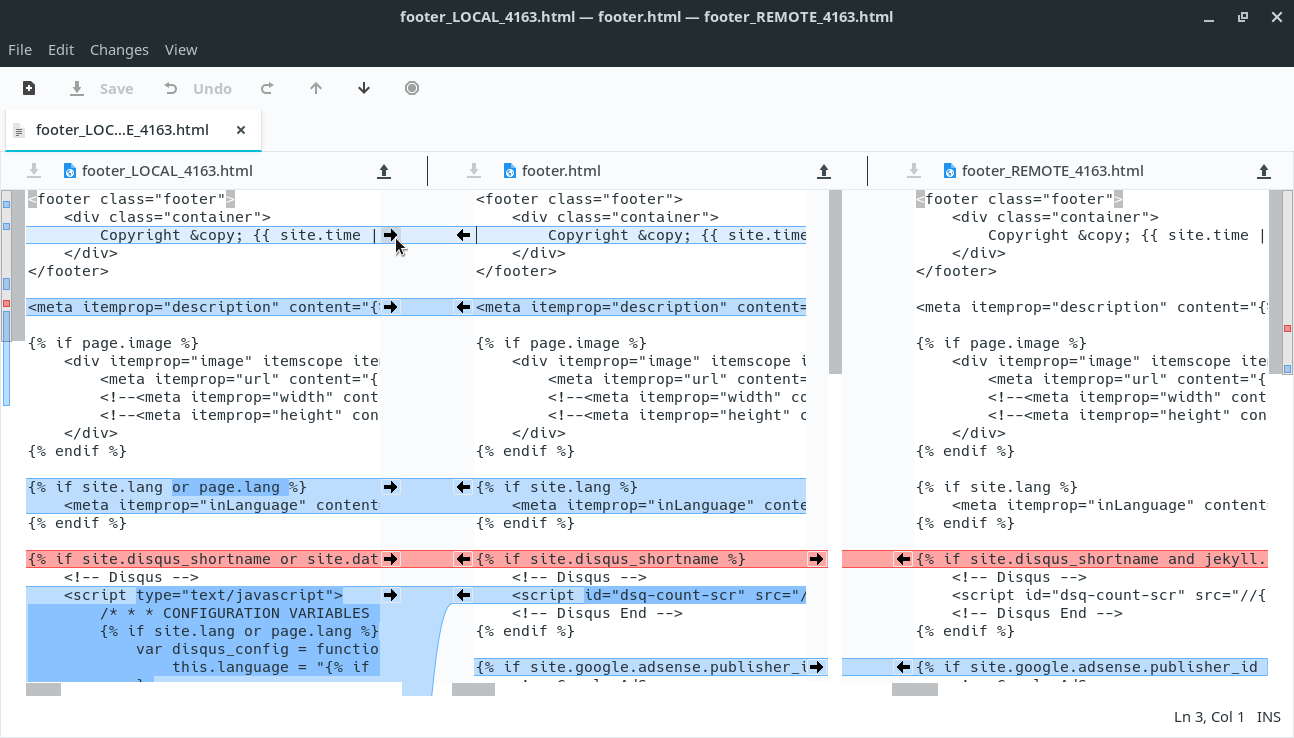
What you really need is the ability to diff the base and "ours" or "theirs". I've found most different UIs can't do this. VSCode can, but it's difficult to get to.
I haven't tried p4merge though - if it can do that I'm sold!
Not the easiest to access but better than copying/pasting (which is what I also used to do).
    [mergetool "meld"]
        cmd = meld "$LOCAL" "$MERGED" "$REMOTE" --output "$MERGED"
        #cmd = meld "$LOCAL" "$BASE" "$REMOTE" --output "$MERGED"
For some reason, when it comes to this subject, most people don't think about the problem as much as they think they've thought about it.
I recently listened to an episode on a well-liked and respected podcast featuring a guest there to talk about version control systems—including their own new one they were there to promote—and what factors make their industry different from other subfields of software development, and why a new approach to version control was needed. They came across as thoughtful but exasperated with the status quo and brought up issues worthy of consideration while mostly sticking to high-level claims. But after something like a half hour or 45 minutes into the episode, as they were preparing to descend from the high level and get into the nitty gritty of their new VCS, they made an offhand comment contrasting its abilities with Git's, referencing Git's approach/design wrt how it "stores diffs" between revisions of a file. I was bowled over.
For someone to be in that position and not have done even a cursory amount of research before embarking on a months (years) long project to design, implement, and then go on the talk circuit to present their VCS really highlighted that the familiar strain of NIH is still alive, even in the current era where it's become a norm for people to be downright resistant to writing a couple dozen lines of code themselves if there is no existing package to import from NPM/Cargo/PyPI/whatever that purports to solve the problem.
It seems like you have taken offense to the phrase "stores diffs", but I'm not sure why. I understand how commit snapshots and packfiles work, and the way delta compression works in packfiles might lead me to calling it "storing diffs" in a colloquial setting.
However, context would matter and wasn't provided - without it, we're just guessing.
Yeah, I'm not sure why it seems that way to you, either.
> the way delta compression works in packfiles might lead me to calling it "storing diffs" in a colloquial setting
We're not discussing some fragment of some historical artifact, one part of a larger manuscript that has been lost or destroyed, with us left at best trying to guess what they meant based on the little that we do have, which amounts to nothing more than the words that you're focusing on here.
Their remarks were situated within a context, and they went on to speak for another hour and a half about the topic. The fullness of that context—which was the basis of my decision to comment—involved that person's very real and very evident overriding familiarity with non-DVCS systems that predate Git and that familiarity being treated as a substitute for being knowledgeable about how Git itself works when discussing it in a conversation about the tradeoffs that different version control systems force you to make.
Perhaps the value of doing it on SCM level is that it can remember what you did. Git has some not-so-nice edge cases.
It's nice to have all the LSP features available too while editing.
This is all good advice, but these days I just ask Claude for solving merge conflicts, and I can't remember it ever going wrong.
Almost all merge conflicts I see in practice are fairly mechanically solved.
Hell, git tools themselves offer a ton of customization, you can have both display and diff command different than the builtin very easily.
Some of Git defaults and command syntax might suck but all of that can be fixed without touching repo format
If you haven’t resolved conflicts then it probably doesn’t compile and of course tests won’t pass, so I don’t see any point in publishing that change? Maybe the commit is useful as a temporary state locally, but that seems of limited use?
Nowadays I’d ask a coding agent to figure out how to rebase a local branch to the latest published version before sending a pull request.
In jj, you just have a descending conflict, and if you edit the past to no longer conflict the conflict disappears; kinda as if you were always in interactive rebase but at all points have the knowledge of what future would look like if you `git rebase --continue`d.
Also really nice for reordering commits which can result in conflicts, but leaves descendants non-conflicting, allowing delaying resolving the conflicts after doing other stuff, or continuing doing some reordering instead of always starting from scratch as with `git rebase -i`.
git config --global merge.conflictstyle diff3
Nearly every time I see a complaint about git, someone comes through with a command like this. Is there a collection of similar tips that makes git better to use? If not, there should be.
Well, isn't that what the CRDT does in its own data structure ?
Also keep in mind that syntactic correctness doesn't mean functional correctness.
There are many ways to instantiate a CRDT, and a trivial one would be "last write wins" over the whole source tree state. LWW is obviously not what you'd want for source version control. It is "correct" per its own definition, but it is not useful.
Anyone saying "CRDTs solve this" without elaborating on the specifics of their CRDT is not saying very much at all.
It's been amazing watching it grow over the last few years.
You can choose to have a workflow where you're never directly editing any commit to "gain back autonomy" of the working copy; and if you really want to, with some scripting, you can even emulate a staging area with a specially-formatted commit below the working copy commit.
You really ought to dive in deeper. jjui makes it all vastly simpler
conflict free merging sounds cool, but doesn't that just mean that that a human review step is replaced by "changes become intervals rather than collections of lines" and "last set of intervals always wins"? seems like it makes sense when the conflicts are resolved instantaneously during live editing but does it still make sense with one shot code merges over long intervals of time? today's systems are "get the patch right" and then "get the merge right"... can automatic intervalization be trusted?
edit: actually really interesting if you think about it. crdts have been proven with character at a time edits and use of the mouse select tool.... these are inherently intervalized (select) or easy (character at a time). how does it work for larger patches can have loads of small edits?
Funny, there was just a post a couple of days ago how this is false.
Are people really merging that often? What is being merged? Doc fixes?
This approach is actually fairly desirable for assets types that cannot be easily merged, like images, sounds, videos, etc. You seldom actually want multiple people working on any one file of those at the same time, as one or the other of their work will either be wasted or have to be re-done.
Developers are quite familiar with Merge Conflicts and the confusing UI that git (and SVN before it, in my experience) gives you about them. The "ours vs theirs" nomenclature which doesn't help, etc. This is something that VCSs can improve on, QED this post.
Vs the scenario you're describing (what I call Logical Conflicts), where two changes touching different parts of the code (so it doesn't emerge as a Merge Conflict) but still breaking each other. Like one change adding a function call in one file but another change changing the API in a different file.
These are painful in a different way, and not something that a simple text-based version control (which is all of the big ones) can even see.
Indeed, CRDTs do not help with Logical Conflicts.
But "bare" is part of the value of Cohen's post, I think. When you want to publicize a paradigm shift, it helps to make it in small, digestible chunks.
The semantic problem with conflicts exists either way. You get a consistent outcome and a slightly better description of the conflict, but in a way that possibly interleaves changes, which I don't think is an improvement at all.
I am completely rebase-pilled. I believe merge commits should be avoided at all costs, every commit should be a fast forward commit, and a unit of work that can be rolled back in isolation. And also all commits should be small. Gitflow is an anti-pattern and should be avoided. Long-running branches are for patch releases, not for feature development.
I don't think this is the future of VCS.
Jujutsu (and Gerrit) solves a real git problem - multiple revisions of a change. That's one that creates pain in git when you have a chain of commits you need to rebase based on feedback.
Merge commits from main into a feature branch are totally fine and easier to do than rebasing. After your feature branch is complete you can do one final main-to-feature-branch merge and then merge the feature branch into main with a squash commit.
When updating any branch from remote, I always do a pull rebase to avoid merge commits from a simple pull. This works well 99.99% of the time since what I have changed vs what the remote has changed is obvious to me.
When I work on a project with a dev branch I treat feature branches as coming off dev instead of main. In this case I merge dev into feature branches, then merge feature branches into dev via a squash commit, and then merge main into dev and dev into main as the final step. This way I have a few merge commits on dev and main but only when there is something like an emergency fix that happens on main.
The problem with always using a rebase is that you have to reconcile conflicts at every commit along the way instead of just the final result. That can be a lot more work for commits that will never actually be used to run the code and can in fact mess up your history. Think of it like this:
1. You create branch foo off main.
2. You make an emergency commit to main called X.
3. You create commits A, B, and C on foo to do your feature work. The feature is now complete.
4. You rebase foo off main and have to resolve the conflict introduced by X happening before A. Let’s say it conflicts with all three of your commits (A, B, and C).
5. You can now merge foo into main with it being a fast forward commit.
Notice that at no point will you want to run the codebase such that it has commits XA or XAB. You only want to run it as XABC. In fact you won’t even test if your code works in the state XA or XAB so there is little point in having those checkpoints. You care about three states: main before any of this happened since it was deployed like that, main + X since it was deployed like that, and main with XABC since you added a feature. git blame is really the only time you will ever possibly look at commits A and B individually and even then the utility of it is so limited it isn’t worth it.
The reality is that if you only want fast forward commits, chances are you are doing very little to go back and extract code out of old versions a of the codebase. You can tell this by asking yourself: “if I deleted all my git history from main and have just the current state + feature branches off it, will anything bad happen to my production system?” If not, you are not really doing most of what git can do (which is a good thing).
Instead, if the feature doesn't work without the full chain of A+B+C, either the code introduced in A+B is orphaned except by tests and C joins it in; or (and preferably for a feature of any significance), A introduces a feature flag which disables it, and a subsequent commit D removes the feature flag, after it is turned on at a time separate to merge and deploy.
Just like you don’t expect someone else’s local codebase to always be in a fully working state since they are actively working on it, why do you expect their working branch to be in a working state?
Whether this is valuable is up to you, but IMO I'd say it's better practice than not. People do dumb things with the history and it's harder to do dumb things if the commits are self-contained. Additionally if a feature branch includes multiple commits + merges I'd much rather they squash that into a single commit (or a couple logical commits) instead of keeping what's likely a mess of a history anyway.
This is in contrast with [Pijul](https://pijul.org) where changes are patches and are commutative -- you can apply an entire set and the result is supposed to be equivalent regardless of the order the patches are applied in. Now _that_ is unit of work" I understand can be applied and undone in "isolation".
Everything else is messy, in my eyes, but perhaps it's orderly to other people. I mean it would be nice if a software system defined with code could be expressed with a set of independent patches where each patch is "atomic" and a feature or a fix etc, to the degree it is possible. With Git, that's a near-impossibility _in the graph_ -- sure you can cherry-pick or rebase a set of commits that belong to a feature (normally on a feature branch), but _why_?
The delta is the important thing. Git is deficient in this respect; it doesn't model a delta. Git hashes identify the tip of a tree.
When you rebase, you ought to be rebasing the change, the unit of work, a thing with an identity separate and independent of where it is based from.
And this is something that the jujutsu / Gerrit model fixes.
You should also be able to roll back a single commit or chain of commits in a crdt pretty easily. It’s the same as the undo problem in collaborative editors - you just apply the inverse of the operation right after the change. And this would work with conflicts - say commits X and Y+Z conflict, and you’re in a conflicting state, you could just roll back commit Y which is the problem, while keeping X and Z. And at no point do you need to resolve the conflict first.
All this requires good tooling. But in general, CRDTs can store a superset of the data stored by git. And as a result, they can do all the same things and some new tricks.
Really though, the problem with merges is not conflicts, it’s when the merged code is wrong but was correct on both sides before the merge. At least a conflict draws your attention.
When I had several large (smart but young) teams merging left and right this would come up and they never checked merged code.
Multiply by x100 for AI slop these days. And I see people merge away when the AI altered tests to suit the broken code.
Yeah. A lot of people are also confused by the twin meanings of the word "conflict". The "C" in CRDT stands for "Conflict (free)", but that really means "failure free". Ie, given any two concurrent operations, there is a well defined "merge" of the two operations. The merge operation can't fail.
The second meaning is "conflict" as in "git commit conflict", where a merge gets marked as requiring human intervention.
Once you define the terms correctly, its possible to write a CRDT-with-commit-conflicts. Just define a "conflict marker" which are sometimes emitted when merging. Then merging can be defined to always succeed, sometimes emitting conflict markers along the way.
> Really though, the problem with merges is not conflicts, it’s when the merged code is wrong but was correct on both sides before the merge.
CRDTs have strictly more information about whats going on than Git does. At worst, we should be able to remake git on top of CRDTs. At best, we can improve the conflict semantics.
That is a worthwhile goal, but remember that code is just a notation for some operation, it's not the operation itself (conducted by a processor). Just like a map is a description of a place, not the place itself. So semantics exists outside of it and you can't solve semantics issue with CRDTs.
As code is formal and structured, version control conflict is a signal, not a nuisance. It may be crude, but it's like a canari in a mine. It lets you know that someone has modified stuff you've worked on in your patch. And then it's up to you to resolve the probable semantics conflicts.
But even if you don't have conflicts, you should check your code after a synchronization as things you rely on may have changed since your last one.
a language aware merge could instead produce
>>>> function foo(){ ... } ===== function bar(){ ... } <<<<<<
The weave approach moves ordering into the data itself. That's the same insight that matters in any system that needs deterministic ordering across independent participants: put the truth in the structure, not in the topology of how it was assembled.
I use gerrit extensively... well it does "solve" that problem, i think its far from an ideal solution. It becomes a mess once you have patches depending on other patches and you have to edit a patch somewhere in the stack, and it very much feels bolted on to git. Don't get me wrong, it works, but i think fresh new ideas on how to solve this problem are still needed.
Is it just lack of tooling, or is there something fundamentally better about line-oriented diffs that I’m missing? For the purpose of this question I’m considering line-oriented as a special case of AST-oriented where the AST is a list of lines (anticipating the response of how not all changes are syntactically meaningful or correct).
Slightly disappointed to see that it is a 470 line python file being touted as "future of version control". Plenty of things are good enough in 470 lines of python, even a merge conflict resolver on top of git - but it looks like it didn't want anything to do with git.
Prototyping is almost free these days, so not sure why we only have the barest of POC here.
To me it sounds like "This is how I imagine the future of X", i.e. a preview of a possible future.
i think that's where version control is going. especially useful with agents and CI
IE if I change something in my data model, that change & context could be surfaced with agentic tooling.
Engineer A intended value = 1
Engineer B intended value = 2
CRDT picks 2
The outcome could be semantically wrong. It doesn't reflect the intent.
I think the primary issue with git and every other version control is the terrible names for everything. pull, push, merge, fast forward, stash, squash, rebase, theirs, ours, origin, upstream and that's just a subset. And the GUI's. They're all very confusing even to engineers who have been doing this for a decade. On top of this, conflict resolution is confusing because you don't have any prior warnings.
It would be incredibly useful if before you were about to edit a file, the version control system would warn you that someone else has made changes to it already or are actively working on it. In large teams, this sort of automation would reduce conflicts, as long as humans agree to not touch the same file. This would also reduce the amount of quality regressions that result from bad conflict resolutions.
Shameless self plug: I am trying to solve both issues with a simpler UI around git that automates some of this and it's free. https://www.satishmaha.com/BetterGit
Bringing me back to my VSS days (and I'd much rather you didn't)
How, or better yet, why would Git warn you about a potential conflict beforehand, when the use case is that everyone has a local clone of the repo and might be driving it towards different directions? You are just supposed to pull commits from someone's local branch or push towards one, hence the wording. The fact that it makes sense to cooperate and work on the same direction, to avoid friction and pain, is just a natural accident that grows from the humans using it, but is not something ingrained in the design of the tool.
We're collectively just using Git for the silliest and simplest subset of its possibilities -a VCS with a central source of truth-, while bearing the burden of complexity that comes with a tool designed for distributed workloads.
They don’t have to.
The crdt library knows that value is in conflict, and it decides what to do about it. Most CRDTs are built for realtime collab editing, where picking an answer is an acceptable choice. But the crdt can instead add conflict marks and make the user decide.
Conflicts are harder for a crdt library to deal with - because you need to keep merging and growing a conflict range. And do that in a way that converges no matter the order of operations you visit. But it’s a very tractable problem - someone’s just gotta figure out the semantics of conflicts in a consistent way and code it up. And put a decent UI on top.
> A CRDT merge always succeeds by definition, so there are no conflicts in the traditional sense — the key insight is that changes should be flagged as conflicting when they touch each other, giving you informative conflict presentation on top of a system which never actually fails. This project works that out.
It has clear contradiction. Crdt always succeed by definition, no conflicts in traditional sense so (rephrasing) conflicting changes are marked as conflicted. Emm, like in any other source control?
In fact, after rereading that intro while writing that answer I start suspect at least smell of an ai writing.
> The code in this project was written artisanally. This README was not.
It’s an awesome weekend project, you can have fun visualizing commits in different ways (I’m experimenting with shaders), and importantly:
This is the way forward. So much software is a wrapper around S3 etc. now is your chance to make your own toolset.
I imagine this appeals more to DIYer types (I use Pulsar IDE lol)
So as long as all updates have been sent to the server from all clients, it will know what “time” each character changed and be able to merge automatically.
Is that it basically?
Anyway, I wanted to suggest a radical idea based on my experience:
Merges are the wrong primitive.
What organizations (whethr centralized or distributed projects) might actually need is:
1) Graph Database - of Streams and Relations
2) Governance per Stream - eg ACLs
A code base should be automatically turned into a graph database (functions calling other functions, accessing configs etc) so we know exactly what affects what.
The concept of what is “too near” each other mentioned in the article is not necessarily what leads to conflicts. Conflicts actually happen due to conflicting graph topology and propagating changes.
People should be able to clone some stream (with permission) and each stream (node in the graph) can be versioned.
Forking should happen into workspaces. Workspaces can be GOVERNED. Publishing some version of a stream just means relating it to your stream. Some people might publish one version, others another.
Rebasing is a first-class primitive, rather than a form of merging. A merge is an extremely privileged operation from a governance point of view, where some actor can just “push” (or “merge”) thousands of commits. The more commits, the more chance of conflicts.
The same problem occurs with CRDTs. I like CRDTs, but reconciling a big netsplit will result in merging strategies that create lots of unintended semantic side effects.
Instead, what if each individual stream was guarded by policies, there was a rate limit of changes, and people / AIs rejected most proposals. But occasionally they allow it with M of N sign offs.
Think of chatgpt chats that are used to modify evolving artifacts. People and bots working together. The artifacts are streams. And yes, this can even be done for codebases. It isnt about how “near” things are in a file. Rather it is about whether there is a conflict on a graph. When I modify a specific function or variable, the system knows all of its callers downstream. This is true for many other things besides coding too. We can also have AI workflows running 24/7 to try out experiments as a swarm in sandboxes, generate tests and commit the results that pass. But ultimately, each organization determines whether they want to rebase their stream relations to the next version of something or not.
That is what I’m building now with https://safebots.ai
PS: if anyone is interested in this kind of stuff, feel free to schedule a calendly meeting w me on that site. I just got started recently, but I’m dogfooding my own setup and using AI swarms which accelerates the work tremendously.
You misunderstand what is being proposed.
Using CRDTs to calculate the results of a merge does not require being allowed to commit the results of that calculation, and doesn't even require that you be able to physically realize the results in the files in your working copy.
.
Consider for example if you want to track and merge scalar values. Maybe file names if you track renames, maybe file properties if you're not just using a text listing (ie .gitattributes) for that, maybe file content hash to decide whether to actually bother running a line-based merge.
One approach is to use what Wikipedia says is called an OR-set[1], with the restriction that a commit can only have a single unique value; if it was previously in the set then it keeps all the same tags, if it wasn't then it gets a new tag.
That restriction is where the necessity of conflict resolution comes in. It doesn't have to be part of the underlying algorithms, just the interface with the outside world.
[1] https://en.wikipedia.org/wiki/Conflict-free_replicated_data_...
Git's merge is already symmetrical for two branches being merged, and that, in and of itself, often leads to problems.
It's completely unclear that extending this to multiple branches would provide any goodness.
I'm a small PR-er so 99% of the time it is Syntax. If if it is semnatic at all often then try trunk based development.
Therefore you could have automerges that conflict in a way that breaks the code.
Example would be define a global constant in file X. One commit removes it. Another commit on another branch makes use of it in file Y.
OTOH where I get merge conflicts in Git it is usually purely syntax issue that could be solved by a slightly cleverer merge algo. CRDT or semantic merge.
Look it up: https://pijul.org
It also makes cherrypicking and rebasing wayyyy easier. You can actually add or remove any set of patches, at any time, on any peer. It's a dramatic model shift -- and is awesome.
https://news.ycombinator.com/item?id=8118817
It’s pretty weird that he has gone back to the same idea without understanding why Git’s approach is better. I would say VCS is largely a solved problem. You can simplify a few things here and there, maybe improve support for binaries and few other things, but that’s almost on the top of existing systems. The foundation is rock solid, so it doesn’t sound very sensible to attempt something from ground up.
And jj was built around rebase being a routine operation, often transparent (cherrypicking being a form of rebasing).
Jujutsi (jj) does that. And it’s git compatible.
I may have been thinking of https://github.com/gritzko/librdx/tree/master/be
Consider the first example in the readme, "Left deletes the entire function [calculate]. Right adds a logging line in the middle". If you store the left operation as "delete function calculate<unique identifier>" and the right operation as "add line ... to function calculate", then it's obvious how to get the intended result (calculate is completely deleted), regardless of how you order these operations.
I personally think of version control's job not as collaborating on the actual files, but as collaborating on the canonical order of (high-level) operations on those files. This is what a branch is; merge/rebase/cherry-pick are ways of updating a branch's operation order, and you fix a conflict by adding new operations on top. (Though I argue rebase makes the most sense in this model: your end goal is to append to the main branch.)
Once you have high-level operations, you can start adding high-level conflict markers like "this operation changed the docs for function foo; flag a conflict on any new calls to foo". Note that you will need to remember some info about operations' original context (not just their eventual order in the main branch) to surface these conflicts.
Having lived through sccs, pvcs, SourceSafe, Clearcase and svn (among others), the introduction of lightweight, sane branching, merging, rebasing etc was a revelation.
Yes, there are still things that an adept could do with some of those other systems that git doesn't make easy. For example we have the holy war between those who demand a git repo has a clean history vs those who would rather a revision control system actually stores revision history and forms a record of what really happened. In Rational ClearCase you would use a different config specification depending on your task to programatically select visibility, and hey presto, you have both views available.
(Not that I would wish ClearCase on my worst enemy these days, those config specs were a language in themselves and the amount of times people would get in trouble with them was a real drag, and that's only one of the myriad downsides.)
Then git came along and did away with so much of that complexity that I imagine there are legions of us who think it's good enough (TM) that version control is more or less a solved problem and nothing irks us enough to seek out alternatives.
I wanted them to demonstrate that they'd thought about it and had some insight rather than give a specific answer. But now it's just "... uh, git, I've only really used git", and you can't blame anyone for that because it's so dominant now. I've updated my question to be about branching strategies but I'm just not as fond of it.
Well, you've inspired me to have a look more into the competition. I don't think git is perfect, I think it's just good enough and it'll take quite a lot to shift people over to something else now we have the whole github network effect. But hey, no harm in looking around :)
For me, jj represents a massive step forward from git in terms of usability, usefulness, and solving problems I actually have.
I think the next step forward for version control would be something that works at a lower level, such as the AST. I'd love to see an exploration of what versioning looks like when we don't have files and directories, and a piece of software is one whole tree that can be edited at any level. Things like LightTable and Dark have tried bits of this, it would be good to see a VCS demo of that sort of thing.
Set git.conflictStyle to zdiff3 and ask Claude to resolve the conflict, or even better, complete the entire rebase for you. A quick diff sanity check against the merge base of the result takes just a few seconds.
> merges never fail
I am not sure what never fail means here.
> Conflicts are informative, not blocking. The merge always produces a result.
What does this even mean? You merge first and review later? And then other contributor just build on top of your main branch as you decided you want to change your selection?
If you want a smarter merge conflict tool, the one I am enthusiastic about today is Mergiraf: https://codeberg.org/mergiraf/mergiraf
1: https://codeinput.com/products/merge-conflicts 2: https://codeinput.com/products/merge-conflicts/demo
I guess I don't understand why not just merge at that point? The point of rebadge is to destroy history...
Not really. Changes should be flagged as conflicting when they conflict semantically, not when they touch the same lines. A rename of a variable shouldn't conflict with a refactor that touches the same lines, and a change that renames a function should conflict with a change that uses the function's old name in a new place. I don't think I would bother switching to a new VCS that didn't provide some kind of semantic understanding like this.
Just a trivial example here:
    lorem ipsum
    <<<<<<< BEGIN MERGE CONFLICT: local copy shown first <<<<<<<<<<<< (line 2)
    dolor sit amet,
    ####### SUGGESTED CONFLICT RESOLUTION follows ###################
    consectetur adipiscing elit
    ||||||| COMMON ANCESTOR content follows ||||||||||||||||||||||||| (line 2)
    ======= MERGED IN content follows =============================== (line 2)
    consectetur adipiscing elit
>>>>>>> END MERGE CONFLICT >>>>>>>>>>>>>>>>>>>>>>>>>>>>>>>>>>>>>>Why aren't AI companies touting "zero-shot"ing huge merge conflicts being resolved by LLMs..
I have tried this. It does’t work.
  - The original 1977 version control system, SCCS, was a CRDT: https://braid.org/meeting-60/sccs-is-a-time-collapse

  - It called its data structure a 'weave"

  - Brahm's old project "Codeville" used a weave for version control

  - But then git blew up in popularity.

  - The project "DARCS" tried to make a robust "theory of patches," and eventually led to the development of Pijul

- Pijul is a VCS that is a CRDT: https://pijul.orgBut nothing in this article is in my top 10. So this doesn’t really do anything for me.
All I really want is support for terabytes scale repo history with super fast, efficient, sparse virtual clones. And ideally a global cache for binary blobs with copy-on-write semantics. Which is another way to say I want support for large binary files, and no GitLFS is not sufficient.
Is there a CLI like git CLI? Have read the readme but didn’t quite get how to use
I guess I can do that with plain commits as well and then rewrite history when I need, but I think having multiple staging levels would be more developer friendly especially in the era of AI coding
I'm no longer waiting for it whereas everything sound awesome : quite no more merge conflict and patches order free.
So sad it's still not production ready.
> Two opaque blobs. You have to mentally reconstruct what actually happened.
Did you not discover what git diff does ? It's clearer than the presented improvement !
Plenty of 3 way merge tools supported by git too, sure, it's external tool but it's adding one tool rather than upending the workflow
> Conflicts are informative, not blocking. The merge always produces a result. Conflicts are surfaced for review when concurrent edits happen “too near” each other, but they never block the merge itself. And because the algorithm tracks what each side did rather than just showing the two outcomes, the conflict presentation is genuinely useful.
Git merge cache (git rerere) is good enough. Only problem is that it isn't shared but that could be possibly done within git format itself if someone really wanted to
Probably true, but it's a shame because there are better ways of storing and processing the data, ways that natively handle binary files, semantics, and large files without falling over.
This is not fiction though. If someone added a param to the functions you’re modifying on your branch, rebasing forces you to resolve that conflict and makes the dependency on that explicit and obvious.
For example: when merging or rebasing it's really important to know what I did myself, vs what someone else did. Yet it has a really opaque left/right or mine/theirs representation which even switches meaning depending on the operation you are doing.
This isn't even a fundamental diff/patch issue it's just that git shrugs and assumes you want to perform some abstract operation on a DAG of things rather than, you know, rebase your code onto that of your colleagues.
Since the weave grows with every line ever written, how do you handle "tombstone" (deleted data) bloat? In a decade-old repo with high churn, does the metadata overhead for a single file eventually make it unmanageable compared to Git’s "forgetful" snapshotting?
This can not be solved with tech, it’s a people problem.
Conflicts between branches is only a symptom of conflicts between people. Some want individual freedom to manage branches in whatever way (and these people are usually very open to other people managing branches in another way), but some people are against this freedom and thinks branches should be managed centrally by an authority (such people usually have a problem working on their own).
> What it is is a proof that CRDT-based version control can handle the hard UX problems and come out with better answers than the tools we’re all using today — and a coherent design for building the real thing.
No such thing is "proven". You have not proven superiority to the state of the art with 400 lines of Python.
The LLM you used to draft this blog post is making your solution out to be far more than it is at this point.
im happy to see new entrants into the space. I think I'm a git beginner+. I know enough to be productive and am no longer fearful of it... and I even train up my coworkers on it and help them out of binds... but I am not an expert by any means and still sometimes resort to radical things to get me through some problem I've put myself into.
Relevant. Loro a lovely CRDT library, explored implementing VCS semantics with CRDTs.
I'm sure there are smarter people than me who could create some hooks to automagically update those references on merge/rebase though. Not sure I would pay a whole LLM each time personally.
This is the most common use case for any compiler or linter
Of significance here because the resolution strategy from merges was deeply at the disagreement between Bram and Linus.
https://web.archive.org/web/20110728005409/http://www.wincen...
Given a large enough amount of data/pain, designing/optimizing to attack specific, known pain points always beats trying to solving a more general problem elegantly. I mean, kudos to whoever decided Zoom clients with shoddy connections should buffer then race back to realtime at 1.x - 2x speed (can't remember exactly how fast it goes-- perhaps it's dynamic?). One could come up with 1000 toy examples of where that breaks (music lesson, drama class, etc.), or just implement it and save a gazillion people gazillion hours of repeating themselves in boring meetings.
Edit: clarification
What counts as advertise vs spam? They seem like nearly identical posts and both projects really exist, separate authors.
Why are random posts marked Dead on this platform? Seems like outright censorship
Can you please elaborate on this? I've seen this argument from others as well, but nobody has ever been able to articulate what that actually looks like and why rebasing branches specifically is to blame.
My perspective: whatever happens to the commit history on your non-`main` branch is your business. I don't care about the specifics until your work is merged into a shared branch that we all understand to be the canonical representation of the software we're working on.
Suppose a file contains a list of unique strings, one by line. A commit on a feature branch adds an element to the list. Later on, the branch is rebased on the main branch and pushed.
But the main branch had added the same element at another position in the list. Since there was a wide gap between the two positions, there was no conflict in Git's rebase. So the commit in the feature branch breaks the unicity constraint of the list.
For someone that pulled the feature branch, the commit seems stupid. But initial commit was fine, and the final (rebased) commit is a lie: nobody created a duplicate item.
You're replying to an LLM-powered comment generator.
These days, I think that all new version control solutions now have to be examined in the light of how well they work with with coding agents.
In that light, the CRDT merging here is interesting, as it allows history preservation in scenarios that would otherwise be destructive. This way, agents can use worktrees with much less hassle as squash, rebase, merge become more straightforward.
If you have a diff that adds a button and a diff that turns existing button blue, the merge of those diffs doesn’t add a button and have all button blue. Because it may not make the new button blue.
Features like “all buttons are blue” are properties of snapshots. Snapshot based revision control, like git, it better for that reason.