A lot of people either forget, or never learned, that Poland was once one of the largest and most influential states in Europe.Yes it was long time ago, but the potential was always there. The real challenge was surviving the consequences of being caught between neighbors whose ideologies gave rise to two of the deadliest systems of the 20th century.
Then it seems our politicians stopped being pragmatic and started bringing up ideological issues more often, which divided the population, while IMO not doing nearly enough to promote further development of the economy.
So now we have a population split on ideological issues, while Poland and Croatia are overtaking us economy-wise. We have had every advantage (geographically at the crossroads of multiple trade routes, sea access, EU funds, hard-working population, didn't turn into a Russia-style oligarchy...) but mostly slept on it.
The EU is based on greedy West European corporations maximizing shareholder value at the expense of their own populations.
The EU is too big and should be reduced to the Western core countries. I wonder how Poland would fare then.
Also I am of not very popular anymore opinions that not distorted trade help both sides of the trade and immigrants really help economy of country that they immigrate into. Including workers.
1. Lack of oligarchy - which in fact was not obvious outcome and little bit of luck on our part and little bit of cultural zeitgeist of 90ties and 00ths. 2. No east-west dithering - PL knew right away to which economic and cultural sphere wanted to belong
I wonder how much the Catholic vs. Orthodox background affected things there
https://en.wikipedia.org/wiki/International_Olympiad_in_Info...
But yeah, it’s just cause they’re cheap and subservient right.
Your point is these countries don’t? What point exactly are you trying to make.
Given how strong Poland used to be in mathematical logic, I can see an alternate history line where WWII does not happen and first computers are developed in Krakow and Lwow.
But computer programming with Polish keywords would indeed be a bit of a hell ;)
I suspect good public education is a symptom, not the cause.
The cause likely is valuing a good education. Culture always wins. You can give people who don't value it a good education and they'll barely benefit.
The drones bit hurts the most. There's a war an hour from our border eating FPVs by the millions, and Poland - sitting on batteries, motors, chips, a generation of engineers - has not stood up a real domestic drone industry. Money is there. Will is there. We just... haven't shipped. That should keep ministers awake.
EVs are worse. Izera is a punchline at this point. Noah literally called the play in 2024 - "don't bet on one champion, run a bunch and let them fight" - and the state did the exact opposite. We picked one horse and it never left the stable.
The Korea idea, on the other hand, Noah might have undersold. Framework agreement is for ~1,000 K2 tanks. By 2030 Poland will field more main battle tanks than Germany, France, the UK and Italy combined.
Rest holds up. "Try all the things" is right - we're just very uneven at the trying. Defense procurement: shipping. Civilian industrial policy: not so much. Software still works the way it always has: quietly, in apartments, mostly without the state in the loop. Which honestly might be a feature.
Why was other comment flagged and dead???
While many in US say "liberal economics" means not interfering with businesses with regulations or anti-trust.
I suppose people have different definitions of "classical liberal", "neo-liberal", etc.
after Brexit - noticed polish engineers didn't want to be in the UK
As a founder, it's a different story though - London is hard to beat from an entrepreneurship and capital access standpoint aside from parts of the CEE with strong ties to to American VC due to diaspora ties.
Edit: can't reply
> dzonga
Completely agree. I've O-1'ed plenty of European and British founders. But London is better than the rest of Europe from a raising perspective, which shows how bad the situation is in the rest of the continent.
[0] - https://www.levels.fyi/t/software-engineer/locations/greater...
[1] - https://www.levels.fyi/t/software-engineer/locations/italy
[2] - https://www.levels.fyi/t/software-engineer/locations/romania
Founder visas are generally suffering from a chicken-and-egg problem, where only a successful company can sponsor anyone
It's easier to raise rounds with better terms in London versus mainland Europe, aside from CEE where diaspora VCs in the US tend to step in to build the ecosystem.
But even then the entire ecosystem pales in comparison to the US.
Sorry, but this is wrong. Cheaper labor is pretty much the only reason for nearshoring from more expensive European countries to places like Spain or Eastern Europe.
A German SWE wants a 9-5. A Czech or Romanian SWE wants to build the next JetBrains or UIPath.
I don't want to hire the former - they're useless and a headache. I want to hire the latter.
It might help to discuss actual ranges instead of "intimate experience" so we can tell if your experience matches reality.
Edit: But as mentioned, the near-shoring resources also were quite substantially less expensive. So you could say we bought cheap and we got cheap.
Edit: can't reply
> Having 10-20% tax rate really helps though to have comparable or better pay rate to western europe with about 50% tax rate
At the employer end, if we offer enough FDI Western European governments do try to match support and subsidies that we could get in CEE.
Additionally, when investing in USD and used to American prices, it's a rounding error.
The drive to the CEE was partially government driven, but is now entirely due to the domestic ecosystem - you aren't going to find talent with the right attitude (business minded and independent) in Western Europe anymore.
having had my run around with London VCs - poor terms, slow moving (btw this is at seed stage) - it's better to bootstrap unless you're in deep tech (which London VCs can help out)
bootstrap and either deal with US VCs once you have numbers to back you up - if you wanna redo & do the VC route.
My last team had two Poles and two Scandinavians (Swedish and Norwegian).
It's been a _very_ long time since I've had a team that didn't have significant Eastern Europeans representation on it.
> [1] - https://www.levels.fyi/t/software-engineer/locations/italy
> [2] - https://www.levels.fyi/t/software-engineer/locations/romania
Both Italy and Romania are at the lower end of salaries though.
Compare to say
Finland https://www.levels.fyi/t/software-engineer/locations/finland (almost twice)
Denmark https://www.levels.fyi/t/software-engineer/locations/denmark (more than twice)
Germany https://www.levels.fyi/t/software-engineer/locations/germany (around twice)
Switzerland https://www.levels.fyi/t/software-engineer/locations/switzer... (more than three times, although this is an outlier)
I'd travelled to Warsaw a few times maybe 20 or so years ago, and you could feel the vibrancy and energy in the air.
The comedian Omid Djalili (a Brit of Iranian descent) had a number of "Polish plumber" skits:
British tradespeople in my experience are duplicitous, lazy, unmotivated, low quality, cocky and expensive.
By the looks of it, Conservative party will never recover from this betrayal and soon followed by Labour who decided to maintain the status quo.
I think the bigger factor is that Polish immigration has effectively ended. We're seeing more Poles returning from abroad than leaving. With the prosperity and stability of Poland, coupled by living in your home culture, immigration is simply not that attractive.
(Traditionally, much of Polish immigration was meant to be temporary. A good number of Poles stayed abroad and assimilated, because immigration tends to be "sticky".)
After 2004, the numbers dropped noticeably.
This feels apt: https://www.tylervigen.com/spurious-correlations
The UK used to be “the dream” when i was a teenager, now it’s the empty shell of what it used to be.
- Access to the EU market
- Cheap labour
- 250 billion in EU subsidies
PS. Ever since the full scale war started I finally learned Cyrillic, and I must say - there is something nice about this alphabet (if you speak a Slavic language, of course). Sadly we don't have an official Cyrillic version of Polish, though, my compatriots would have their brains explode if someone promoted one.
But yes, transliterated Russian doesn’t look quite right- rather cumbersome- and I assume the same would hold true for a Polish Cyrillic.
You have no clue what you are talking about. I wonder why this sort of obnoxious reasoning always comes from Poles and never from Czech people for example.
Yes they do.
> And they are still benefiting from slave labor
Not sure whether that really matters now-a-days for the economy.
> stolen precious metals
One of the cores of industrial and mine centers that made the German Empire thrive during the Belle Epoque, are now owned by Poland.
> Not to mention the Marshall Plan.
Half of Germany, didn't got to get it but where instead paying reparations for whole Germany. Sorry, I'm a bit tired of acting like Germany only got the history of being on the west side of the iron curtain. It got both treatments.
I definitely blame my difficulties with respiratory illnesses on living there as a kid...
All the polish I know that work in IT enjoy handwork as well. They are hard workers.
Going by your history, you clearly have a strong bias for China but adding spyware or putting countries into debt isn't virtuous.
Most than century after Poland gained independence age WW1, you can still see the economical differences from being occupied by Germans and Russians.
Again, that economic difference from last round was due specially to the failure of communism. And don’t forget that the US poured money into west Germany intentionally to show off their system. Look, I get some people don’t like Russia right now, but you can’t judge history through a modern lens; only through the zeitgeist of the time it occurred in.
So to counter my argument about Russian occupation from up to 1914 being irrelevant you bring Polish Kingdom from the times of The Holy Roman Empire?
And I assume that polish literature from 18 hundreds was already deeply prescient anti-soviet? Because the russian occupant in 18 hundreds had exactly same flavours as those during the communism.
Also the German occupation was in many regards as bad as Russian one but they had absolutely different face. But that is not part of the discussion really.
And the fact that russian communist occupation of Poland had been absolutely awful was fully clear in Poland as soon as late 1940s (according to my old family members). In parcitular - some part of my family was ended war in some prisoner / working camps in western europe and had a choice of staying in the west or going back to Poland. How terrible idea to go back it was - became clear in the first few years after stayed so until the end in 1989.
I remember vividly an interview one of the russian soldiers was giving in polish television on the day when Soviet Army was leaving Poland.
"You don't even understand what you're losing. You will soon realize how big of a mistake it is and regret it deeply."
Guess what? We don't.
Adam Mickiewicz, Dziady, 1823 "Nie dziw, że nas tu przeklinają, Wszak to już mija wiek, Jak z Moskwy w Polskę nasyłają Samych łajdaków stek."
Also have you noticed how and why the trade stopped?
Unless Moscow is not part of russia you can't say they weren't occupied by russia.
The Soviets really valued STEM. They also quite valued emancipating women.
Just for context, in the 60s, around 5% of chemistry PhDs in the US were women. In the Soviet Union, it was 40%! [0]
Of course, that doesn't excuse all the other things they did, but the amount of badass female engineers from Eastern Europe I had the honor of working with is a direct result of the pipeline the Soviets built.
[0] https://www.smithsonianmag.com/smart-news/soviet-russia-had-...
In addition to the points of sibling comments, their respective starting posititions were drastically different: West Germany got the marshal plan, which benefitted their economy, the East had to pay reparations to the USSR, which meant whole factories, trains, even railroad tracks, all in all amounting to about a third of industrial capacity, were transferred to the USSR.
An East German state (Saxony) also consistently has the best education system among German states.
https://de.statista.com/statistik/daten/studie/201453/umfrag...
In general, East Germany (economically) mostly only does poorly when compared to West Germany, but not to the rest of Europe ;)
Try telling this to my mother, I'm sure she'll be excited to hear how emancipated she was.
And the transformation to market economy involved at least two periods of suicidal decisions in name of ideology that regressed the economy (by the same person, even)
Anyway the trick to explosive growth as a country is who you trade with and how you count things. We now sell things to Germany instead of USSR, of course there’s “growth.” There’s also some very real growth, quite a bit of it - but I wouldn’t put one bit of care in a “top 20 biggest economies” ranking. NL is one of the biggest food exporters in the world because it sells mediocre tomatoes to Germany instead of selling rice to Brazil and food exports are counted in euros, not calories.
But I don't think our example has an effect on morale and spirit of resistance.
One of the examples:
It boggles the mind that people can look at a country whose average inhabitant meets the objective criteria for being developmentally challenged and wonder why it is an economic basket case.
This is a pretty simple and obvious observation. Have you ever been asked to take a proctored IQ test to help establish the "average IQ" of your own country? Presumably not. So why do people keep getting took by this silly idea that "average IQ per country" is a thing?
What you do see are attempts to synthesize IQ from aggregate economic and educational attainment data. But obviously these are really just proxies for economic development, which then begs the question.
Focusing on his critics is more illuminating and damaging to your presumed position:
Systematic review by Wicherts et al: "In light of all the available IQ data of over 37,000 African testtakers, only the use of unsystematic methods to exclude the vast majority of data could result in a mean IQ close to 70. On the basis of sound methods, the average IQ remains close to 80."
They of course follow it with the conjecture: "Although this mean IQ is clearly lower than 100, we view it as unsurprising in light of the potential of the Flynn effect in Africa (Wicherts, Borsboom, & Dolan, 2010) and common psychometric problems associated with the use of western IQ tests among Africans."
It's always curious how "common psychometric problems associated with the use of western IQ tests among Africans" don't carry over to economics and other things. Wouldn't you expect them to have similar problems with other western "ideas"? Also interesting how Easterners adapted to western IQ tests so well they are better at them than the West.
I'm not getting further into the details here because the easiest-to-understand point here is that there are not in fact programs to generate reliable "average IQ" numbers in different countries. I am struck by the fact that message board nerds from America believe these programs exist, when almost none of us have ever taken an IQ test.
Given a multitude of such values it would even be possible to get back to a precise IQ value.
IQ tests are just factor analysis artifacts. You can dream up 100 questions that you conjecture may have something to do with intelligence and not even know the answers and have 10,000 people answer them. Product of the factor analysis of the answers will yield a normal distribution which you can then center on 100. Calibration can be more complicated than that but you get the point.
The natural circumstances people find themselves in are also just noisy questions.
[0] https://lubimyczytac.pl/ksiazka/5124728/czesc-pracy-o-kultur...
I feel like one uberhard worker has an unhealthy return. But a group of uberhard workers have a healthy return - they compound each others hard work and build a prosperous _environment_.
My wife and I work very hard, as do our colleagues. But together we've built a pretty healthy routine, home, and (for now at least) financial situation. This has enabled us to have kids more easily than most, travel, etc.
The hardest workers /busiest folks I know are farmfolk relatives, and they also have a level of social connection and family connection that I envy all the time. It's mostly from them showing up to help with _everything_.
Behind Germans, or Scandinavians, but ahead of most Mediteraneans.
But yeah, some of the most skilled and passionate engineers I’ve worked with have been from Poland and the surrounding countries like Czechia.
The pension fund is usually not considered a tax formally, but most people I know assume with our demographics and pension system we are just paying for current retirees (and our 'savings' will be impacted by inflation when it becomes impossible to maintain), so practically it's a tax.
Than there is 23% VAT (ofc much less than 23% because both the IT company and the contractor pass it to client and subtract some cost; so only a piece of it affects the contractor; it's a convoluted thing and I don't really know if I should treat it as ~22.9% or 2.3% tax on a contractor and it's client).
I've been building software here for almost 20 years. Started a software house, grew it to ~50 people, sold it, now back to bootstrapping from scratch. The fact that this is a normal sentence to type from a Polish city is, honestly, kind of the whole story.
That "institutional framework" line in the article is doing a lot of heavy lifting. Having run companies through Polish bureaucracy — it's fine. It works. A generation ago that bar was on the floor. Boring is a feature.
Politics aside, the 35-year arc has been quietly extraordinary. European to the bone, with old roots and a real appetite for what's next.
But it's fallacy to think that lots of wealth hasn't further concentrated in cities over the last 50 years. A lot of my family is from upstate NY, and I remember visiting them as a kid and feeling like they were nice places. They have all deteriorated greatly since I was a child. E.g. people always complain about how expensive housing is in the US. Well, there are plenty of cheap places to live in upstate NY - housing costs in a lot of those places have lagged inflation for decades. The problem is nobody really wants to move to Cortland, NY.
The issue looks especially clear when you compare small towns in close proximity to big cities compared to further out. There are lots of vibrant, quaint small towns on Long Island, for example, because they get a ton of money from their proximity to NYC. I often think a lot of the upstate NY towns would look just like the "cute" Long Island towns (e.g. similar architecture and history) if they had an influx of money.
In my experience, these places tend to be where rich people from cities own vacation property or can commute to a city for work. An example in Minnesota is the Brainerd Lakes area, which subsists almost entirely on people from the Twin Cities visiting their lake cabins from May to September. There are some nice small towns and plenty of beautiful homes, but it’s a result of outsiders bringing money in. Next door you have Aitkin County which is poor as hell because it’s basically a swamp/peat bog that has been partially drained for agriculture, 65% of the county is wetlands: https://www.mngeo.state.mn.us/maps/LandUse/lu_aitk.pdf
Most of rural America has been hollowed out to the point where local hospitals are closing. I’m not making any judgements about rural poor people, just that rural areas tend to be poor due to a lack of local economic opportunity.
The hospitals are closing because there arent enough medical schools in the US so there is a doctor shortage and since doctors are highly educated the vast majority of them prefer urban living. Most rural hospitals have to pay around double to convince doctors to work there compared to urban hospitals.
But also you start to notice that definitely a lot of people who left Poland are coming back, and with that skills and new economic opportunities.
- it was kind of inevitable once Poland stopped being oppressed by its neighbors. The USSR, Nazi Germany, the German Empire / Prussia, Austria, Imperial Russia, etc. have basically been dividing the country since the 1780s. Without these restrictions, Poland is a natural leader in its region purely on population alone.
- A general lack of ideological “mind viruses” that seem to plague the western world. Most Poles are pretty straightforward, common sense people. They might have opinions you don’t agree with but it’s not a country of extremists in any direction.
- the general openness to American culture and (over)work ethics. I think Poland probably looks more to America than it does any EU country, although this of course isn’t simple, especially lately. But in general it’s a pretty hardworking, business-open culture. My impression is that it’s much easier to operate a business here than say, Germany, Italy, or France.
- Something I need to read more about, but IIRC Poland dealt with its oligarch problems in a different way than Russia or Ukraine did post-USSR and so doesn’t really have this issue.
I want "kultura zapierdolu" t-shirt now.
I want to stray from the politics too much, but we definitely self-sabotage in canada. It's kind of an immature teenage angst to self-loathe to the point of punishing yourself all the time.
The mind virus actually makes you love the host.
Yeah when Poland banned abortion and declared a number of "LGBT free zones" a lot of Poles I know came here to Czech Republic
Uhh, the Law and Justice party was packing the Polish Constitutional Court, filling the government with party loyalists, and placing restrictions on freedom of speech and assembly only a few years ago. I suppose veering close to a constitutional crisis isn’t ideological per se, but that framing doesn’t seem quite right
I wouldn’t describe PiS and its supporters as a dynamic cultural movement in the way MAGA is.
„Poland is the largest beneficiary of EU funds 2014-2020, with one in four euro going to Poland“
https://www.gov.pl/web/funds-regional-policy/poland-at-the-f...
Update: The comments below this are strange.
I ment: „Poland gets money, Poland transforms it into more money”.
Is Poland more efficient in it than other countries? I do not know. Would Poland have generated less money without it ? Probably? Is an annual investment of the 2-3%of the GDP into a country a lot? I think so?
This is not a "present" given to Poland. This is ensuring a better life for all Europeans.
But the result is inarguably positive. Those countries had only recently become democracies after decades of military dictatorships or otherwise unstable third-world style governments. Today they're the most dynamic economies in the EU in many respects, and their democracies are well established and functioning.
The EU doesn't get nearly enough credit for how it transformed the continent. People have forgotten how nearly all European countries were in a very bad shape after WWII. Fascists had remained in power in Spain and Portugal. Soviets were orchestrating communist takeovers in countries like Italy. It's a small miracle that the liberal democratic economic order won so quickly and decisively.
(The techbros hate it for a different, if related, reason - they aren't nearly as successful at capturing regulators, astroturfing and controlling discourse, and otherwise taking charge of that second entity as they are with the hapless US federal government).
Ofcourse Christ conservatives hate it.
I'd propose a different reason - the techbros disassociate with the EU because if someone want to work in tech that means getting fairly intimate with US culture, companies and markets. There is a reason this conversation is happening on a message board backed by a US company (moderated to US standards, I might add) - the Europeans don't have the ecosystem to sustain something similar.
If Europe were capable of building the ecosystems needed to fielding a large number of competent tech companies then techbros would start turning up there too.
>American alt-right/far-right/MAGA/techbro
Bucketing these all together doesn’t even make sense. A “techbro” has completely different reasons to dislike the EU (regulatory regime unfriendly to tech startups) than some MAGA focused on US competitors.
As someone from the tech industry, I’m disappointed in the EU as it falls further and further behind on innovation. I love the EU though and frequently visit it (which is not something a MAGA would do).
The EU is very turning major capital cities into complete shitholes. My city of youth, Brussels, is now a 3rd world hellhole where religious extremism (and not a christian one) reigns undisputed king and where drug-dealing cartels are running the show.
I fled that city.
> It's a small miracle that the liberal democratic economic order won so quickly and decisively.
We'll see how well the economic order "won" once there won't be enough money to pay for pensions and once islamists are going to take political power. 25% of Brussels is now bearded men and veiled women (and that number was near to 0% when I was a kid: so in my lifetime my native city turn from 0% to 25% muslims): if you think this shall lead to anything else than the "economic order" we're seeing in islamic country, you're a fool.
France is currently importing about 500 000 people per year, mostly from muslim countries, and it's estimated only 10% of these people are ever going to find work.
I find the EU's stance totally myopic and they're destroying the western culture with totally uncontrolled immigration, while handing the keys to the kingdom to religious extremists.
You mention WWII and fascists and communists: we got rid of those. But only to replace those with islamist extremism, which have already taken several cities, like Brussels.
So, no, the war against deadly ideologies ain't done yet and it's way too early to claim victory.
It's also quite thick to claim amazing "dynamic economies" when in USD the EU hasn't seen any grow since the 2008 financial crisis, at the same time where both the US and China skyrocketed. The EU is barely countering inflation and it's doing that at the cost of massive public debt increase.
I don't have the same reading of you at all as to what's happening in the EU.
I see the EU falling into both irrelevancy and islamism (btw islamism is already a major talking point of the next french elections, where two candidates are critizicing the "entrisme islamique" for the subject becomes very hard to ignore).
No growth since 2008 (in USD and inflation adjusted). Hardly any company in the Top 100.
A failure of a continent.
But I’ll clarify that I wrote that Spain, Portugal and Greece specifically have become dynamic economies in the context of the EU. Spain has grown at a consistent 3% for a decade. Of course the far-right argues that it’s the wrong kind of growth because it’s fueled by immigration (backwards-looking political movements prefer zero growth and a shrinking population if it means less people of the color they don’t like).
You are free to personally visit Brussels to see what a shit hole it is.
In what sense are they "dynamic economies"? Their GDP per capita has barely increased at all over the past two decades, they're mired in debt, and haven't produced a single new company that's significant on the global stage.
It was after that US/Russia sponsored this communist takeover of our country that the new puppet governments have thrown the natives into extreme misery until someone from the EU decided to reduce the levels of corruption and misery. We simply swapped one master for another and hasn't been good for our land.
So please don't compare our country to whatever "solutions" brought by the same entities who caused our problems in the first place. We needed almost 50 years to remove socialism from this country and reduce the venezuelan/cuban style poverty forced upon us.
I rather have workers get the money than more corporate welfare.
Some capitalists create enormous value, some destroy it, some are essentially passive recipients of returns generated by others.
Capitalists provide real productive functions like capital allocation, risk-bearing, founding, governance, monitoring, etc.
Capitalists are completely useless when they have no workers, so I don't understand your points outside of "wow capitalists require a lot of workers to exist."
Hence the rush towards LLM systems, the dream of perpetual labor machine is too enticing.
There is also no risks for capitalists, do we live on the same planet where the stated US economic policy isn't to socialize the risks and privatize the gains?
So you argue no capitalists ever lost money? It happens all the time, the risk is real.
They are still getting half of what Belgium is getting and unlike the overwhelming majority of bureaucrats in Brussels Polish farmers actually produce something useful.
https://en.wikipedia.org/wiki/Polish_material_losses_during_...
And don’t forget the Partitions and The Deluge, too.
Crazy how people just like to pretend that wealth acquired before 1950 somehow just appeared there naturally.
Think of it as defense spending
Meh, idk what magic maths they pull, but any other sources I find do not corroborate their graph.
https://www.researchgate.net/publication/352708343/figure/fi...
https://dimiter.eu/Visualizations_files/cee/gdppc_country.pn...
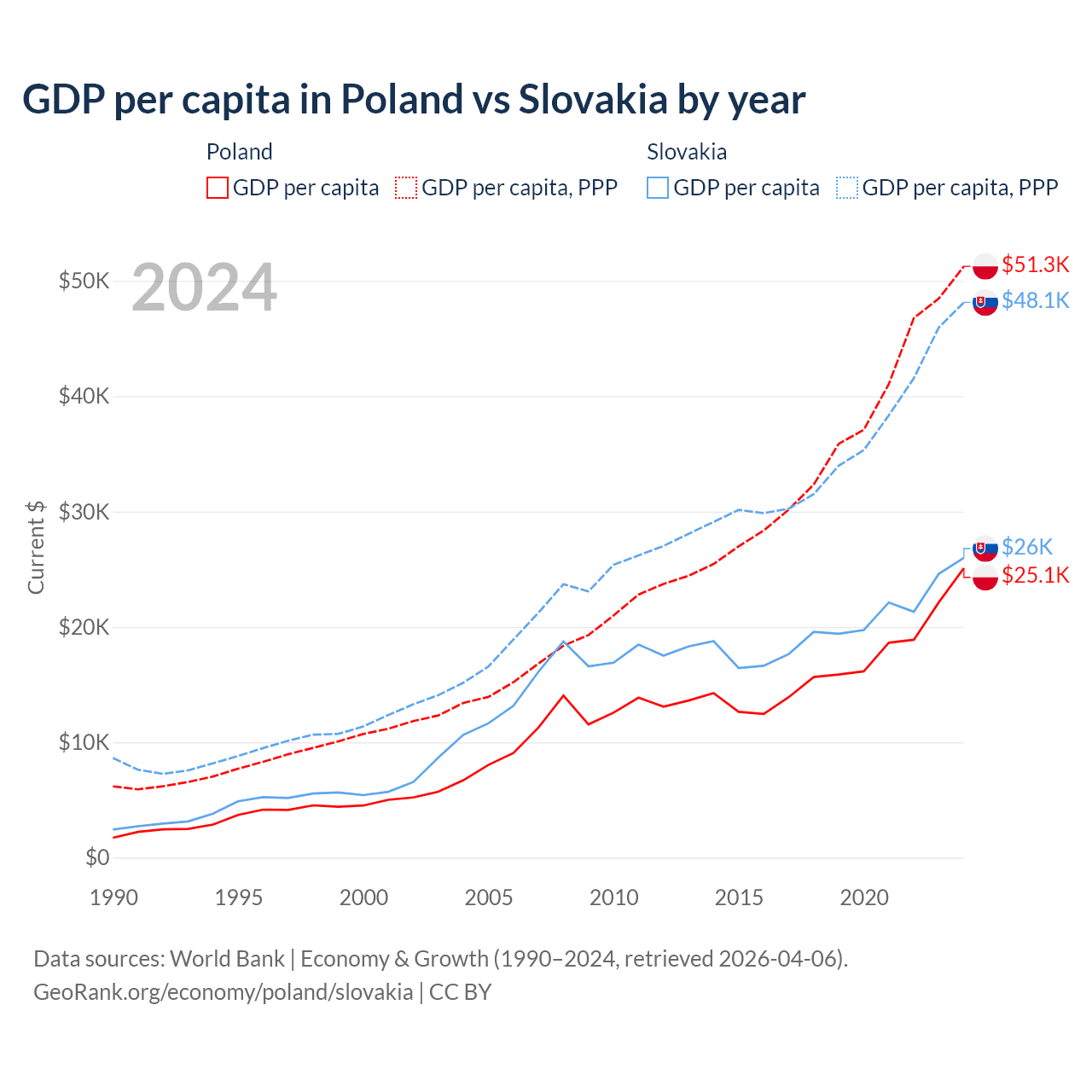
Slovakia and Hungary have trailed % growth compared to Poland, but they are far richer countries now that they were 20 years ago, and the GDP per capita for Poland, Hungary, and Slovakia is quite close to each other[0].
I'm not trying to say Poland didn't do well, it did! I'm just saying the advantages of being in the EU outweigh any national merit by a lot, which should be quite self evident.
[0] GDP, nominal, per capita: 31,336 / 28,430 / 31,242 https://en.wikipedia.org/wiki/List_of_countries_by_GDP_(nomi...
https://georank.org/assets/img/charts/economy/poland/slovaki...
Some moron always show up with the "but it was all the EU subsidies" talking point, which is quite frankly part of racist tropes of eastern Europeans being dumb and worse than westerners. Could you imagine them accomplishing anything on their own? That's ridiculous. It's us, the western saviors, who did this with our penny subsidies!
Ireland were in a similar position for instance (received €40bn in EU subsidies in the first 45 years of membership; now a net contributor).
EDIT: Net contributions seem to be $3bn/year (total, independent of tech) while loss for other EU countries due to corporate tax evasion is $6bn/year.
Of course these countries have 5-10m inhabitants so in term of raw GDP and industrial power they can't compete
https://georank.org/economy/bulgaria/hungary
And yes, my own take why this does happen is that there was certain order to the region in the past centuries - the West was modern and wealthy, the East was backwards and poor and all was in its natural place. This new situation is unfamiliar and needs a sort of explanation that would preserve the balance somehow. In short, they cope.
Another argument: Poland's GDP had already been growing at a similar pace before it joined the EU (but after it got rid of communism).
Also, the reason you've given doesn't explain why it worked so much better for Poland than for Czechia, Slovakia and a few others.
It's hard to see the other paths they could be on tho. One person's failure is another's raging success. It might be a bit like the way we take a peace for granted, because we can't internalize the cost of all the ways it could have been worse.
There are also crowds of young anti-woke Poles claiming that Poland should leave EU because we would be better without it and claiming that EU is puppet of Germany. I've also seen opinions that Israel is a puppet of Poland, aimed at Israelis. If you want to, you will see all opinions you could imagine.
The "logic" of xenophobic nationalism is that narratives are selected for how well they (1) cast "us" as victims, (2) cast some convenient "others" as villains, and (3) fire up "our" feelings of hatred. Neither logic nor truth are particularly desirable - and narratives which are particularly defiant of logic and truth may be a way of virtue signaling within xenophobic national social circles.
On the contrary. Since the EU has no meaningful penalty mechanism other than withholding funds, and enormous capacity for shared damage absorption, once a country passes a certain threshold of development membership in the EU actually encourages government misbehavior including democratic backsliding, because it insulates the government from many potential adverse consequences.
For example, governments around the world have to fear violent revolution. But in the EU, the shared desire for law and order is so strong that the rest of the members are likely to support a member state in repressing such a revolution with essentially any degree of brutality, regardless of the condition of that state’s democracy, because the alternative (a successful coup in an EU member state) is impossible to contemplate.
There is no lesson of "democracy" to give. At best it is a guided democracy, and this is very generous.
For example, VPNs are going to be forbidden, and the free speech compared to the US is a little toy.
Elections are often a facade in many EU countries.
In France for example, it's always the "right" (btw you can be socially or jailed if you support them by using the wrong words) against the existing party, and communists are begging it's better to vote for the existing party, than support the newcomers.
It's a loop, this is why there is this joke that voters are "beavers", because at every elections they are asked "build a dam" against competition.
There is the same beaver thing, over and over again for 30 years.
Even people that are actually elected you have nowhere your word near their decisions (and even less near Von der Leyen and similar people).
Poland understood long time ago that it needs a safe country, and that they need to make sure that the people in their country are fine and safe before helping the whole planet.
Hungary and Poland are a little bit in the same boat, their relative independence saves them (e.g. refusing the EUR currency, refusing some policies) that allows them to have more leeway to support the local people, while benefiting of the funds from the EU and Schengen.
The EU prevents your money from being stolen, except when the EU itself decides to withhold or deduct it. Hungary has lost over a billion euros in ECJ daily fines...
If you push it even further, this is forgetting about the hundreds of billions that are centrally distributed to third-parties (and this is just Ukraine!). So, your money, our decision.
Tight global integration is not a bad thing. Even if we took at face value your argument that a strong domestic market protected Poland in that case, you can't cherry pick the one instance in which lower-than-expected integration was beneficial without also considering all the other times in which it was harmful.
You could get the money but you had to get bureaucracy to be right and transparent to cut down on fraud, and that helped the rest of the govt to have less fraud.
Furthermore, as the GP hints, EU funds earmarked for Poland don't necessarily remain in Poland as investment. Much of that money circulates back into the pockets of contributing countries. You have to look at the entire paper trail to understand where money is actually ending up.
Also worth noting: Poland didn't receive a dime of reparations after the War. Germany (and with later contribution by the Soviets) had unleashed such mind-boggling destruction on Polish cities, towns, cultural inheritance, industry, etc. that only the so-called Swedish Deluge matches or exceeds this devastation.
The EU presents certain clear economic benefits for member countries. Nobody disputes that. But the patronizing and paternalistic narrative of some countries - reminiscent of their goofy rationalizations for their occupation of that region during the 19th century - need to go away.
Poland received virtually all of the lands that were considered Prussia though.
Probably worth more than the EUR 1 trillion fantasy figure that Polish right wingers demand.
The fucking krauts (both the German/Prussian and the Austrian/Hapsburg varieties) can and should toss them a few złoty for economic development as recompense for the horrific treatment they've dealt Poland over the centuries. It would be nice if the Russians would too, but that's not the reality we currently live in.
Times were much better.
It is a tax haven, with one of the highest GDP / person in the world, why is it, by magnitudes, the biggest recipient of EU largesse / person??!
Additionally a lot of the EU's institutions are based there or have offices there, some of which might count as investments as well.
Lastly, everything there is really expensive. So you need to invest a larger amount to achieve the same thing as elsewhere.
I have been to Luxembourg and to Hungary, Bulgaria & Greece - the otherwise obvious contenders for "poorest" in the EU and Luxembourg should not be in the picture.
Next time, please check how many Poles left Poland for western EU since they joined.
[1] https://www.pap.pl/en/news/poland-largest-recipient-eu-funds...
I'm old enough to remember internal borders with passport checks in Europe, before the wall fell and Poland was still on the other side of that. Nice to see them moving on from that.
Thanks to the EU free movement of people, I've now studied, worked and lived in four different countries. I know people all over Europe. I currently live in Germany. Germany benefits a lot from the EU. Yes it costs money. But there's trade, access to skilled labour, etc. as well. And if you look at Poland, it's what sits between Germany and Belarus & Ukraine. So, there's a strategic relevance as well. Poland doing fine is good for everyone else in the EU.
The question is whether growth is objective and fair or whether it is not.
For comparison of wealth in Poland, ALL net-subsidies would have to be deducted, because this is essentially wealth taken from other countries, and distributed to poorer areas in the EU. I am not disputing that this leads to more growth; I am disputing the "country xyz is now rich" while not even mentioning the subsidies. And that reuters article does not mention that at all.
It also has to be mentioned because the crazy bureaucrats in Brussels want to aggressively expand eastwards. They think that the richer areas in the EU need to pay for that expansion. I simply fail to agree with that "logic" at all and I also consider it hugely unfair to richer areas. The richer areas made good decisions; now this is being negated by bureaucrats in Brussels. That is unfair. (This is not meant against Poland, but against the constant expansionistic agenda from Brussels.)
People believe this because every single member state is using EU institutions as a punching bag whenever they have issues locally. The people have no idea how the EU work, they only hear about it when used as a bogeyman
It also ignores the fact that absent the EU, countries would still have a lot of subsidies.
Imperialism and stealing from Jews were also among those "good" decisions. Yes I know it's not all bad, but neither is it all good. It's very reductionist to describe the imbalance like this.
Did you recently crossed borders? On many the checks are there again, because of fear of immigration terrorism or something, so the people could see, politicians were doing something to make them feel safe (but what I could see when passing borders, especially between poland and germany, were looong lines of trucks, so much for free flowing goods).
Not sure of the current situation, though, but last summer and autumn was horrible with checks (probably still better than what was before, but having experienced the real open border situation, having them restricted again is frustrating).
Quick ID check happened once - when I was traveling with bus across border.
Back in a days it was a lot, lot slower and more detailed.
Oh for sure, I have childhood memories of the really dark time, but it is way worse now, than it was back in 2015. I missed flixbus connections because of intense checks and changed vacation plans avoiding long waiting times at borders within EU (my recommendation, cross at night).
Is it only certain countries?
Every country can choose independently, and for each border. From a cursory search, it appears e.g. Poland currently only checks the borders with Germany and Lithuania. You'd have missed any checks on your specific trio, if this list was true at the time:
https://home-affairs.ec.europa.eu/policies/schengen/schengen...
I'm surprised how quickly people have forgotten that North America was a giant open border zone until very recently. You only needed a passport to travel overseas. In hindsight that was actually a pretty unique arrangement.
Pretty different from having a chance to be stopped by a random check while crossing.
This is something I tell people I am generally politically/socially align with (liberals/progressives) when they start talking about “handouts for red states.” California and other areas were not developed on their own, they required years of sustained federal investment and interest in the area.
It obviously goes without saying that conservatives in the US need to stop demonizing taxes so much for the same reason/they need to recognize that as the some of the largest beneficiaries of federal tax dollars they are cutting their nose to spite their face (I believe Kentucky is still the most subsidized state in the US).
All of us should want our states cooperation with the federal government so we can all rise together, and we need to view investing in our neighbors as a collective good.
If they were to ask where you think this "federal investment" funding came from, what would you reply?
Upwards spiral versus downwards. Money pours in for both cases, but only one is really an investment.
If you look at a map of the American South Virginia, North Carolina, South Carolina, and Georgia will just move on. Actually it’s already happening and has been happening for the last 30 years. Other parts of the American South are however, stuck more firmly in the past and getting further behind and that also applies to some of the Midwestern states.
Louisiana has another ongoing long-term problem the gulf of Mexico is eating away at the bottom half of the state lands end is moving further north that involves scientific observations oh boy thems fighting words.
In a similar way, Western Europe benefited from a lot of investment after WW2, while Eastern Europe didn't receive the same investment then.
So the recent investment OP mentioned is just balancing the scales.
Building useful infrastructure, in the can do America of the past worked, the parasitic AI data centers currently, however, appear to be a financial dead end.
That era of America appears to be gone at the Federal level, infrastructure, schools, science, medicine, college, vaccines, voting etc. etc. don’t appear to be on the current menu.
Two of the three are intrinsically tied to the locale. You can't move the National Forests to Manhattan. They closed the military bases in the most expensive areas like California decades ago to save money so they are mostly located in flyover country now.
Social Security actually is a welfare handout but retirees are choosing to move to red states. Unless one is arguing to forcibly prevent retirees from moving to the sunbelt, Social Security dollars will disproportionately flow into those states.
There is no red state "handout".
You can give all the caveats you want but my point is it doesn’t matter what the reason is, these states rail against taxes and the federal government despite leaning heavily on their investment and “donor states” need to see it as a positive for all of us.
Why does it matter if it’s national parks or military bases or whatever? Do you think these states would gladly give it up so they can “liberate themselves from federal intervention” or whatever? Fat chance.
I don't know. I want to agree with you, but a large part of the economic growth in Poland is off-shoring and cheap tax (~12% on contract) for tech workers. The average tech wage there now is pretty similar to the UK, and I don't really see many startups there - probably in part because of how bureaucratic their business system can be. I don't know if this influx of foreign money from off-shoring and surge in real estate pricing is sustainable or good in the long run.
Other than a massive influx of overdevelopment of flats in the cities (sometimes too rushed, I've seen reports of flat blocks subsiding because of cutting corners), I'm not sure where else the increase it.
Because that seems extremely implausible, and actually very insulting to the incredible success of Eastern Europe, before and after joining the EU, in closing the gap to Western Europe over the last 3 decades.
https://ourworldindata.org/grapher/gdp-per-capita-worldbank?...
Whether or not it's offshoring is a little less obvious, but I can't think of more than 2 or 3 successful Polish tech companies.
It is absolutely a huge offshoring target at least for the US.
Anecdotes from your bubble inside one particular industry, that represents a small fraction of the economy of a nation, do not adequately explain the post soviet transformation of economies containing hundreds of millions of people. That's all.
Specifically I asked for evidence that current GDP growth is significantly driven by this specific type of foreign investment, as claimed. None has been forthcoming.
Also some companies are moving their offices from Poland to India now.
Sure, its not ideally distributed, but nowhete is. Such economic success will drag many parts of the country up. Yes, jobs not paid the best will have to commute from further. But compared to where Poland was 2 decades ago (been there many times), its great growth and success.
Plus you guys have correct mentality to by far the biggest threat to Europe - russia. Not so common in eastern Europe, russian-paid politicians are quite successful in some places. But of course Poland has a history with russia to remember so thats luckily not an option.
It is for as long, as the EU exists in its current form. The rise of anti-EU parties in both Poland and Germany makes it a risky investment.
Surveys here have been showing a trend towards greater public support for the EU. Its advocates have been pushing for closer integration and even talking of a referendum on rejoining. Although of course this also has to be viewed cautiously because the polls before the Brexit referendum had also pointed towards remaining and one of the biggest fans of the EU recently has been that unpopular PM who might not be in office for much longer.
Also, for Germany, and I assume, other EU countries, cohesion and economic strength of the EU is the most important value that exists.
* It was pretty sensible EU directive implemented badly by national govt * It was pretty sensible EU directive implemented okay but communicated badly * Outright lie about the problem and the scope of it.
One example: The people complained that "EU will force them to pay to scrap solar panels"
The truth: Some countries added price of recycling into price of the solar panels, some didn't. Those that did had free recycling, those that didn't needed owner to pay a fee when scrapping it. So, naturally, buying solar panel from country with no fee was cheaper and scrapping it in country with fee was free. EU noticed that loophole and forced countries into including the fee in panel cost:
The truth: Poland applied it by just applying fee to panels bought before the rule unification
The lie number 1: EU forced that implementation on Poland. Nothing was forced, that way of "fixing it" (vs eating the cost was what Polish govt chose
The lie number 2: (and I have no idea where it came from) "You will have to scrap your panels made before this date AND pay for it".
Sometimes I suspect most of that is just russian propaganda using anything to undermine EU
One of my favorites was “EU is banning juice”, when the definition of juice was being standardized and local producers of fruit-flavored sugar water couldn’t keep selling their beverages as “juice” anymore.
In reality it was a way to harmonise banana grading, no one was forbidden to sell abnormally shaped bananas, it would just be classed lower than the "Extra" class.
An economic investment as well as one of solidarity. People forget that the EU is a peace project that ensures peace via economic cooperation. This nuance seems trivial but is actually massively important. I can see trust degrading in the US but being fortified across the EU.
Look at Hungary recently, they did a 180 not because of Brussels or Berlin saying they should. Hungarians are sceptical of both. However they do trust the Polish people who they see as genuine peers who are very pro-EU.
While what you’re saying may be true, and this prosperity may be good for all of Europe, I think there is a lot of resentment about who the beneficiaries of the EU structure are.
And it's a good thing, but I wish Eastern European countries would recognize this and become more of a team player instead of shitting on EU.
Poland waited for Trump 2nd term, threatening the take some of the EU territory by force to finally transition from buying US weapons to buying from other European countries.
In the early 20th century Texas for instance was a poor state, a recipient of federal funds, but now it's an economic powerhouse. (To be precise I still think it's a recipient of federal funding but it holds its own now.)
When Western countries got money via the Marshal Plan:
https://en.wikipedia.org/wiki/Marshall_Plan
Poland had... "friendly" Soviets "supporting" their country for almost 44 years...
As someone who has lived in both countries its such a hilarious anxiety.
What's hilarious about it? It seems pretty well-rooted given the actual history of the two areas.
- 1939: Germany invaded in 1939, officially starting World War II.
- 1941: Germany occupied the rest of Poland after attacking the Soviet Union, which had previously occupied Eastern Poland.
- Teutonic Order/Prussia: Throughout the 13th–16th centuries, the Teutonic Order fought numerous wars against Poland.
- Medieval Period: Records show invasions by Margrave Gero (963), Margrave Odo I (972), Emperor Otto II (979), and multiple campaigns by King Heinrich II between 1003 and 1017.
But Germans making huge mistakes out of misguided idealism is still a problem. And given the size and influence of Germany, the rest of the continent has always to process those mistakes as well.
Intergenerational trauma is a real psychological phenomenon.
A „hilarious anxiety” is an incredibly naive world view.
It's unfortunate that 0th order thinking jumps to this framing, it's one reason I always laugh when people talk about SpaceX taking 'government handouts' without these folks realizing the 100x ROI the government got out of their investment. All investments are 'hand outs' but not all 'hand outs' are investments.
Clear thinking at a large enough scale will prevent a populace from self destructing due to stupidity about this topic.
The EU gets huge benefits for that investment, the CEO of GM gets a multi-milion dollar pay packet.
At least Poland does it legally.
The lion share of this budget has been defrauded, fraud is only slightly less widespread than in Hungary. Piles of (only) documentation are produced by professionals then funds are funnelled to the families of local authorities. Honestly I'm confused, maybe that's indeed how EU funds are suppoused to work?
It's not trivial that this works. In Hungary we messed this up big time, hopefully it can get fixed now.
Even without funds distributing EU cash, a common market works as a leveller this way and pulls up the poorer countries, because if you can live work and operate anywhere, people naturally pick the cheapest and easiest places to start a business serving the EU.
Spain and Portugal were the previous beneficiaries and everyone benefits really as jobs are created everywhere.
This is far better than a situation where larger economies dominate all others forever.
Would you say that The US and Mexico should be forced to implement free movement of people, goods, services and industry with a new North American Union capital in Mexico city?
If not, what is the difference?
Mind you that Polish workers are the next in line to be screwed if Ukraine joins the EU.
So when German workers got screwed when Poland joined EU it was fine, but Poland is where you draw the line?
If it was the EU contributions that were the dominant force here, Germany could… simply do the same and prop up its own struggling economy with money printed by the ECB. Instead, it prefers to see it crumble under an obese welfare state that largely funds inactive third-world fake asylum seekers. So clearly, there’s way more nuance to economic success than simply having funds redirected from one account to another.
If you talk about asylum seekers (which may be a valid point), notice also that German social security institutions are filled to the brim with Eastern European claimants.
Utterly false: nationals of Poland, Romania, Bulgaria, Czechia, Slovakia, Hungary, Estonia, Latvia and Lithuania account for approximately 4.9% of all SGB-II Leistungsberechtigte (~256,000 of 5.24 million as of December 2025).
> The Marshall plan also did not involve the US having completely free access to Germany economically and move all their companies to Germany for cheaper wages.
This is such a bizarre point. The openness of the common market goes both ways, you do realise that, right? For more than the first decade after the accession of the Central Eastern European countries to the EU, Western European countries saw an influx of workers that were well educated (or skilled in trade professions), which helped fill the gaps in their labour market. So if you were going to try to draw an analogy here, you’d also have to point out that the US didn’t import millions of Germans after the war into its own labour market. Well, barring some rocket scientists who had built weapons of mass destruction and death for Hitler.
Anyway, yes, that’s how the common market works: companies can move operations to countries where labour is cheaper (in Poland), but other companies have encouraged labour to move where they already operate (in Germany). And what’s forgotten in this discussion is that the cohesion subsidies are in fact a form of compensation for the inherent imbalance that a pure common market would exhibit. That’s why it took years in negotiations for those poorer countries to decide under what terms they’re actually willing to open up their markets, and in many cases it’s been a very controversial issue.
You are by the way underestimating the credit that the Marshall Plan gets in Germany. It is taught in schools and not commonly denied.
The comments are questioning what you wrote, which implies without evidence, that a small amount of EU money relative to Poland's own GDP, in just 6 years, is somehow entirely responsible for Poland's growth.
> I ment: „Poland gets money, Poland transforms it into more money”.
I have noticed that absolutely every time Poland's success is mentioned, someone from EU steps in to downplay it. A self-serving bias. Seriously, that type of comment is absolutely everywhere. Any YouTube video. Any Reddit post. In last couple days I have seen it about dozen times, last time today here: https://www.reddit.com/r/ArchitecturalRevival/comments/1t6k7...
And each time it's some unsubstantiated remark, not once do those people actually bother to check what the actual amount of subsidies did Poland receive over the past 22 years, or how does Poland fare against other EU members. They always imply that ALL THIS SUCCESS is thanks to EU.
For the record: Poland received in total about as much as its yearly budget is in 2026. Other recent EU members also received more-less the same or, per-capita, much more! Did you bother to see how other EU countries developed in that time?
Growth-wise, since 1990, Poland's economy grew substantially each year (even before joining the EU in 2004) and is only behind China: https://pbs.twimg.com/media/F5Z8u1mWMAAHtUU?format=png&name=...
Seriously, look at that damn map. Find other EU members on that list.
Ergo, Poland must be doing something EXCEPTIONAL if its combined growth FAR SURPASSES not only any other recent EU members but ALL BUT ONE country worldwide? It can't just be that relatively small amount of the EU money, or the EU membership itself, can it?
So, for f*ks say, how about western EU shuts up and acknowledges IT'S NOT ALL THANKS TO THE EU, will it?
I am personally a big fan of the EU, but those downplaying comments are so annoying I can't but think it's some sort of jealousy. Credit where credit is due to POLES themselves.
You could just as well claim the growth is thanks to NATO membership because, if you look at Ukraine and Belaraus, it's quite plausible as well.
Eh, as an American I've spent many hours reading Europeans railing against the United States here on HN.
Not once has a European ever given the US credit for the Marshall Plan.
I actually look forward to seeing the EU become the global hegemon so they can learn about how much "fun" it is. The US can sit in the stands eating popcorn just like Switzerland.
I don't think quantum computing currently is able to help in the AI industry, I don't think this is having any impact.
WIG20 is essentially 5 banks, 3 energy providers, clothing, small shops + Allegro + CD Projekt Red. I don't think any of this has major world impact.
They have all the fundamental human-capital strengths of economies like Germany. It's really no surprise they're doing so well.
Sensible smart people working hard will get a lot done over time.
For what it's worth Poland is the only place I've ever visited where felt I could easily see myself living there. It doesn't surprise me that a lot of Poles are moving back.
There is a while set of jobs in Pharma that got moved to Warsaw and no longer available in NL/DE.
But Poland did well capturing them and then growing new businesses locally, so now there's local brands and such that are expanding abroad on their own.
In that sense, the Poles have been seduced by consumerism.
It also used to be that having a large family was a source of honor. Today, it makes people uncomfortable. They may even take a condescending view of those with many children. People have formed a strange association between having many children and poverty.
What you find is that the highest fertility in the developed consumerist world tends toward the poor and the rich. It's the middle class that has the fewest children. This makes sense through the lens of consumerism: the consumption of the rich is not constrained by having more children, while the poor can't consume all that much anyway, so having more children doesn't really change their buying power meaningfully where conspicuous consumption is concerned. It is the middle class (especially the upper middle class) that is anxiously keeping up with the Joneses and engaged in aggressive and petty consumerist competition. They have just enough to consume conspicuously, but not enough that they don't need to prioritize their spending. Consumerism simply prioritizes conspicuous consumption to the detriment of fecundity.
I bet a lot of people here criticizing that EU funding went to Poland are typically Right Leaning, and think they are making a some killer point about socialism, when back home they are also taking in the hand out money.
If you have a lot of farmland in a red state and the profits are reported in a blue state, then counting the reported profits on the corporate balance sheet will give a distorted picture of what is happening.
Look at e.g. General Mills, based in a blue state, but a great deal of what they buy are ag inputs from red states.
But wouldn't the farm, selling to the big corp, realize the profits in their own state? Or are you saying the farms are owned by General Mills?
I was under the impression that most of the farms are owned separately and sell to General Mills.
Are the businesses from who they buy ag inputs in the red states not compensated at market rates for the raw materials they provide?
Do the red states also not receive massive taxpayer funded farm subsidies for the corn and wheat they grow from the federal government?
Minnesota's GDP is higher because it has a larger population and a more diverse and greater value-added economy than it's its ag focused neighbors.
It's GDP per capita is actually lower than its very sparsely populated neighbor, North Dakota, but the economic power of a jurisdiction ultimately comes from its population*productivity.
It’s hard to believe those type of people actually wanted to replace it with non European immigration, though (which is what happened). Of course cause and effect is a complex concept to wrap ones head around..
The right to vote on fundamental societal issues should come with some sort of mental means testing. I'm only half-kidding. I think.
Not for any particular dislike, I wish that the actual brits actually take back the power from the scum government and fix it, just a sight of relief that their mess could be whole EU mess if Brexit didn't happen
I think they're doing everything right and for their people
Have yet to visit. but even by just 2018 or 2019 I only would have jokes and a confused face if someone was telling me they had chosen a job or life in Warsaw as opposed to a bustling city in a Western European country. Now, I think I get it. Modern and cosmopolitan veneer, safety, opportunity, educated population, nationalist pride that isn't delusional, a sensical immigration policy being enforced before enforcing it becomes a human rights problem. I like it.
What the US and most other western countries do are: Let infrastructure rot, defund education, reroute money to large corporations. This is how you end up with failed state.
I’ve never seen it, I travel a lot.
Instituations haven't been renewed, education hasn't been brought up to reflect the latest reality of life and digitalization of state workflows? Hah, no.
But if a fraudulent bank requires saving? Sure, 500 billions or more can be paid upfront. Multiple times if necessary.
(Yes, exceptions for Iceland, Ireland, Cyprus, and a few others)
Start with education spending per capita.
Inflation-adjusted funding per student rose from $14,969 to $20,322 over the past two decades.
K-12 funding rose $1,610 per student in real terms between 2020 and 2023 alone.
"Schools in the United States spend an average of $20,387 per pupil, which is the 3rd highest amount per pupil (after adjusting to local currency values) among the 40 other developed nations in the Organisation for Economic Co-operation and Development (OECD)."
Because it suits their prejudice.
People have already addressed this falsehood.
As I hinted at in another comment, more money for education doesn't help if the culture doesn't value it. And largely, US culture does not value a good education.[2] Or more precisely, not possessing what many other countries consider "basic skills" is quite acceptable here.
Case in point: I've spent time in a poor country with terrible education. Over there, if you were slow doing arithmetic on paper (multiplication, division, etc), everyone considered you to be an idiot. Because of that, even mediocre students who merely graduated high school and didn't go to college have those skills.
Over here, you have Verizon Math.[1] After that crazy episode, I've seen this problem. And it's not just that interchanging dollars and cents is a custom, a lot of people genuinely don't understand the issue. I've been to yard sales where things are advertised as 0.25 cents, and asked them about it. I was expecting a response like "Yeah, yeah, it's sloppy but everyone knows what it means." Instead I got genuine confusion.
Verizon Math isn't an isolated quirk. If you come from any of these countries to the US, much of the US population will appear to be idiots to you (rightly or wrongly).
In one of my jobs, we had a bunch of Russian and other East European coworkers. They were appalled by all of this and started working on after-school tutoring activities for their kids. Because they came from a culture that viewed a lack of certain skills as "being idiots", they were really concerned that their kids would grow up to become idiots like the rest of the Americans.
My point isn't that one should know basic arithmetic. There are plenty of legitimate arguments to say it's OK not to.
What my point is that there is no baseline knowledge level in the US where being below it is socially problematic. Because of that, there is no peer pressure to retain the knowledge they learn in school. It's OK not to know how many days are in a year.
I used to tutor 3-5th grade students, and after I realized this, I gave up. The kids didn't need help understanding the material. They already did. They just didn't see a need to retain it. If their friends don't value the knowledge, and their parents don't value the knowledge, there's little I can do to help them.
[1] https://verizonmath.blogspot.com/
[2] The good education is there for the few who value it. But the rest of the population doesn't benefit from it.
For example, for the US to have a chance in the EU, it would first need to fix its YOLO fiscal policy of sustained 5.5% debt/gdp deficits.
We shall see in a few years as US's debt balloons and the average American becomes pseudo-slaves from a few overlords... to see if the EU is really bad as some Americans believe it to be.
However had, it also is still a net EU subsidized country:
https://www.statista.com/chart/18794/net-contributors-to-eu-...
In fact, Poland gets the most money. So, before we can evaluate the net worth, this number would have to be deducted, which would instantly make Poland drop more than 5 ranks in that chart if you look at it. Just compare the numbers for yourself, the calculation is trivial to do.
Here is total GDP per country:
https://en.wikipedia.org/wiki/List_of_countries_by_GDP_(nomi...
(You have to compare the same year of course; my calculation above is for the year 2024. Poland is now ranked higher than in 2024, but the net subsidies still are given in. Those "Poland is now rich" never take that into account.)
1. Hard working people
2. Biggest recipient of EU subsidies used for projects which generates more profit. Infrastructure, internet, etc. To compare, Czechia used it for stupid things like bicycle lanes, child playgrounds etc.
3. Building permit is very easy to get for basically anything. Yes, this way you can sometimes get chaotic new buildings, but this can be solved later. In comparison, in Czechia, obtaining a building permit is difficult and depends on the whim of the official. Also we have basically non-existent property taxes, so new homes are unaffordable for everybody and only used as an investment.
4. Not allowing imigration from countries where people don't want to work and with hugely different religions and customs. This worked for Czechia too though, our biggest immigrants are Ukranians which are also slavs and very hard working. Official statistics is, that they paid in taxes more than they got from social support.
Without the full picture, these don’t seem like stupid things at all. What makes it stupid for them to invest in these things?
Sort-of like the guy who lost his keys in a bush, but is looking for them under a streetlamp b/c there is more light there.
And btw those same countries who make it super hard for, for example Syrians, to gain employment, then made a whole bunch of exceptions for Ukrainians. For example in Germany, Syrians without full command of German were told to attend language schools, but when the Ukrainians arrived they suddenly made exceptions and suddenly in our department we had Ukrainian cleaning crew who spoke neither German nor English.
As far as immigrants though, approximately 100% of them wish to be productive members of society, I agree. You dont go through the effort of emigrating without an entrepreneurial spirit.
Later I bought even nicer motors, meant to provide exceptional control and feedback for tactile/haptic behaviours, and they were from Poland too.
Then I got to work on a robotic arm which contained a bunch of components from Poland. At this point it was clear to me that it wasn’t coincidence.
Finally, I built a drone with my kids and again, the motors are Polish. And they’re excellent.
They went from being a place I would only expect to encounter cultural food items from to a place that entered a high tech supply chain which seems to produce high enough quality components that I see them without seeking them out.
As a Canadian it made me very envious. We should be able to do this. I’ve seen a handful of Canadian motors in my life, and they were all blower motors a long time ago. Our ability to build cutting edge technology seems to be so limited as to be virtually irrelevant in most cases.
It's been a while and I can't recall the other big one. I know some engineers from one of them went on to work for Clone Robotics, which seems to be doing interesting stuff with other types of actuators.
If your banking system is conservative and you don’t have a venture capital backed risk taking infrastructure - it’s systemic issue. It is the same problem with Europe.
I earned ~2–3x more than I do now working for a Canadian company, doing the best work of my career. I'm so unimportant here, they would readily discard me and laugh if I asked for a raise. This is Canada. But, I like this place, the people, and the work. I think it's important work. I'm at a stage where I prefer that over cash.
I don't think many of my peers feel the same. There's a sense that there's no point in working for Canadian companies if you don't have to. On balance they perform worse, pay less, have less interesting opportunities, and work you as hard as any American counterpart would.
So, the reason you can buy motors and robotics components from Poland and not Canada is because Poland has lower costs (i.e. people make less money because the economy is less developed), not because Canada doesn't know how to make them.
Again, I'm not saying this is a good or bad thing, and I think we've certainly started to see problems as the manufacturing know-how of advanced countries deteriorates as they outsource much of their manufacturing to lower cost locales. But having an economy with a lower percentage of economic activity from manufacturing isn't some sort of failure, as it just means that economy has moved into more profitable activities.
Folks seem to be trying like heck to minimize the services jobs though with AI, etc. Maybe countries should retain a healthy mix of these jobs.
I hear you, and I partially agree. What I worry is that this made more sense ten or twenty years ago, though.
Living in Canada for 40 years, I'm no longer confident that we can continue using economic levers to allow ourselves to output less and buy more from poorer countries. We're stagnating, and the numbers are clear and directional.
We are not a very productive country compared to a younger version of ourselves, and our productivity only falls. Our most recent GDP increases belie population increases that outstripped wealth creation, leading to decreases in GDP per capita. We're growing and yet doing less.
At this rate we will need to be more resourceful, and our relative wages will continue to fall. We should be prepared and capable in all manners of wealth creation, industrial and otherwise.
Our government has stated it will do things like focus on tax competitiveness, internal trade barriers, and AI investment. To me this is depressing as hell. It's nowhere near the fighting spirit we need to make real progress. And frankly, what is AI investment? What the hell is Canada going to do with AI? We have some decent schools and interesting companies, but our government has no business speaking about the matter as an economic opportunity. We may lead the G7 in terms of research outputs here, but our spending plans on AI-related infrastructure and policy are a rounding error on singular US tech firms' balance sheets. We need to be serious. The gap between rhetoric and realistic outcomes is so absurd as to seem irresponsible.
Canadians are getting poorer quickly and at this rate we will eventually have those lower costs, but no trajectory leading us to developing better industrial and high tech manufacturing. We should have been finding ways to leverage our higher cost labour force for advanced manufacturing 20–30 years ago. Now we will have to leverage our middle-cost labour for barely-competitive products in industries with far more competition.
So I agree completely 15–25 years ago, but today I believe Canada's not doing so well, those costs will collapse, and we're going to wish we got ahead of this.
What part of the economic food chain are government employees?
> Most Canadian employment growth is now reliant on the public sector. Public sector employment climbed 0.9% (+41k jobs) to 4.45 million in July. Annual growth shows 4.8% (+205k) jobs added, a rate 8x greater than private sector growth. Canada’s now so dependent on public sector growth that government workers represent 1 in 4 employed workers.[1]
[1] https://betterdwelling.com/a-quarter-of-employed-canadians-n...
That would require work. Canadians just want to buy real estate, watch it go up 10x, then sell and retire in Mexico.
The point is that capital holders decided doing risky things isn't worth it, so they invested in unproductive low-risk assets, then the government juiced the immigration rate, said assets rose, capital holders are making off like bandits leaving Canadians behind in a stagnant economy holding the proverbial bag...
The industrial heritage is strong.
Btw great furniture, it’s still in my living room many years after, pretty much still pristine.
The same has been happening in Slovakia; GDP growth per annum very comparable to Poland since 1995.
As a typical example my very German car has many components with "made in <Poland/Slovakia/Hungary>" on the side.
Shocking.
Well done, UK. You really shat the bed and, by the look of it, still are. Diarrhea, possibly.
Oh boy, are you wrong on that...
Strange, that if you are from Norway or Switzerland, you cannot be a migrant anywhere, instead you are always a welcome citizen born afar who did not know it yet.
Racisms and other -isms seem to be a problem, let's hope it gets better, not worse, in Poland and on earth.
Would they probably be doing better or worse if those people had stayed in power? Was that a significant factor in this?
I really enjoyed Warsaw in December, the air seemed fine to me.
https://data.worldbank.org/indicator/NY.GDP.PCAP.CD?location...
https://data.worldbank.org/indicator/NY.GDP.PCAP.CD?location...
It is a story of a country that made a lot of the right decisions along the way. Managed to keep consistent high growth, not a pony trick or boom/bust mode.
Poland should be a role model for many other countries.
Recommend a book: https://www.amazon.com/Europes-Growth-Champion-Insights-Econ...
And Noah's blog post: https://www.noahpinion.blog/p/the-polandmalaysia-model
In what sense? Czechia is richer per capita. Almost all of the former Soviet satellite states in eastern Europe have had largely peaceful (since 1991) sustained economic growth. The exceptions are exactly those countries which continue to have Russian troops occupying portions, namely Belarus, Ukraine, and Moldova.
The protests in Czechoslovakia came later, called the Velvet Revolution, from 17 to 28 November 1989. In June 1990, Czechoslovakia held its first democratic elections, a year after Poland.
Poland paved the way for the whole of central and eastern Europe. The Round Table produced the negotiated-exit template that Hungary built on in its own talks that summer, and that Czechoslovakia, East Germany, and the Baltics drew on as their regimes fell within months.
And it did so from the deepest macroeconomic crisis of any of the satellite states: hyperinflation running into the hundreds of percent by late 1989, an unresolved sovereign default from 1981, and chronic shortages.
Since then Poland has converged fastest of any of them. From a low base it has climbed to the upper-middle of central and eastern Europe by GDP per capita PPP, overtaken Hungary, and is now closing on Czechia and Slovenia.
GDP/capita is often a relatively useless metric in modern times. For instance Ireland has one of the highest GDP/capitas in the world -- around 50% higher than the US. But that's because of economic games with their working as a tax haven to enable corporations to avoid paying taxes to their home countries. It doesn't translate to anything for the average Irishman.
"Often" is the wrong modifier. GDP/capita aligns very closely with material standard of living for the median person. If you look at the GDP/capita growth in India and China since 1990, or South Korea, Singapore, and Taiwan, since 1950, that reflects very real increases in material standards for ordinary people.
There's two, relatively well-understood situations where GDP/capita isn't reflective:
1) Countries where the economy is dominated by resource extraction or tourism 2) Tax havens
But it's pretty easy to tell whether one of these exceptions applies. It doesn't in the case of Poland, which has a broad, diversified economy with a high level of industrial production.
We visit western European countries and it's like WTF it's cheaper here?
The multi-generational spread is wild - my boss remembers being raised in 80's scarcity culture verging on 2-3rd world hunger. But our entry level employees are running around demanding everyone to be up to date with everything they see and hear in these little glowing rectangles. It's like two separate progressions have been superimposed on top of each other.
Poland had a mass solidarity movement rise up in 1980. The USSR didn't decide to send in the military then; they were lucky.
https://en.wikipedia.org/wiki/Soviet_reaction_to_the_Polish_...
There was a lot of unrest in Poland, and general strikes. Martial law was imposed.
If you were an immigrant from Czechslovakia in a refugee camp in Austria at around that time, you'd be learning to speak Polish.
See: https://en.wikipedia.org/wiki/Revolutions_of_1989
Round Table agreement, which paved the way to the partially free elections in 1989 won by the opposition, preceded similar events in other countries by several months including Velvet Revolution in Czechoslovakia and the Fall of Berlin Wall.
The story is told in much more detail in the OP. What do you feel is missing from it?
Maybe all of those hardworking people could have done even better with a different macro strategy?
Signed, Dutchman.
Our greenhouses, factories, trades works, all favorite destinations amongst Polish (season) workers.
It feels like despite overwhelming evidence presented in the own article that communism was bad, they felt they had to say something vaguely nice about communism. But they can’t even keep it going for more than a sentence, because the next sentence says actually education was better after communism.
There are almost no globally competitive Polish companies. The "growth" is branch offices of German and American corporations taking advantage of engineers who'll work for 40% of Berlin rates. Remove the foreign-owned sector and you're looking at a mid-tier economy running on EU structural funds.
It's a great place to live, genuinely. But calling this "Poland's economy" is like calling a McDonald's franchise "your restaurant"
I have family in Poland, they are from smaller villages and they ALWAYS complain about EU and the economy. I wonder if things are similar in large cities.
Must be the proximity to Germany...
That's funny because Poland became dramatically richer after joining the EU, it allowed them access to one of the richest markets on Earth.
I understand that if you're from a smaller village you might also have missed the enormous infrastructure investments (highways, airports, sewage systems, etc.) that have only been possible because of EU money.
Then there's all the foreign companies that you mentioned whose investments have provided jobs directly and indirectly - as a EU member, Poland has become a lot more attractive for foreign investors.
And arguable, Poland carries a much bigger weight in international policies then it used to.
These points are not to say that there's nothing to criticize about the EU. As a matter of fact, there's not shortage of things to criticize. But it's unfair not to see the enormous gains Poland got since joining.
I would go so far as to argue that Poland is one of the biggest success stories of post-1989 Europe.
Ah, the Polish MAGA.
Probably Russian-influenced as well.
Also, people like to complain.
But I only know of them because they bought some successful small companies in my country and shut them down to reduce competition, for which they are universally hated around here.
CD Projekt is listed on the Warsaw Stock Exchange. Is that an American/German/Singaporean/etc company?
are you one of those anti-trade people where the only real ""growth"" doesn't involve foreigners
Yes, for the benefit of their stock markets and at the expense of their own populations.
A rising tide lifts all luxury yachts.
Same issue in all southern and eastern European countries.
And as demand of those cheap engineers go up, salaries rise. It's not just Poland: Go see what happens to engineering salaries in, say, Spain vs Berlin. You find Capgemini opening offices, because the labor is that cheap. New grads making as little as 20k in some regions.
So compared to that, having big tech moving over and paying over local market rates, and expanding enough so salaries end up rising is much better than the alternative: They don't come, there's no money, the engineers emigrate, and the country becomes poorer.
It's basically importing expensive R&D for "free" while helping establish a heavy industrial base (which has also proven very fruitful for South Koreans). I'm sure there are other examples like this. You also get a better trained workforce, and then the import of the technical knowledge later where it is slower to digest but with the ability now to turn that knowledge into working production.
Cursory search shows 1% companies in Poland are foreign enterprises which drive ~40% of output, ~30% of workforce and ~70% of exports. These are companies that will dip if Poland gets too expensive or geopolitics, in the meantime what is Samsung or Hyundai or Huawei of Poland. At end of day, countries need national champions committed to their own midstream industries who end up capturing the rents.
Singapore isn't a "fake rich" country because most of the companies that have settled down there are international businesses, the money is as real as anywhere else, so are the jobs. Always strikes me as a bit atavistic when people talk about companies as if they're owned by a country despite the fact that the value creation and supply chains run through two hundred countries.