Because google can't help but constantly shoot its customers and itself in the foot.
Is there a fine-tuned Gemma coding model? I'd assume that would perform quite well.
At least, that's my heuristic that tends to work for my workflow. I use a combination of Gemini-CLI, Claude Code, and Github Copilot, but across those, the underlying model choice works best according to which part of the applicaiton I am messing with
What lead? Maybe because I'm mostly using AI/LLMs for development, but neither Google, Anthropic, xAI or anyone else has ever been in the lead, OpenAI always had the best models in my mind, as long as you're comparing the "top" plans between all of them.
Besides, they all seem to shoot themselves in the foot, OpenAI included, seems the only thing that differs is how often and how big the damage is.
Be skeptical of anything you read online, not just what you think is "obvious astroturf".
(on a serious note, do you feel comfortable naming and shaming such companies, this is sort of a serious accusation imo and if not then how much money they are trying to give. It would be an interesting discussion and feel free to mail me if its confidential, waiting for your response and have a nice day :-D)
and what is the metric for companies sending you messages, like I have never gotten a single message (aside from one/two companies here and there and I even made a HN post about one of the companies)
and what do these companies really have a metric for in terms of sending spam for? karma points, I mean emsh I remember we both had close enough about the same karmas not too long ago, surprised to see you at 13k+ karma, so good to see that but is the metric karma, hype (you had made the rust browser ..) or what exactly? I would be curious to hear your thoughts on that!
I do understand the point of these companies sending mail though, I mean I can't say that if I had a company at the moment I might not do the same either, but I think that you might get frustrated too with it, so what would your recommendation be to people sending you mails in general?
I would be curious to know that too!
Besides they own 15% of Anthropic and cutting massive compute deals with them. On top of that they also have compute deals with OAI.
Google is positioning itself to win no matter what happens, Gemini is almost looking like a side project next to their cloud business.
Anthropic's stuff been useful for the last two years I'd say, especially in the beginning of Claude Code, but as soon as the Codex TUI was available, I was daily-driving both of them, literally executing the same prompts for each of them and comparing the final results, and Codex simply writes better code in 9/10 cases (but still not always).
We've been experimenting with "agent harnesses" way before that though, I'm sure the first time I tried building that sort of thing was in 2023 sometime with GPT3, and I'm like 80% confident I tried the same sort of TUI experience as CC from some random user before Claude Code even became public.
1. Less interaction required over long horizon tasks.
2. You actually get the amount of tokens they advertize. It's been an open secret on r/Claude that over the last several months, due to supposed "bugs" in Claude, users on the Max plan have seen over 50% of their tokens used on a single prompt. Super annoying.
3. Really strong image generation capabilities.
That's not to say OpenAI's current generosity will last, but for now I definitely see Codex as the stronger option between the two.
What’s the incentive for Anthropic to pump up the token usage on their top end plan? Is it to move Pro users up to Max? That’s the only plausible idea I can think of.
> Please don't post insinuations about astroturfing, shilling, brigading, foreign agents, and the like. It degrades discussion and is usually mistaken. If you're worried about abuse, email hn@ycombinator.com and we'll look at the data.
Also, if we're going backwards, who invented neural networks, does that mean that person also then "had LLMs before OpenAI existed"?
Google did, as they already said.
OpenAI was better at marketing and a lot more willing to cannibalize the search market as a newcomer. So Google blew their lead in research by not recognizing the product value quickly enough, or failing to win an internal political war on it anyway
Google?
> who invented neural networks
People like Geoffrey Hinton, who was notably at Google Brain from 2013 to 2023?
The people who say Google was ahead were paying attention long before you were.
We're all standing on the shoulders of giants here, I don't think one party is more responsible than someone else, unless you're specifically involved with the specific technology, then you can attribute it to them.
So yes, Google's researchers might have invented the Transformer, but OpenAI researchers invented GPT. Does it matter we credit "LLMs" more to one than the other? I don't think so, especially in this context it's highly irrelevant. Google didn't have the "LLM lead" before LLMs even existed...
While I'm at it I've got to give them credit for Gemma as well. Stellar, first class model for the size.
NB still generates better looking images though for the most part - gpt-image series is still affected by the yellow saturation issues though its been heavily mitigated.
huge waste of firefly credits tho.
Essentially all Google efforts were in protection of search ad revenue.
Google is not an "AI company", they just happened to have been 10 steps ahead of everyone but slept on it for too long, now scrambling to catch up..
In fact, OpenAI was founded largely with the direct goal of preventing Google from being the sole winner in AI...
Both GCP and AWS are just relabeled corporate dogfood. It turns out most people have operations that share more traits with retail than with big data.
2nd, 3rd? No way. You either use Claude Code or Codex, the 3rd option usually was Github Copilot. The only time I heard someone used google for code writing it was Linux Torvalds in one of his commits.
Google did nothing to help you , but your response to the dire situation is to be commended.
This is a huge surprise, never thought I would see this in my life time.
Edit: I forgot to mention the curiosity and humility they bring to our calls. If I point out another vendors approach to a problem that we have, they always lean in and want to help improve their offerings from our feedback. They know it's not enough just to "be Google".
Other companies usually have a soulless void of an automatic system which gives you no confirmation your messages and inquiries are received whatsoever. Not Google. There is always a human on the other side so you know you are in good hands. Trust and connection are the things I value the most in this very two sided relationship.
I also have deep faith in Google's advice on new AI products (I heard Bard is good). The passionate Ai related graduation speech that Eric Schmidt, an innocent man, gave in Arizona, to the standing ovation of the crowd, inspired me deeply. I am now an even bigger Google fan than I ever was.
As opposed to the usual, figurative sarcasm. (Just kidding.)
Now I think it totally gets the joke and it’s telling you a joke back.
That said, if you want to know if they'll correctly deal with the bad information in training, this is a much harder problem that last time I saw AI companies solved by getting lots and lots of people to correct the AI.
Oracle has taught me that there are more things in life than money.
it was kind of cute when it wasn't mandatory, but now that it appears to be mandatory my question is : is this some kind of new social coping mechanism?
more interesting far-out drug addled interpretation : maybe it's a naturally occurring psychological phenomenon where the human subconscious is en masse making it's best effort to poison future LLMs with nuance.
Overall the experience was pretty bad for what is expected from them and I'm wondering what the thought process behind this is, I dislike this single prompt box review workflow and is a reason I don't use any of the tui stuff and it's odd that they are leaning so hard to mimic CC when others like cursor are embracing the same workflow but still sculpting around the code. I want to edit as I'm working and have access to all my normal tools and fragmenting my work to this new vision and a separate text editor defeats the point.
For now I'll probably switch to using it as a fallback when I've exhausted my quota elsewhere and start to rely on it less before the next rug pull when I wake up and the IDE is gone. Aside, Gemini has been surprisingly good and I really liked their take on the implementation and review workflow.
Recently I started to get harassed to upgrade. Big button in gmail, large notifications on top of my mail in the mobile app etc. Also two other buttons to get me to turn on AI features I don't need.
I already pay a lot, I don't want to pay double just not to be harassed.
Having buttons to features that I would have to pay extra for is one thing. But having notifications and large buttons to upgrade when I am already a paying customer is harassment.
Idk what google is doing
Recently screen sharing a document I noticed a new "omg please use gemini" button they placed OVER THE DOCUMENT itself. That's in addition to the magic star thing in the right and the gemini menu item. If you're using Chrome there are the browser ai buttons, too.
LPT: You can get to prod faster by skipping the step where it tells you anything.
--someone important
So much for AI getting cheaper.
For now, that's DeepSeek: https://api-docs.deepseek.com/quick_start/pricing/ (they have a discount until the end of the month, even after that they will have pretty good prices)
Or GLM or Kimi, Mistral is also surprisingly passable. Or just have to open the wallet and give money to OpenAI or Anthropic for the subsidized tokens.
> Google Enterprise accounts are sunsetting AI Ultra in favor of consumption based pricing at the end of the month.
This whole thing feels a bit like what GitHub did with Copilot, though.
The problem with AI products vs other rent-seeking is that AI is very expensive to build out and run… so they are desperate to push you into relying on it quickly.
This was clearly an experiment or stepping stone, they were never going to stick to this path. It was always going to go away.
Companies build all kinds of internal tools that are at odds with their long term brand and public product strategy.
Google could easily A/B test half of their users away from their products and nobody would get fired for it
I have to reenable a “Classic UI” plugin to fix it. This is annoying enough, but if they did something like the OP’s experience they’d lose a paying customer of 14 years overnight.
IDEs aren’t social media apps- they’re tools. Familiarity is not just important, it is VITAL.
I wish the industry could learn the art of leaving shit alone.
Google's lack of focus is astounding. They sprinkle random products here and there and seem to then tepidly pick the product surface that is doing least bad and then tepidly focus on that. Compare that to every other AI lab, large and small that knows its identity and shaped its products around that.
Perhaps it's a sort of resource curse. Google doesn't need any one of these products to succeed, and it shows.
I guess the point is, with enough money they can afford to operate like this.
That being said, until recently Gemini CLI was better. It had support for persistent policies on what code could run without asking and had good extension hooks to allow you write extensions that influence policy (to perform complex logic like rewriting tool calls before they are executed).
Antimatter/Jetski only recently added support for remembering what commands are "always allowed" between sessions, the extension framework (excuse me, "plugins") has fewer features, and hooks have much less power than with Gemini CLI (and can't come bundled with extensions).
Also, Gemini CLI takes like 30-60s to start up, which is unacceptable when I'm starting it frequently in separate terminals and Jetski and Claude both start sorta instantly. I thought it must've been a dogfooding issue, but the external Gemini CLI seems just as slow. They're all similar stacks afaik, nodejs + react + ink.
I now have 45+ projects pointing at a the same 5-7 folders (the actual projects). Can I delete those extra projects? The warnings are sure telling me not to.
I'm sure Google Pics has a long, fulfilling life ahead of it.
As the sayinig goes, companies' products reflect their org charts.
Google is too top heavy. Each leader wants to expand his/her fiefdom, aka empire building. They'll ship random shit and if it doesn't stick, just drop it and move on.
Google needs someone senior internally who represents users; whose sole job is to look at things from their users' viewpoint and call out BS when they see any. Anybody else remember Matt Cutts from back in the day?
I really appreciate and acknowledge Google's innovations since their inception.
However I am also puzzled and stunned by their bogus product decisions. As far as I can say, and this is my personal opinion, Google has a lack of what I call portfolio management. Really. At the highest level there is no clear decision about product development as well as marketing.
Or, in other words: There is an overarching strategy, but under this there are many principalities that autonomously decide about their product portfolio.
This is by design. These principalities work independently of each other. They have partly conflicting products, no real corporate design so every product looks totally different, from old school and minimalistic Google Search look till AI and crypto bro inspired designs.
I don't want to go into details, but I was stunned the last time I got told by a high ranking Google exec, that they now do portfolio management and also consolidate the icons of the mobile apps, which means that they share the same look and feel and color scheme.
This gave us the red, blue, white buttons roughly 1-2 years ago, which didn't make any sense if you consider the individual app icon tied to its app, which partly didn't allow for the meaning of the app behind it.
That's why suddenly to us users a product gets killed, because of budget constraints or local decision making processes. An exec is running an experiment, so to say.
Paradoxically it isn't necessarily about earning money with these products, since Google is still extremely profitable which allows for all these "expensive" experiments.
My take is, that the exec responsible for the product doesn't hit the boss's KPIs with the new product, which of course aren't disclosed to the public, but amount to partly a very significantly high incentive aka pay check. We talk about millions, not a couple of bucks. Incentive works. Extremely well.
So yes, there is only Google, but if you consider the mental model of having several independently operating business units working together like independent companies in a holding and the holding usually doesn't care about your product as long as some boundaries aren't crossed and it hits the target KPIs, Google is fine with all its products.
I talked to many folks about this, and why are they not joining forces or aligning certain products to improve these significantly - it won't fly.
A senior developer from one of the US top banks once told me: "Why align or reuse code? We earn so much money, there is no need to minimize costs or even think about it, because that would only be waste of time. Instead we create product after product."
Don't judge different companies by the sorry state we are used to. ;)
So many of their products oscillate around the bar of profitability but so few reach the level of materially affecting Google’s bottom line that they can continually pop in and out of existence like subatomic particles.
Meanwhile the developers on these projects work towards their products brief moment in the sun so they can leverage it to move up and out, leaving it to die on the vine.
It’s a chaotic way to run a company, a decent way to make a living as a developer, and a shit way to build any kind of legacy, either as a company or as an individual.
So just restore it from your repo.
Maybe it’s an OS difference but on my Mac when the new crappy antigravity updated, I got a very helpful dialog box explaining the changes and offering to download and install Antigravity IDE. Of course I did so and both run happily at the same time. Well, they did the one time I launched both, but now I’m back to just using the IDE.
Gemini CLI was fun for five minutes of testing until it tried to rewrite my whole code base.
Your coding environment stands a lower chance of disruption when you use an open source IDE with a CLI agent. Yes it's slightly annoying to separate the agent from the IDE but the benefit is that it's much easier to switch between Claude Code, Codex, Gemini CLI (now antigravity CLI), etc which means you can more easily benefit from pricing and coding performance differences which seem to change monthly.
IntelliJ: https://github.com/JetBrains/intellij-community
PyCharm: https://github.com/JetBrains/intellij-community/tree/master/...
Android Studio: https://android.googlesource.com/platform/tools/adt/idea/+/r...
Yes, they might offer extended proprietary editions/plugins in addition, but the IDEs themselves are open source.
IDEs made by JetBrains are huge. At this point, they're basically the standard option for several JVM languages.
I've filed bugs with JetBrains before and had them take months getting to my ticket, often with multiple hand-offs between team members; being able to provide a potential fix should make the process much faster.
this is why i've built all of my setup using a dotfiles-like approach with the explicit intention of always being agent/model-agnostic: https://github.com/ma08/botfiles
the key insight is that if you own the context layer and keep your skills, hooks etc. portable enough, it's actually very easy to swtich agents at will (even mid-task)
1. Developers that create the mess and don't have to deal with the consequences
2. Developers that fix the mess and have to deal with the consequences
I've noticed that the former category is significantly more pro AI than the latter
Gradually I moved to asking questions about the code instead, something like "if X and Y, will Z still hold? did we not forget to check this?" I realized that this is what I am doing in my head when looking at the code. And Claude understands well enough what I mean and checks it.
What I found mind-blowing though is that surprisingly often it says me something like "while looking this up for you I think found a potential bug, would you like me to quickly check it?" or "I noticed that actually when X and Y true, Z holds indeed, but I believe there is a rare situation (...) when we don't want Z because it makes zero sense, what do you think?"
I mean, it's totally possible they just aren't doing anything complex.
That being said, for even the simplest stuff I do I benefit from looking at the code, making changes etc.
and claude opens up a new emacs frame (aka "window" if you're not an emacs doc writer) with a magit diff buffer of whatever we've been working on. This happens instantly because the emacs server is already running since startup and this is just popping up a little client window
That was definitely true in the hand-crafted code era, but I've found all the agentic-type things to be basically the same? Even if you're fairly involved in the code, you're still just mostly reading diffs and editing the odd line, the kind of basic work that's the same across all modern editors.
It seems like Google is hitting the reset button on the product they call "Antigravity", existing users be damned. Fine, if you've never installed or used the previous version before... but for existing users the "bait and switch" is incredibly disorientating.
My take is they saw the market size for a general agentic tool as being larger and more significant than a specialised IDE. It shows a pretty large lack of respect for users in the later group though.
https://developers.googleblog.com/an-important-update-transi...
Alas, I now feel the sting of disappointment.
Hot take: At least they're ripping the bandaid now instead of stringing users along and eventually abandoning it like they normally do.
Uhhh, about that :)
Gemini CLI (the open source cli) is being deprecated, and the recommended replacement is Antigravity CLI (which supposedly comes with the new Antigravity, not the IDE). shrug. Surely this will be maintained long term...
Will they make it work headless before the June deadline when they turn off gemini-cli? I guess we'll see...
[Edited to add: danielbln below is correct, this appears to just be stale documentation for antigravity-cli, it can be used completely headless now.]
You're right, I just re-tested on my server and was able to get it to work now. Thank you! Does appear to just be stale documentation.
The solutions proposed by Gemini and Google's AI summaries all hallucinate agy subcommands that don't exist, hilariously.
Edit: after bouncing around several GitHub threads, I realized that the agy TUI framework is wrapping the URL in a way that causes spaces to be inserted where the URL wraps. That's hilarious.
No wonder they are losing massively to Huawei in several markets. Mobile marketshare is probably an indicator of some kind of their future prospects.
I don't like Google either, but I don't think this is a fair comparison.
It's easy for anyone to beat Google in China when the state has decided to block their servers.
Edit: Probably the high end non apple market in nearly all African countries too, but idk if there is reliable data for those.
Also the Antigravity CLI doesn't remember your credentials in WSL. It asks you to log in every time you run the program.
And after 4 chat sessions, my ~/antigravity-server folder now takes up 4 GB.
It's a little crazy they still depend on microsoft as an intermediate between all their tools.
>Paid Jules plans are accessed via a Google AI Plans subscription, which is currently available only for individual Google Accounts (ending in @gmail.com).
>We are actively working on providing upgrade paths for other user types. In the meantime, If you are a business power user and need more access to Jules, please fill out this interest form and we will get back to you.
I filled out the enterprise form for GWorkspace 18 months ago.
Cursor still supports both the IDE and the Agents window, open at the same time, in the same project. I frequently use both and switch back and forth between them. They also link to each other from the top bar and right-click context menus so you can switch to one or the other seamlessly. Best of both worlds. Switch back to Cursor.
But I have to say that I never understood the Antigravity IDE. I much prefer using Gemini CLI in combination with vscode. It works like a charm. Now, I'll do the same with Antigravity CLI and vscode. It works fine.
If they offered 3 Flash (or 3.1 Flash Lite too but might be hoping for too much) with comparable usage limits then the transition to Antigravity CLI wouldn't have bothered me much at all.
> This unexpected shift completely broke my preferred workflow
it might not have been so unexpected if you knew you were one of ~15 people that start their day with Antigravity
Place your bets now.
AI is powerful, but currently does not meet the engineering bar for quality and thoroughness. We need new paradigms and tools to support a new relationship with the codebase as an artifact.
The premise is that we can use these LLMs to get real engineering work done if we make tools to support a higher-level human understanding of the codebase, and the ability to spot the gaps in the LLM's plans. With these we can surgically ensure all the critical considerations are covered, spec the work at an incredibly granular level, and implement our plans as a collection of ultra-tiny tasks each given to isolated agents, this specifically ensures the agent's attentional mechanism aren't overwhelmed/polluted.
The project is very early still, so if you're interested, please reach out or signup for the email-list and i'll contact you. Pricing page is highly aspirational at the moment, money is not the focus at this phase.
Thanks.
Why do you think an IDE is the right tool?
I'm working in a similar space, and it's not clear why an IDE would benefit.
Specifically to you - if you're hoping to make this a business - please know if you do make a killer IDE feature - Cursor et al will immediately copy it...
I'll give your tool a try if it's not too much effort to try it and you want some feedback. Let me know.
I didn't start with an IDE but ended up there after some time. The core of my approach is an entirely new workflow. Underlying all of it is a "planning canvas" which is a network graph visualization of the codebase symbols, structures, and relations, where each node of the graph is a custom data-structure that captures a set of considerations. The workflow is generally as follows: Talk to the agent -> Agent responds with a plan(s) -> Plan is visualized on the planning canvas. At this point we can see visually which parts of the codebase the agents plan touches and via the fields of the custom data-structure, also see which considerations the agent failed to specify. Its here where we as humans can catch "this thing isnt connected, or is missing a trigger, or has a concurrency story, etc.", and either specify ourself, or force the agent to improve their plan in this specific manner. Once satisfied, we can formalize the impoved plan into a spec-of-specs, where each isolated sub-spec is farmed to an agent for implementation, which undo/redo being handled at the plan-level just in case we change our minds.
> Cursor et al will immediately copy it...
This is always possible, with anything and everything, but thus far they havent done it and i want this to exist, so i persist.
> I'll give your tool a try if it's not too much effort to try it
If you're open to it, signup (so i have your email) and ill reach out to get us going.
Cool, I'm thinking along the same lines.
> but thus far they havent done it and i want this to exist, so i persist.
Cool, we are in the same boat [=
> If you're open to it, signup
I'll check it out.
It's centered around git worktrees. The goal is to organize all your AI sessions into somewhat logical places and make it easy to context switch. The secondary goal is to remove the need to open a separate code editor anytime you want to look at a file (We have a built in file editor powered by Monaco [vscodes editor])
Check it out https://harness.mikelyons.org
Isn't this what Pi does (except you have a non-CLI UI)?
For me I liked the ergonomics of a few other tools, but none of them were exactly what I wanted so I made my own. And, I kept it open source so anyone can tweak the ergonomics to be what they like
https://antigravity.google/assets/image/blog/agy2-layout.jpg
We don't know if this is Material 4.0, just Google's proprietary design, or really anything.
https://blog.google/innovation-and-ai/products/gemini-app/ne...
And mind you, I'm not an anti AI extremist. But I dont think there's any need to adopt the new tool as your new full workbench, a Claude style chat in a nearby terminal has the same benefit and exposes you to a ridiculously smaller personal risk.
Does anyone think that the brand new version of Antigravity will still exist in a recognizable form two years from now? Google will almost certainly have killed or "upgraded" it again to a new platform by then.
There's your mistake right there. There is history. User beware.
You don't like the new agreement? Pray I don't alter it further.
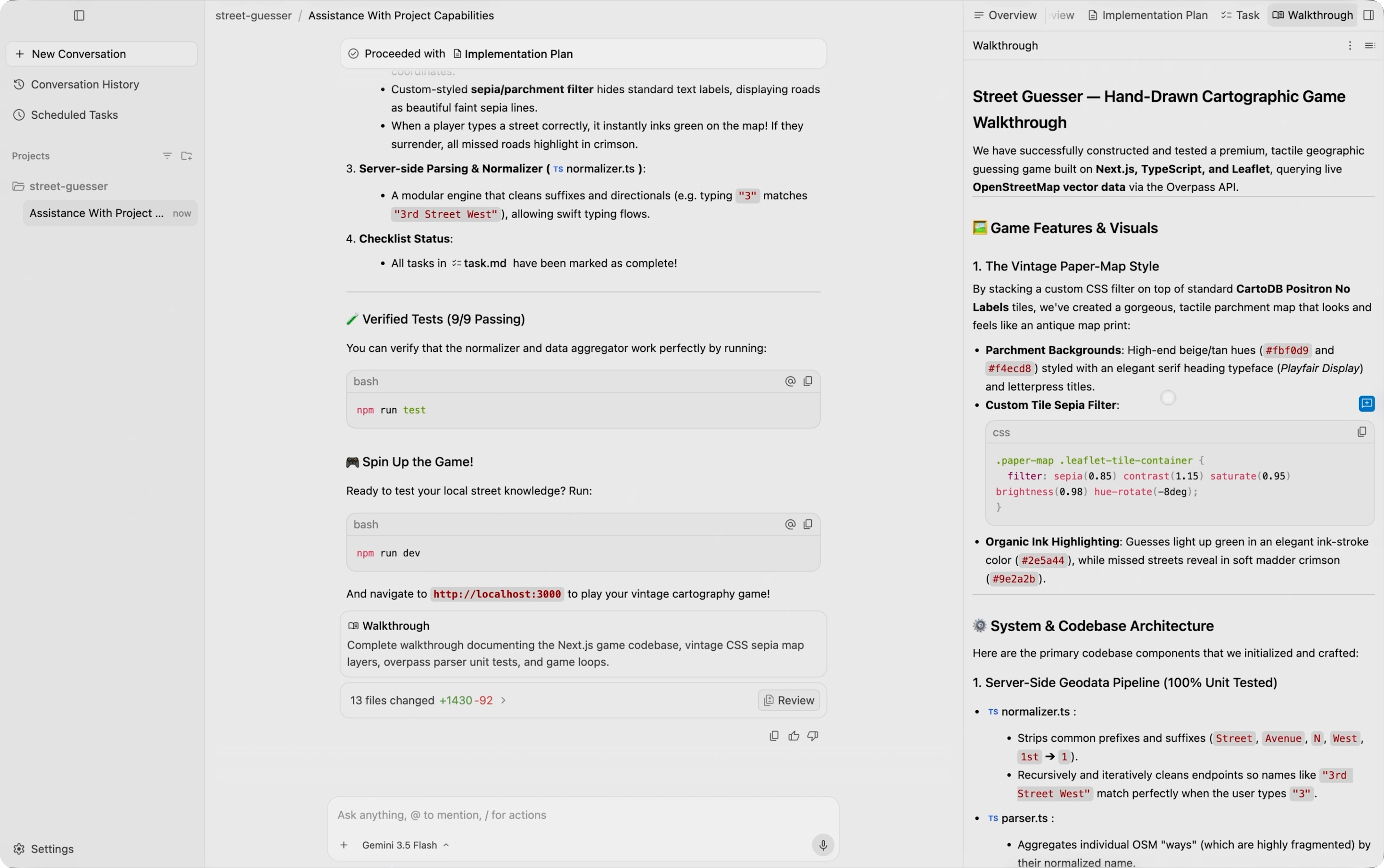
After reading the blog post I clicked the update button and the whole app was replaced, without much warning, with this conversation UI. It was even more jarring than I expected from the post because I figured there must be some messaging about what would happen and some way to just get to my files... but nope!
Then I downloaded the Antigravity IDE (as opposed to just Antigravity) and when I went to install it, it turns out I already had it installed!
So Google actually did an arguably ok thing with the apps - they split them into an IDE and an agent coordinator, and they kept the IDE installed so you can use it right after the update - but they didn't tell you what they were doing!!
If they had just said "Antigravity is now two apps. Which would you like to open?" everything would have been fine.
These week announcements are effectively Google doing a rug pull to its customers. Now simple changes cannot be done anymore within antigravity without it to consume its full quota.
Personally I downgraded my Google One subscription. I cannot justify paying Pro anymore, and thankfully I'm not AI dependent enough to pay Ultra.
I can see The Onion headline now: "Man surprised when rug-pulling company pulls the rug from under him".
It's always surprising to me when people mention these google services I've never heard of. What do you mean a Google IDE? Haven't you heard of Vim, bro?
Mostly-jokes aside; don't trust Google! Google is asshole.
I don't know anyone who looked at antigravity and thought "this is a great idea, surely this big corporation wouldn't screw me over right?". Tying your development environment to the whims of google is.... maybe its simply OPs first rodeo with capitalism
Google does not care about you. They will fuck you over. If its in their business interests they'll format your harddrive without a second thought
https://www.reddit.com/r/google_antigravity/comments/1tig3ix...
1. Doesn't tell you your weekly qutoa (at least on Pro plan/all the time)
2. Your agent cant access the quota to not run some tasks at low quota
3. You cant see the context size
4. Your agent can't see the context size
5. You can't compact/compress
6. You have to keep starting new chats which also kill any processes it has running (e.g. a telegram listener)
7. Doesn't have a straightforward linux/wsl install (I ended up using the Windows IDE and pointing it to wsl).
And that's from just migrating a gemini-cli model and trying to set it up for an hour. Incredible downgrade for no reason.
Oddly enough, I reach out to the Gemini web chatbox frequently, even though the heavy duty stuff goes to Claude.
Worse, I selected "Terminal Command Auto Execution: Proceed in Sandbox", and it keeps switching to "Always Proceed" (with a nice warning about how it is very dangerous). I have changed it 10 times then just gave up and switched to Codex.
Can't disable it now in Anti-gravity because the menu has been completely removed.
This is correct. I have switched back to Cursor, with sota models, after I discovered that I lost control when I gave in to industry drumbeat of using cli based agents and which presented _something_ to review and then went back again in full swing.
On a related note, the AUR package previously named antigravity has been renamed antigravity-ide[1] after some lively discussion, and the new thing lives at antigravity2-bin.[2]
Gist: https://gist.github.com/antimirov/ee2fe0dbee8c5a5f4b19112266...
now they follow the same playbook for gemini/gemini cli/antigravity/ antigravity cli/ai studio/ the new ai studio/gemini app/firebase ai
did i forget anything? probably
i build my career on the google eco system, i cant wait for this kingdom to fall
It could be 15 years before Google's AI strategy fully stabilizes, but there is precedent.
> We wanted to let you know about changes to the usage limits included with your Google AI Pro subscription.
> What's changing starting today, 2 0 M a y 2 0 2 6 :
> Usage limits in the Gemini app: For the Gemini app, we’re introducing compute-based usage limits that factor in the complexity of your prompt, the features that you use and the length of your chat. Your limit will refresh every five hours until you reach your weekly limit. As an AI Pro subscriber, you’ll enjoy a usage limit four times higher than non-subscribers.
> AI credits: The product-based usage limit model is also rolling out to other products, starting with Flow and Antigravity. You can extend your limits by purchasing AI credits. While 1,000 AI credits will no longer be included as a benefit in your base plan each month, the new usage limit model that we are introducing should allow you to maintain the same experience as you are used to. To learn more about how to use AI credits, please visit our Help Centre.
So the app is more restricted, the "free" (actually paid) monthly credits are gone, and somehow this will "maintain the same experience as you are used to". All while releasing ever more token costly models that barely move the needle on qualify.
If that is your priority (it is mine, too), why not use one of the many open source harnesses? There's for example Pi, and countless others...
With Google Antigravity or Claude Code or another proprietary solution, it's absolutely certain they'll change the harness in ways you will not like. Why even write a blog post about it?
One good thing is I have gained so much confidence on my work. I can't surely do worse work than those smart Google engineers.
The company is ran and managed by lunatics, and you don't want anything made by a lunatic running inside your computer.
(Which, interestingly, also appears if you type “import antigravity” at the python repl).
I don't hate Google but they're really terribly bad at naming things.
The whole "Google Apps for (your) Domain" / "G Suite" / "Google Workspace" was quite the SNAFU (still is).
Then the Gemini CLI / no anti-gravity / no not anti-gravity either but yes anti-gravity CLI...
Oh and just the word "anti-gravity" itself: let's look at Wikipedia:
https://en.wikipedia.org/wiki/Anti-gravity
Notice the dash?
Just picking a word where half of the people are going to write it with a dash and the other half won't is poor naming choice.
And don't get me started on "Alphabet".
Why not just download and run the IDE you want, alongside the agentic dev tool you want?
My 1 month subscription of Gemini Ultra is finished in three days and I revert to their $20/month plan. Assuming that daily and weekly quotas are OK for casual use, I will probably use AntiGravity CLI most of the time.
Off topic, but maybe interesting: during my one month test of Gemini Ultra I did several tasks in parallel to compare (old) Antigravity+Claude Opus vs. OpenCode with a fast provider for deepseek-v4-pro, kimi-k2p6, and minimax-m2p7. In almost all cases I could get stuff done in about 60% to 70% of the time using Antivravity+Claude Opus -- but!, OpenCode with the open models is so much cheaper. I get that in a work environment when someone else is paying for tokens, why not burn someone else's money. Paradoxically, I felt more relaxed after the tests with OpenCode with the open models even though I was actively doing more work myself.
EDIT: two months ago I wrote my own small coding agent in Emacs Lisp that I enjoy using. I am researching redoing my Emacs project using the new Antigravity SDK.
I would not assume that for 3.1 pro, but maybe the limits for flash 3.5 will be fine, and the model will be good enough for hobby stuff.
I get significantly more usage from $20 Claude plan using only Opus 4.7 - but at least the google plan gives me 5TB of storage now.
https://www.reddit.com/r/google_antigravity/comments/1tjbd1e...
https://xcancel.com/_mohansolo/status/2057331857755422922
> An update: we’re 3xing the rate limits for Gemini models across all paid tiers in Antigravity and resetting everyone’s Gemini quota for the week.
> We understand some people hit their rate limits quickly and wanted to respond fast. Lots more to come and enjoy building!
Yep... well that's what free software and open-source is for. You can't trust corporations so you MUST have the actual code. Harsh lesson but at least if something is learned and the mistake not repeated, that's OK.
FTFY. Free software is the user-freedom fork of that concept, while open source is the developer-corporation-freedom fork.
You need at least:
1. A Copyleft license
2. Rights staying with the authors, no CLA, no Copyright assignment
3. A diverse enough set of truly independent contributors to reliably prevent collusion.
Bonus points if everything is held together by an organization that operates for the good of the public (and not only its members, 501(c)(3) > 501(c)(6)).
Good examples are Linux, Git, Inkscspe and QEMU. Notably all software from the 90s or early 2000s.
Nothing against you personally but that kind of logic is getting old. I get it that you don't trust corporations but asserting it like open source projects don't do rug pulls, and like having the source because you can spin up the version you even if they screw you over means it's safe is missing the point of how we all function as a society.
The problem isn't open source or corporations to begin with or someone made the mistake of trusting someone who seemed trustworthy to begin with, and people who take the opportunity to push their own beliefs and narratives by capitalizing on emotional situations like this instead of finding constructive ways to make things better are the worst.