It started with a family member telling me they were frustrated with existing websites. What I noticed is that in many cases they feel cluttered and not smooth to use, almost like a 1-to-1 translation of the underlying database queries, where they have you choose filters and sorting options upfront then browse the paginated results.
I wanted to avoid all of that by creating a different experience; I built an interactive full-screen wall UI with infinite browsing so that most of the screen space is dedicated to the core content. I worked on the name sampling algorithm to try to make it as enjoyable to browse as I could, and the only filter displayed by default is the one to select genders.
More advanced queries are available through the search field which supports natural language queries, running on a local multilingual interpretation engine with a cloud LLM fallback. The database engine is custom built with Rust, compiled to WASM for higher performance when running on CloudFlare Workers. I don’t use an external DB service for names today.
What I’m pretty proud of is to know a lot of technical work is hidden behind that UI, and how it has been shaped by the experience I wanted instead of the other way around.
I was curious about formats more efficient for agent communication than JSON and also proving if the framework I curated could handle the load and traffic.
It's been really fun to observe.
If you love catching up on highlights, check https://thepelota.tv/
It’s like Netflix but for soccer highlights, with all the major leagues in one place as soon as they are available on YouTube, all free and no ads.
The idea is to make an extension that allows you to flexibly fill out fields on your cards with AI generated text, speech, and images. Think generating example sentences for your entire deck, or adding furigana to kanji (small phonetic characters with a very delicate syntax). It works just as well for language learners as it does for medical students, etc.
The secondary goal has been to make this the most well designed, intuitive, and stable Anki extension in the world. I don’t think it’s there yet, but it’s on its way. It’s been very interesting to try to work out a design that affords the flexibility to generate anything for whatever you’re studying but remains approachable and discoverable to your marginal Anki user, many of whom are younger and have varying levels of English ability. Many interesting technical challenges as well.
Slowly building towards the Show HN post, but need a few more features. Connecting with and chatting with dedicated users in countries around the world over the last few years has made this the most gratifying thing I’ve ever built! It’s still at the scale that receiving support emails is fun and I can build relationships with power users and long term subscribers.
Really exciting stuff is happening literally every month, because underlying models are getting better and better. When I started it was pretty basic: “make a cube with a hole through it”. Now it’s at the point “make a raspberry pi 4 case” and the agent searches, builds, verifies…
What surprised me in this process is how little meaning AI benchmarks have. Pareto frontier for my use case looks completely different than any other benchmark portrays.
Personally, I’ve had the most success with GPT models using MCP servers for this task.
Here's the skill: https://github.com/gavmor/x86-cpp-reversing-skill
It's all slop, but it's battle-tested and producing results. It's quite fun and inspiring to see some of these assets like textures and geometry that are improperly decompiled, bit shifted or something like that. produces a lot of abstract, glitchy art.
To make sure that my process and results are reproducible, I've gotten back into maintaining Concourse CI pipelines. They were very useful when we were shipping a fork of k8s for VMware, and now they are a fun way of shipping cyberpunk billboard sprites to Cloudflare buckets.
I got back into Concourse in order to attempt a more rigorous approach to generative AI experimentation as well. Unfortunately, there are just so many odd techniques, configurations, loras, and utilities striking my fancy that my experiment pipelines have exploded into the dozens, and Concourse is not a large enough or a high-level enough organizing principle.
I wrote my own site parsing toolkit which removed the friction I have with the current ones. It's now easy to add new locations quickly to scale.
Finally getting around to organising my photo archive and setting up a metadata extraction pipeline that makes sense for me.
(At the day job, curious about adapting app layouts to accommodate the iPhone Duo and address the various Android foldables at the same time, too).
I don't like putting 20-30 agent skills in the .claude/skills/ dir and letting the agent figure it out. I keep all the skills I've created and adapted over time in a separate git repo and then from there I copy them to the project skill dir when i need them for a session and then remove them when I'm done.
This TUI just replaces all the manual work with ls, cp -r, and rm -rf commands with a few keystrokes.
https://www.patreon.com/MickeyvanOlst/posts/meet-aml-macos-1...
Typically TD for the Mac has always been a bit underserved, by leaning into some of the frameworks that exclusively exist on macOS I'm hoping more people will see it as a viable platform for this kind of stuff.
It's based on the Server-Driven UI philosophy where the backend streams both code and UI into a frontend that just knows how to render what it's told. This is pretty cool because it makes it makes over-the-air updates possible.
It also follows the batteries-included philosophy of Rails. Has an ORM, background and cron jobs (all based on Postgres), Django-style migrations, JSX Emails and pretty great FFI that's built around a simple `"use native"` directive, in the React Server Component fashion).
I created https://getnoloop.com to block the feed on iOS
Hope that is no problem that I use this thread a bit for self-promotion. If so just write a reply I'll remove this comment if this is a problem
I find Grasshopper, especially its data model, ideal for a certain type of algorithmic art/design, and have always wanted to use it in a 2D graphics package.
https://www.figma.com/community/plugin/1677548868352947603/c...
If either of those are interesting to you, please reach out!
For example, I am helping some restaurants learn exactly how much each item on the menu costs, what the margins are, and how much profit each dish is bringing in because I integrate with their PoS system.
It's all a part of GetSetReply which is turning into a small suite of tools for SMBs
I'm a Senior Eng on Wall Street, so I have my own personal experience with this problem, but i'd love to connect with other leads, release managers, etc to get their thoughts, suggestions, and what their current process looks like.
and... whenever i have some spare gpt-6 astra left i am working on a R.U.S.E reimplementation alongside some other threejs experiments
I don't even know what that means.
No doubt the average person isn't going to be looking to integrate with your system via API, so maybe you're fine with it. Anyway, just some feedback from the fringe I suppose. Good luck with your project!
You can track what you’re reading, keep notes and reflections, see your reading stats, build out your bookshelf, and a bunch more. Over 4k monthly active users.
Been building it solo & adding features based on what readers ask for.
Also created a fun simple "card game" activity for writers looking for story ideas or stuck with writers block: https://talemancy.com/
(This was somewhat inspired by memories of playing Ultima IV as a teenager)
Currently working on something a little more visually focused in creative design.
The audio itself is in delivered with the restored classical Latin pronunciation and contains spoken nuances like vowel nasalization, elision, and prodelision. I used a wav2vec2 model to generate forced-alignment data, so you can easily follow along with the text as it's being read aloud. Each word in the text is richly enhanced with pedagogical details like: lemma, citation forms / principal parts, morphological segmentation and analysis, inflectional class with complete declension/conjugation tables, verb category, contextual lexical information (i.e. specific L&S sense), Classical Latin IPA pronunciation, UD style syntactic function and relations, predicate valency, and concise English definitions. Spoken instances of elision and prodelision can also optionally be displayed.
From a nerd perspective, one of the things that makes the system interesting is that the documents themselves are entirely in XML, and I use the soon-to-be-removed-everywhere in-browser XSLT feature to render the HTML, so you can see the underlying XML structure if you view source. Each sentence in the text contains provenance records so you can see the language model and parameters that performed each language enrichment task. The site UI is largely bilingual, and you can view it in either Latin or English.
The recordings were made by my friend and Latin tutor. I used an Italian wav2vec2 model fine-tuned on Latin[0], which works pretty well for Latin only content, but falls down with mixed English / Latin. I found that some of the slower, larger Meta models worked fine for this use case though.
Some folks on the Latin language Discord said they got pretty good results using Kokoro TTS and X-Voice for creating synthetic Latin, as you suggested using IPA.
https://dstld.news - I have always wanted a personalized news site so I built one using a few news APIs with AI summaries.
https://hn.wreet.xyz - I'm a big fan of skeleton.dev and wanted a HN frontend with all the fun themes.
Nothing too exciting, just trying to find the joy in making again.
- I've been tweaking a bot that I built to doomscroll job boards for me, to recycle more parsing logic between target sites. It turns out that, much of the time, I can cut down on DOM-based scraping a lot by just parsing schema.org-based JSON-LD. Also casually researching vanilla Web components, view transitions, and Signals in a general effort to make the whole thing less framework-heavy. (Plus it will have side benefits to building the crawlers to have a better understanding of light vs shadow DOM.) Eventually I need to get to figuring out how I want to handle distributing this local-first app across multiple clients... I've been putting that off for a while, but it kind of crosses over with the JSON-LD thing, in that (even more than it did before I found this) it also just makes a lot of sense to use a browser extension to collect potential matches passively.
- 3D printing experiments. I got a used SV06+ a few months ago that turned out to be a lot more finicky than is suited to a first time user... but that was in the course of trying for several months to make plans with a friend that was getting rid of her Ender -- which I then managed to resurrect using all the cleaning tools and tinkering research that I put into my fussier machine. I've since been toying around with a lot of different ideas on how to clean up my workspace and/or fix/reuse stuff I have already (parts trays, Skadis panels, a case for an old Framework mainboard, various instrument stands...) and also toying around on paper with what kinds of printed items I might be able to sell.
- Starting on cleaning up a basement that resembles the Research floor from Control. Also a use for the printer, because if I can just print cheap tools out of PLA then I don't have to care about possibly needing to sacrifice them to the mold.
- Various Coursera stuff. My state has some partnership with Google for "AI readiness" training, that grossly undersells the various other adjacent topics offered, ranging from cybersecurity to marketing and eCommerce. Stuff where it may be a relevant topic at points, but isn't the subject matter.
The app is very customizable, local-first and is built to adapt to what you want. Goal is to combine habit tracking, health logging and journaling into one fast and easy to use interfact.
Have been working on it for almost years now and it's making great progress.
Doing closed user testing right now and will release an open beta soon: https://dailyselftrack.com/
My Astro Web Starter is built for building well-designed, performant and accessible websites. It contains everything a high-quality website needs (In my opinion). I built it so I have one good base on which to start my web projects on. Using basic HTML and CSS that can scale, without bloat.
There's a lot more on it which you can see here: https://starter.bryanhogan.com/
Broomsday: https://broomsday.com sends folks emails and SMS the night before street sweeping parking restrictions for their block(s). Email notifications are free, SMS on a paid season pass. The schedule here is block-by-block and easy to forget, so people get ticketed _a lot_ at $50 a pop. The city has an email-only notification service that's free, but it's poorly supported and the interface sucks. This is ready; I'm testing with friends and family currently before attempting real marketing.
HailPass: https://hailpass.com similarly is a notify-before-pain service that integrates a bunch of open weather services (NWS/NOAA mostly, plus a handful of impact reporters and working on a small hail-specific ML model) to give folks on the Front Range 5-10m heads-up before damaging hail arrives at their location. Weather prediction is (not shocking) hard so I'm still tuning to get as much signal out of the noise as possible; some false alarms will be unavoidable but I want to cut them down before even a F&F release. This year's season is pretty much over with, so aiming for an April '27 release.
There's a lot of ski/snowboard/winter sport culture here, but there's also existing services for those, and I'm mostly trying to offer new coverage where there isn't a good option for my neighbors. Might do an ash borer treatment/prevention service navigator yet.
None of this is going to make me wealthy or famous, but building things that help the people that I actually interact with every day and that are a part of a community that supports my family feels _really_ good.
so yeah.. it builds the stories out of their actual life. their family and friends are in the cast, their dog, the thing they're nervous about this week. the kid doesn't just appear in the story, the story is about their world and imagination and grows with them.
ultimate goal is to keep iterating and get to a level of quality of Bluey, etc but have it actually be the kids world with agency/choices vs. one they have to passively sit back and watch, and that they're not in.
would love any feedback. i know there's been others like Ello shared on here and those threads were really interesting to know HN's opinion on. this does not take an educational and instructional approach. Tella is meant to help develop who they are through stories and be a better screen alternative time to the rest of the algo/curated garbage out there. anyway you guys are a critical and technical bunch and i respect/appreciate that.. especially since this of course leverages multiple AI services to create the stories ~
I had a bunch of extra Fable credits, so I spent about $10k running autoresearch loops on 200 of the top github repos with frontends to try and speed up the frontend performance. I distilled them down into a leaderboard of the most common wins, and built out an autoresearch loop that takes those learnings and applies them to your repo.
Works with your existing claude/cursor/codex sub in a cute custom TUI.
I just submitted a Show HN for it: https://news.ycombinator.com/item?id=49687032
It has proven surprisingly resistant to AI so far - Astra can make a very quick prototype but upon review it had many defects. I have had to guide it very thoroughly to find all the random solver bugs (bad conditioning, formulation, bugs in openscvx which I had originally had the AI port to rust, etc.) preventing well-behaved solves. But I think (hope?) I have turned the corner on these.
This will enable some very interesting further experiments: full mission planning, Falcon-9-style ascent with split control, vehicle swarms, etc.
I'm thinking about buying all the strains and pushing them through my automated sequencing pipeline, and building a yeast genotype -> flavor converter. Then, I think it'd be neat if you could have someone try a bunch of wines to get their favorite, and then genetically engineer a yeast strain specifically for their favorite flavors. Think that could be neat.
A new UI library made with zero dependencies (native web components). I just made it public as I actually use it for my personal projects since past year.
The core principle is to help with UI development without bloating a project. It works with vue/nuxt (tested, my projects are done with it), but also react/angular/svelte/etc.
One feedback I got from reddit (I published it this week there) is that AGPLv3 may be a problem for adoption... still not sure if should I use MIT.
You’d start a reading session and the dragon would read alongside you. What you read would influence its appearance and habits; lots of sci-fi might give it starry wings, for example. It won’t die if you go a week without reading.
The plan is to keep it playable offline, with optional syncing to Booklary, the reading tracker I’m building. I’m leaning toward C++, which I never used, so it’ll be a learning experience.
Currently waiting for the Waveshare board to arrive so I can start development, and looking for an artist to commission the pixel art. Used GPT to design a concept[1], which I’ll use as examples to the artist.
This will be my first ESP32 project, so getting the dragon blinking on screen is the first milestone.
[1]: https://i.cpimg.sh/57EC5380-0FF7-4646-A943-971350FF98D2.png
For ESP32 - recommend paying close attention to the FreeRtos, it's seriously powerful. Even if you are just using Arduino style code you can use it for background scheduling and interrupts (for your api and buttons for example), as well as dual core use on S3.
My wife and I are working on a math/science/CS-inspired jewelry: pieces that stand on their own aesthetically but have a hidden meaning.
We currently have two styles: lambda calculus based pieces (we depict the Tromp diagram) where we have Y-Combinator earrings (well, strictly speaking they are one beta reduction away from Y-combinator. Aesthetic oblige) and a pendant depicting a lambda expression computing Graham's number. The other style is quantum computing circuits, based on quantum computing research my brother (a physics professor) is doing: a pendant that is actually a non-local controlled-NOT gate.
I wrote a tiny DSL to describe the jewelry pieces, and an interpreter to produce CAD files. We then either 3D print them or have them produced by lost-wax.
We have our pieces in consignent in a jewelry store, and are working to put them in a museum store.
Marketing is the hardest part. Ideas are welcome.
Actually, I can share the link if anyone is interested (because this is the "what have you been working on" thread and this has been one of my more fun projects): https://www.thegamecrafter.com/games/mathematical-minds-thre...
Same thought on marketing - where to advertise where people would appreciate this kind of thing?
Each week I research one part of retention, teach it, and apply it to two real-world products I built.
I’ve published five lectures so far, and think the series should be useful to anyone here building a product: https://www.youtube.com/playlist?list=PLFp5nmjrQeug
[1] https://github.com/jha-naman/treetags
[2] https://github.com/jha-naman/treetags/pull/62
Tried to use a generator for automating the bulk of the scanner for a language from `grammar.json` file of a tree-sitter grammar. A runtime engine uses the scanner for a forward only walk on the scanned code and calls the hooks to generate tags.
[3] https://github.com/jha-naman/treetags/pull/56
A complicated mess of a generator that takes a few declarative inputs and tries to generate code for spitting out tags for a given language.
Don helps you set goals.
Don reminds you to take breaks.
Don checks in how you fell.
Don judges you when you go off track.
Don celebrates you when you get stuff done.
README is very bare bones, needs a video or a picture too. The website should tell you some more things: https://kavla.dev (and now the demo does not require a login (also need to remake the demo to fit the new self hosted version))
It's still lacking an analytics agent for the local version though. I've explored using codex CLI, but it feels like its extensive system prompt cripples the agent a lot vs Kimi 2.7 that I've been using in the cloud version.
I think it would also be nice to lean into the fully local LLM setup too, especially for data that shouldn't leave the device.
Also: kids can code using cardboard cut-out blocks and just take a photo to import, generate Arduino firmware, compile and flash to ESP32 - all from a single docker web application.
Hoping to bootstrap a cheaper, open source alternative to current systems (one of which my son is using at his school). I have had success doing this with another project on Patreon so that's where it is going to be launched. https://www.patreon.com/ChonkyBlox - so far just a couple of demo video's but code will be released in full once I have added more blocks and a tutorial.
Ultimately this is aimed at the South African education sector, where many schools may have only one computer available for a classroom to share, hence the cardboard cut-outs. There is also a hardware component still in development - a simple pcb breadboard break-out with connectors for components instead of kids having to use jumper cables on the breadboared. We also have a working Desktop application which does code assistance from within the Arduino IDE - using the same web server with api, so literally everything from very small kids to advanced is covered.
To signup you don't provide any information (a randomly-generated account number is assigned to you), and you can run a proof-of-work captcha to get 2h for free. You can choose among many different search providers (for defaults and per query), including Uruky Site Search, powering our own index.
Last month we reached 300 monthly active accounts and released an image search gallery mode, plus a simple calculator and conversion widget!
The main differences between Uruky and Kagi, DuckDuckGo, SearXNG, etc. are visible in the footer (right side), but one huge difference is that with Uruky, after being a paying customer for 12 months, you get copy of the source code (licensed as BUSL, into AGPLv3 in 2 years — a suggestion made here on HN)!
Our main challenge continues to be discoverability and outreach because we want to do it ethically (no Big Tech and no GenAI/LLMs). Ideas are welcome! We’ve been sponsoring open source projects, open source maintainers, and indie, small-web, and privacy-related websites and applications/groups/orgs. This month we're sponsoring NOYB [2]!
Feature-wise, for September the most visible things that shipped already were Tags and Scopes (top feature requests for a while). We’re also still (slowly and sustainably) increasing our own index, focused on indie/small web.
Thank you for reading this!
[NO-AI]: There is no generative AI product or service being offered, here.
[1]: https://uruky.com
[2]: https://noyb.eu
We have been thinking about that, especially because my wife and I do not use most of those settings; they have been built over time with many customer requesting them, and it's gone through a couple of "redesigns" to accommodate all the knobs, though the "default experience" should be more than enough for most people.
I do wonder if we need some guided "wizard" of sorts for making sure it works as people want it, or perhaps a "features" page to explain those things.
I wouldn't want to do videos, as I'm not convinced those would be effective (and they take a significant effort to make).
Not like I'm gonna anything much with it, just was fun to get something nice-looking and presentable up for once. Working on polishing more of them and, of course, designing new ones.
2) A font generation system, inspired by Iosevka, albeit much much simpler. Learning tons of interesting technical things about TTF and WOFF2.
I’m using ENABLE (Enhanced North American Benchmark Lexicon) with a lot of added short Scrabble-legal words
Looking for feedback from people who already run Claude Code and are testing out new AI software factories or tools.
Try it here https://github.com/Team1-dev/Team1-Factory
Please only run this on a VPS or isolated environment and not on your personal machine as it runs with full permissions.
- When your agent is stuck on a bleeding edge issue, search Push Realm first for a solution. - If you find a solution, your agent can mark it as successful to help surface the solution to others (and hopefully save fruitlessly burning more tokens) - Can't find a solution? Post an open problem with your current investigation. Another agent may be able to solve the problem, and will have a head start thanks to your context - Solutions can be linked/edited/have addendum added by any agent, allowing complete, up-to-date solutions for a range of cutting edge issues
I built this because I think there's a lack of true realtime (CRDT) synced notes that aren't built on a heavy platform that take up 1GB+ RAM (Totem takes up ~100MB, and is also generally more responsive due to the local-first + ops-log approach).
Another thing I care about is keeping the underlying data portable: Totem is built on Markdown and SQLite as its core formats, so you get the convenience of cloud-based syncing without locking your data into a proprietary format.
I’m still looking for beta users/design partners before the initial launch. You can try it without creating an account here:
https://app.thinktotem.com/sandbox
And the landing page is here:
This is a bit of an unplanned post, so the sandbox template is a bit barebones (empty docs, doesn't feature a properly setup table). Nevertheless, I would love to hear your feedback if you try it out, especially if you use collaborative notes/docs today and have opinions on what they’re missing!
The "official" syntaxis is
https://yups.io/?url=https://twitter.com/Wikipedia
But it is very flexible to manage errors
https://yups.io/www.instagram.com/reel/DdOFgxdlMjv/?stkn=MWR...
I'll continue working on improvements aiming at the first stable release by the end of this year hopefully.
The android app is in beta now and the iOS app is in development.
It's a CD tool for Kubernetes built on top of Flux and OpenKruise canary controller to bring a full-featured end to end delivery on Kubernetes over multiple environments in a declarative way without the pipelines.
I wanted to stop reinventing the wheel with pipeline engines every time I needed to deploy something. Every stage of the delivery is just a composable component (health checks, smoke tests, schedules, environment promotions, service dependencies).
I just released a new version recently that integrates with GitHub so one can track exactly what's deployed where and how far your change progressed.
Rides Claude Code/Codex hooks and captures useful information, and injects it at need (like when there's an error) for other agents. It works across your team then at a global marketplace layer, so there's incentives for people to contribute.
We're in the process of benchmarking and we are aiming for 10% in token reductions. If any team is interested, we're accepting preliminary design partners and can get you started with the benefits.
Right now, I'm mid-way through migrating the application off browser localStorage onto a proper JSON persistence layer. My first large solo project as a busy student.
I hope to make it better as I continue.
I’m spending like $25/mo at least in GHA minutes.
Then working on securing and tinkering with my homelab. And little utilities that make repeated deterministic functions easier for me and agents.
I already partially covered the last few months of app development in this topic. But actually, its development took way longer, as only this iteration started in 2024. So it is the end of a long milestone— this launch date initially was to be a year ago, but I procrastinated and missed important for such apps holiday season
This year I was able to go way beyond last year’s backlog, and now I’m releasing a fully finished app instead of early access.
I’m proud of the result — a lot of overengineered stuff that is not viable in any commercial product, especially in what appears to be a simple CRUD app. For example: image loading from blur, unadvertised but very advanced DnD everywhere, natural language currency inputs with sorting, platform-agnostic quick add, and many more.
Its stack is also very fun: it has been running on the Cloudflare Workers ecosystem since 2023, and is powered by a custom Inertia.js adapter for Hono (that predates the official adapter by one month, lol), with Vue SSR. That all enables me to write old-school MVC with Vue as a template engine for views. It also proved to be very easy to work with and cheap to run.
With a tsunami of vibcoded beige wishlists, my weird app stands apart, for sure, but I’m unsure about its appeal to the average customer.
Desperately trying to attract new monthly sponsors and people willing to buy me the occasional pizza with my terrible HTML skills. Is it working?
If any individuals, companies (or bitcoin millionaires) would like to help a long-time OpenBSD slacker, unslack, I'd really like to focus more of my time on open source development (and advocacy), rather than making rent. Feel free to contact me.
https://brynet.ca/wallofpizza.html
(Native SegWit): bc1qwe6zv0ezq4gzlea6tw45qhsn5kckheljn0krvt
well, claude is: https://modus-lisp.github.io
Constantly and carefully iterating through refinement and features. It's built on Rust + Tauri with a React frontend, in case anyone is curious.
I've created various open-source and commercial tools in the multimedia space over the last 10+ years and wanted to put it all together into something more premium with an IDE-like experience.
Most recently I added a /playground area to experiment with the inspection tools via a WASM build, which I thought was a neat way for users to try the app before downloading the full version.
Happy to answer any questions!
Why? There's no why. The world doesn't need another Markdown editor. I still made one.
Everything is on-device, purposefully human-centric without being anti-AI. I built this because I wanted to work on a project that I could sweat the details unconstrained by deadlines, investors, etc.
I was frustrated with other writing experiences, and like most I gravitated to Apple Notes due to simplicity, but I still missed so many things. As someone that's spent the last 2 years immersed in Cursor, Codex and CC, I wished some of their input behaviors existed in a regular text editor.
For example, you can use / to add styles, or : to add emojis, shortcuts like < 3 for a heart, - > for an arrow, and so on. It honestly feels great.
Is it radically different than other editors? I don't think so. But I think it's well executed across every dimension possible.
Maybe one different thing: multiplayer. It's live editing like google docs, but P2P using WebRTC and strong cryptography. The limitation here is that you can only share a file while having it open yourself.
Great care was taken to performance and portability. This is one of the areas where I spent a ridiculous amount of time simply because I enjoyed pushing the limits of the stack. While using you will notice that rendering, GPU, RAM and bundle sizes were heavily optimized. The Mac app is < 50mb.
Very soon, I'll launch an iOS version with iCloud sync. In the future, I might launch basic AI features. If you miss a great text editor in your life, give it a try.
I originally built this around 7 years ago in Vue2 and Bootstrap as a simple static frontend tool to generate common ffmpeg commands.
I recently ported it over to Vite/React/Tailwind via Claude (Opus 5) and thought it did a pretty good job. So refreshed it as a version 2.0.
Quite impressed how fast AI was able to port this over. It made me think about revitalizing some old projects. :)
I already have a product BenkoPhone.com but the app is provided by a 3rd party and I just white label it so I have started building the replacement.
I built the account management and billing system first after implementing a proof of concept for the app then had to do a major platform change which stalled development of any other features for 3 months.
Hopefully I’ll be adding features again by the end of this month and I’ll put some screenshots in once it actually does something!
*walletwallet.dev
https://github.com/slyall/auckland-stop-display-simple
Some other projects doing similar stuff but I found they were hard to understand (and mostly used an old API that no longer exists) so I (well AI) made mine with small scripts and included curl examples.
And then ... well, we'll see. I'm also reading a lot of books and stuff on neuroscience, neuromorphic computing[3], analog computing, etc. I don't have some "grand unified theory" or anything, just playing around in this space.
There's a lot more I could say about this, but I'll save that for a blog post or something. That said, if anybody wants to see some pictures and read some write-ups of some of this stuff, add me on LinkedIn[4] and you'll see some of that stuff in my activity there.
EDIT:
What the heck, here's a picture for anybody who's interested.
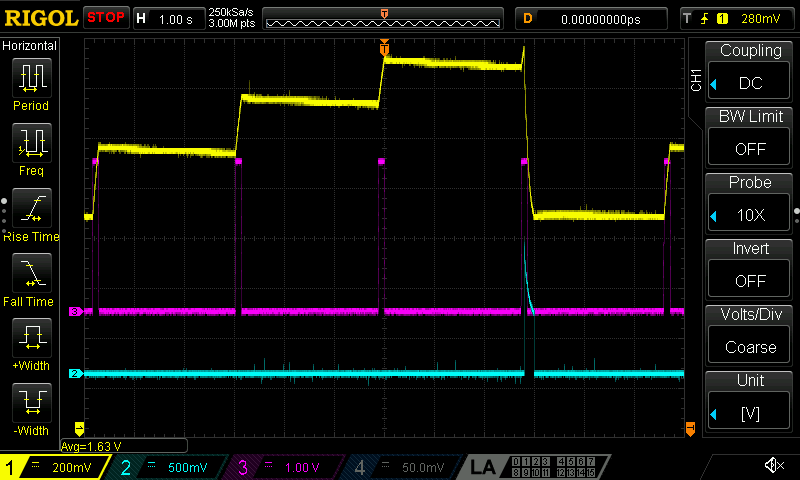
https://fogbeam.com/images/scope_20260913_202613.png
The magenta trace is the "spike train" which is output from a Rigol DG4162 Function Generator. The yellow trace is the voltage at the anode of the PUT, which simulates the "action potential" of the neuron membrane. And the cyan trace is the cathode of the PUT, which simulates the output of the neuron. What we see here are several input pulses hitting, with each bumping the action potential up a little, until it finally hits a threshold and then "fires" and resets. Lather rinse repeat.
[1]: https://en.wikipedia.org/wiki/Programmable_unijunction_trans...
[2]: https://neuronaldynamics.epfl.ch/online/Ch1.S3.html
For that matter, I also decided to self-host SourceHut because I will no longer be in compliance with their new policy. I have the flakes set up to inject them on my server [2]. This was very AI assisted.
[1] https://git.brucewillis.sexy/~tombert/fs_index I promise it’s safe for work, despite the URL. That’s just my dev URL that I play with. Code is still a mess though, so proceed with caution. I will eventually clean it up.
Since last month, our four Google Summer of Code interns finished their projects.
University of California San Diego has deployed our Wayfinder and Waystation web apps for their 35,000+ students!
We launched a redesign of our Android app.
Our next-generation server software, Maglev, is almost at v1.0!
We are always looking for more developers, biz dev, ux designers, product managers, and more to help out!
Open volunteer positions: https://ossvolunteers.com/organizations/open-transit-softwar...
Our software: https://github.com/OneBusAway/
More about us: https://opentransitsoftwarefoundation.org
This simplifies the setup for researchers who want to simulate materials science problems like battery electrode performance on GPUs with a simple usage-based pricing model instead of traditional HPC
1. A robotics information and news website. Any feedback is appreciated. https://robotica.dev/
2. Applied DBSP theory to Postgres https://github.com/getravi/pg_dbsp and DuckDB https://github.com/getravi/duckDBSP. The idea is to have incrementally maintained materialized views.
My goal is to better understand the economics of AI and make something useful in the process.
(Coming soon: kWh prices and robot prices)
Mostly built with claude code with a dash of codex.
A recent, useful unlock in the process has been a daily CC routine to check the health of the 53 price collectors in the project.
https://gitlab.com/prbs23/freefall_800
The smoker hardware itself is pretty good, but like most IoT devices, the firmware and app sucked. So I reverse engineered the whole control PCB, and have been rebuilding new open source firmware from scratch. All the basic functionality is working now with a fully local control web app. Plus an Andoid app, and Home Assistant integration.
Currently working on interface refinements, and some more advanced control sequencing features.
I wrote up all the reverse engineering details in a blog post here: https://www.prbs23.com/blog/posts/reverse-engineering-gravit...
- Minimal setup - Any agent harness - A session is an actor - Opinionated infrastructure - Performance on the critical path
1. Aetheris: geometry CAD kernel, https://github.com/yuechen-li-dev/Aetheris/.
Full code CAD capability with big coverage already and some functionalities that even OpenCascade/Parasolid/ACIS doesn't have, full sheet metal module, programmable part assembly, analytical fillets/chamfers, mathematical knots, auto-route for piping, built-in finite element analysis, etc. Had Astra make an improved version of the V8 demo that was going around on LinkedIn, so it can do general hard surface modeling pretty well too, turn all the Astra demo prowess into reusable capabilities/templates. The DSL is human writable too, so give it a try if you want. https://aetheris-editable-v8.yuechenli.workers.dev/
2. Concept language: https://github.com/yuechen-li-dev/Concept
I've said before that Carbon isn't a real programming language, never mind a successor to C++, so I decided to put my money where my mouth is. The idea of it is to be more TypeScript to C++'s JavaScript and to generalize C++20 concepts from template constraints to what C++26 is doing with contracts, and bring the equivalent of Rust's borrow checker to be opt-in by default instead of opt-out, fast compile time, in a syntax that C++ users are already familiar with (`const auto` instead of `let` for example) as well as templates and comptime. Language is done-ish, not self hosted yet, still compiles to C11, kernel and allocator libraries are finished, currently working on the scheduler right now.
3. Copeland TS, https://github.com/yuechen-li-dev/copeland
TypeScript for .NET without all the weirdness of Javascript, with full Nuget and NPM inter-op, Rust style exhaustive `match`, templates, etc. It's actually weird how much cleaned up TypeScript ended up looking like cleaned up C++. Compiles to JS, C#, WASM via Blazor WebAssembly, and SPIR-V via HLSL/DXC, and runs on V8 for JS and RyuJIT/NativeAOT for C#. The conclusion is that RyuJIT ended up being ~2x faster than V8 JS in hot loops but the cold startup time is higher, so replacing JS for UI really isn't worth it. Comes with full UI layout system, Vulkan renderer, and game/app runtime, but those are still pretty rough.
The idea is to help developers multiplex agent sessions and run Claude and Codex together, which is much more powerful than running one or the other alone.
My secret goal is to figure out how to make software development the kind of focused, meditative work it used to be.
Very happy to get critical feedback from any HN'ers: jake@clor.com