• RetroTechie a day ago |
    The relevant bits:

    https://nyx.net/history.html

    ~1987, PDPs, beige boxes, CRTs, looks good!

  • icedchai a day ago |
    Wasn’t world.std.com older?
    • jasongill a day ago |
      it appears that Nyx was operating about a year to 18 months before The World was
      • icedchai a day ago |
        I think it comes down to the first site to offer “real” internet access (telnet, ftp…), not just usenet news and mail. Reading through the history Nyx offered that in October 1990, but The World had it earlier.
        • hollerith 18 hours ago |
          I think the more important distinction is where the telnet or ftp client ran. Real internet access to me means that it can run on the home computer. In comtrast, the early way of accessing the internet from home required you to use minicom, TERMINAL.EXE, Telix, Procomm Plus, MacTerminal or such to log in to a Unix shell account running on a remote server, then invoke telnet or ftp there.

          (Yes, I remember SLIP and PPP, which complicate my narrative, but my recollection was that those were introduced later, in 1992 or even 1993.)

          • icedchai 9 hours ago |
            I think you're right on the SLIP/PPP timeline. I set up my first SLIP connection in either late 92 or early 93. It was painful. (This was on an Amiga!)
            • hollerith 8 hours ago |
              Yeah I remember SLIP being finicky enough to be tedious or painful.
              • hollerith 3 hours ago |
                SLIP or slirp. I don't remember which.
          • bux93 9 hours ago |
            At the time though, even with the clients not running locally but being dumped into a shell, being connected to the internet was qualitatively different from using a BBS. While some games ("doors") on BBSes were multi-user or even connected to another BBS, from that shell you could telnet and gopher and finger other systems and they were all just expected to be online all the time. And distance didn't matter, you could just go connect to a server across the Atlantic.

            The BBS experience was mostly asynchronous; go online and download/send mail and messages, download a file - and if it's not locally available, request it. (Other networks, like X.25, were mostly only useful to access paid-for information services and didn't universally connect to other countries and such. And confined to businesses and libraries.)

            slip/ppp (which in the beginning, you'd start up from the shell prompt) was a nice addition (telnetting from multiple windows for example) but for me it only became a killer app once you started using the web, for the graphics.

            (In those early days, downloading popular stuff was best done from your BBS, which supported resumable downloads via zmodem, so I'd still use telemate for downloads rather than relying on the web - you'd often max out the 33.6kbps dial up connection that way, too.)

            • icedchai 8 hours ago |
              I remember running "screen" on some early shell accounts when dialing in at 9600 baud. They were SunOS 3.x or 4.x boxes, I think. You could get your telnet-from-multiple-windows that way.
              • hollerith 8 hours ago |
                Your parent and I have been having a discussion about the transition of online services from a situation dominated by BBSes to a situation dominated by web browsers, which of course involved a vast amount of technical details. We were debating which one or two of these details are most illuminating for understanding this history. In that context, any discussion of screen is just a distraction.
                • icedchai 6 hours ago |
                  I was very active during that era. There was a significant period of time where early "ISPs" providing shell accounts or enhanced BBS environments (doors that allow telnet, etc.) existed, before graphical browsers took off. In that context, "screen" and other utilities available in Unix shells were still relevant.
                  • hollerith 4 hours ago |
                    Yes, "screen" was relevant when we were getting our internet access through a Unix shell account. So was stty, term, fg, bg, jobs, traceroute, C-s C-q style flow control and many other things that are not relevant to a broad understanding of how and why the BBSs world gave way to the web-based world (or of which provider might deserve the title of the oldest internet service provider).
                    • icedchai 4 hours ago |
                      I agree that some of the minutia is irrelevant, but you can't really understand the transition from BBSes to web without discussing the in-between times, like those shell providers.

                      For example, do you remember "slirp"? It basically gave you an emulated SLIP / PPP connection through a shell account. I knew people who used that before their "ISP" offered real IP access.

            • hollerith 8 hours ago |
              I dont disagree with anything you wrote except the emphasis: what was a "nice addition" for you personally (namely, for the IP packets to reach all the way to the user-facing machine, enabling for the first time ever the use of an internet client with a GUI) was the main reason internet usage and mind share started to explode in 1993.
    • kfsone a day ago |
      Cursory glance at the historys of both suggest Nyx first gave some kind of access in '88 while std.world.com first customers appear to be summer '89. That said, elsewhere, Nyx lists 89 as their beginning. shrug
    • Singletail 21 hours ago |
      It depends on how you define "internet access" -- shell, SLIP, PPP...

      Nyx was first if you consider a shell account with a Usenet relay through Isis as an "ISP".

      The World & Panix beat them to TCP service.

  • gumby a day ago |
    It's great that it has such a lineage and is still around, but according to its history it was a bbs / netnews login host. World.std.com was providing internet access in 89 or 90 by log in, and of course many universities by then had hordes of people dialing up, logging in, and using the net; A similar BBS->net hybrid was the Well.

    Pobably The Little Garden (later TLGNet) in 1990 was the first ISP in the sense it's used today: there were no user hosts that you logged into and then ran programs; it literally only provided IP service and you had to have a router to connect.

    We gave instructions on how to make a router with KA9Q and and an old PC, to those who needed it.

    Fun trivia: the first person who managed TLG full time (before that it was just a spinoff of Cygnus, with its first POP my spare bedroom) was Tom Jennings, the author of FIDONET one of the Ur-BBS systems, and surely the biggest.

    There are a lot of folks from that time on HN.

    PS: the name The Little Garden came from my favorite restaurant back then, a famous hacker hangout where folks from PARC, Stanford, SRI, Sun etc would hang out. Gosper was a regular.

    • kelnos a day ago |
      > World.std.com was providing internet access in 89 or 90 by log in

      According to a quick search, nyx.net was started in 1988 (or possibly 1987; sources seem to disagree).

      But yeah, I interpreted "oldest" as "oldest that still exists", though I'm not sure how they intend it. And nyx.net isn't an ISP in the way we think of it today, anyway. Technically they do "provide" "services" on the "internet", but ISP usually means an entity that provides people with a connection to the internet...

      Oldest ISP probably goes to UUNET, though? IIRC they only did commercial connections. For dial-up IP it seems that might have been CERFnet? The Little Garden came soon after. The World did sell dial-up shell/proxy accounts before that (but possibly still after nyx.net did), but it wasn't IP to your home computer.

      • reaperducer 21 hours ago |
        ISP usually means an entity that provides people with a connection to the internet...

        Today it means that.

        In the 80's and very early 90's, there were hundreds of national, regional, and local computer portals. Many of them offered a subset of internet features. Some had e-mail gateways, others usenet, or gopher, or uucp, or some combination. They provided internet services. Sometimes direct through the protocol, and sometimes behind their own user interface.

        A raw pipe to the net supporting all protocols, as we expect it today, would come later.

        /Old enough to remember mapping out e-mail paths on paper, and having an address with a bang path.

        • icedchai 21 hours ago |
          Yes, it was fuzzy and there were lots of shades of gray. The term "Internet Service Provider" itself was not even common until the mid 90's. Many local providers started as BBSes, moved to UUCP feeds with news and email, then to an IP connection.
          • bradknowles 19 hours ago |
            And GNN was widely considered to be the First Nation-wide ISP for residential customers. It started out as a partnership with O’Reilly & Associates with AOL. It grew beyond what ORA could handle, so they turned to AOL to take it over. AOL wasn’t ready to do that at the time, so they made ANS take it (ANS was the Tier-1 backbone provider that AOL owned). Then it got too big for ANS, and finally AOL had to take it anyway. And then AOL killed it, and offered GNN users a free AOL account in exchange.

            At that time, I was the Sr. Internet Mail Adminstrator for AOL (although our team really only handled the SMTP gateways), and I was assigned the job of taking over the entire GNN mail system.

            I’ve recently been interested in putting together a much-delayed after action report for that time when the entire GNN mail system was completely hosed, due to a DEC Field Engineer doing an upgrade on the drive controllers.

            For anyone who has more information on what you remember of that time and date, please contact me.

            • icedchai 4 hours ago |
              I remember some other big names from around that time, like Netcom?

              ANS operated the NSFnet backbone so that was a pretty good acquisition by AOL. I worked at a small regional ISP and we had connections to Sprint, MCI, UUNet, ANS, and a couple others. Most of them were T1's though we had bonded T1's with a few.

    • bwann 15 hours ago |
      TLG's NOC website helped me so much back then when I was getting my own ISP started in 1996. Seeing things like circuit troubleshooting steps, how to interact with a Cisco router, how to deal with a telco was so valuable. It could've all been locked away but it was freely readable, I'm grateful the info was there.
    • nickdothutton 14 hours ago |
      Thanks for bringing back some old memories. Ex-UUNETter here and once-upon-a-time BBS sysop before then. I look back fondly on those days.
  • chrissnell a day ago |
    I was looking at the WHOIS record for their IP block and it appears that they're now hosted in EC2 like everything else. I was hoping that they were still colocated somewhere.

    I was working at a regional ISP in 1995 and it was so fun and amazing to work in an office with serious high speed connectivity way back then. I had a Linux desktop with a public IP that I could telnet to from home. Good times.

    • Melatonic 18 hours ago |
      What ISP?
    • o_-_o 13 hours ago |
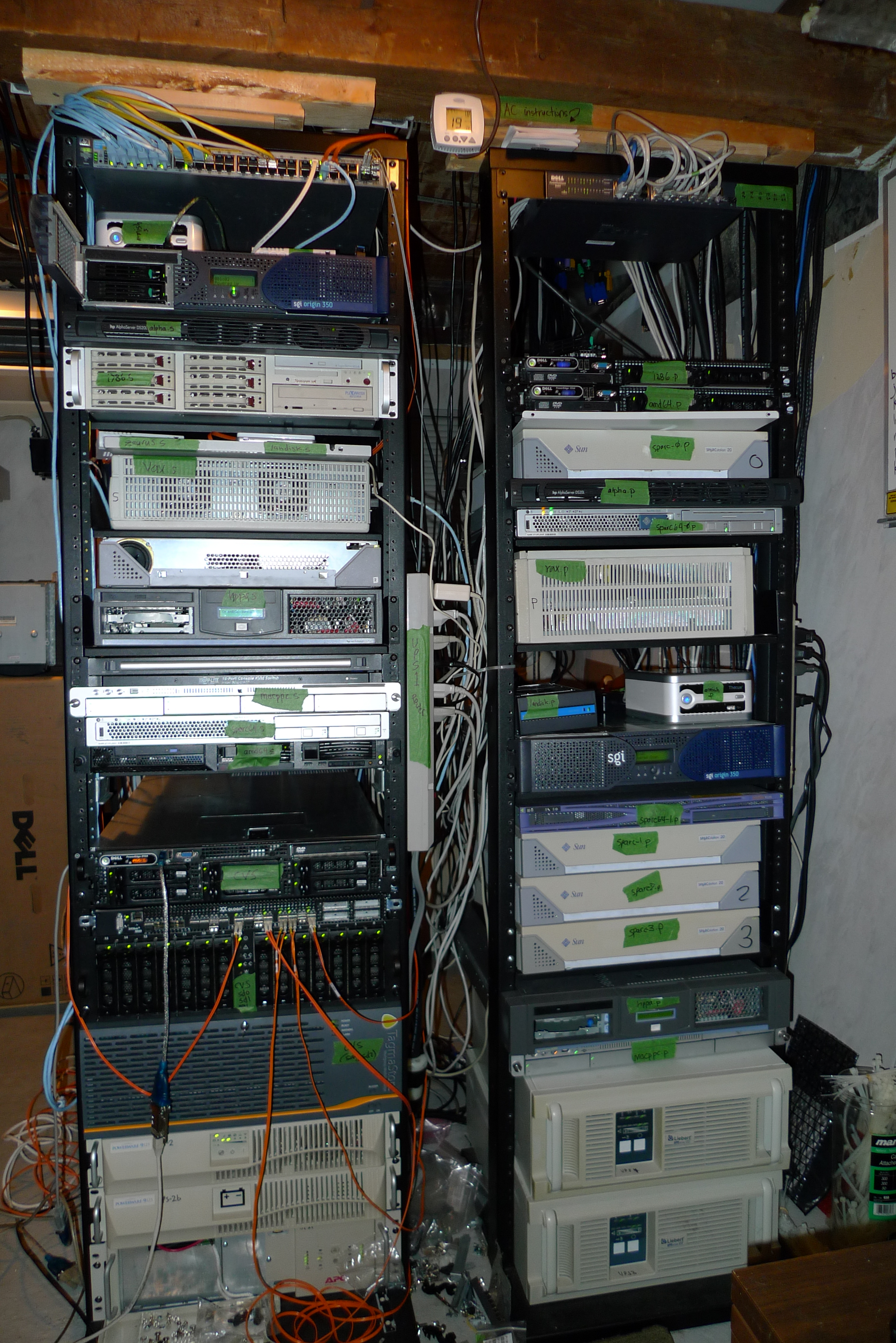
      source: https://www.nyx.net/funddrive.html

      As you've likely seen by now, Nyx has had to move away from Tryg's place because of his illness.

      —Andrew Burt (President & Founder, Nyx.Net)
  • jibalt a day ago |
    The first sentence seems to be missing the word "provides" or "offers".
  • lanerellis 19 hours ago |
    I first used Nyx in the late 1980s, when it was the new sensation, as I'd already been operating my own Commodore 64 based bulletin board system (BBS) since 1984. I knew the original administrator Andrew Burt, and we're still connected thanks to Facebook. I was friends with the amazing Trygve Lode too, who had the hardware at his house after it left its campus location. Another friend now runs it. What a fun surprise to see it mentioned here today.
  • Melatonic 18 hours ago |
    Anyone in the Bay Area remember Rahul.net ?
  • logicchains 17 hours ago |
    Nyx nyx nyx..
    • N_Lens 14 hours ago |
      My thoughts..enter the mind, but not the ear.
  • notorandit 15 hours ago |
    I was on it back around 1992. Nice!
  • relistan 10 hours ago |
    Cleveland Free-Net started in 1986. Limited internet access, but had most of things people used. And it was free. https://en.wikipedia.org/wiki/Free-net
  • onionisafruit 8 hours ago |
    I like that the sign-up method still involves printing and mailing a form (plus having it notarized).